
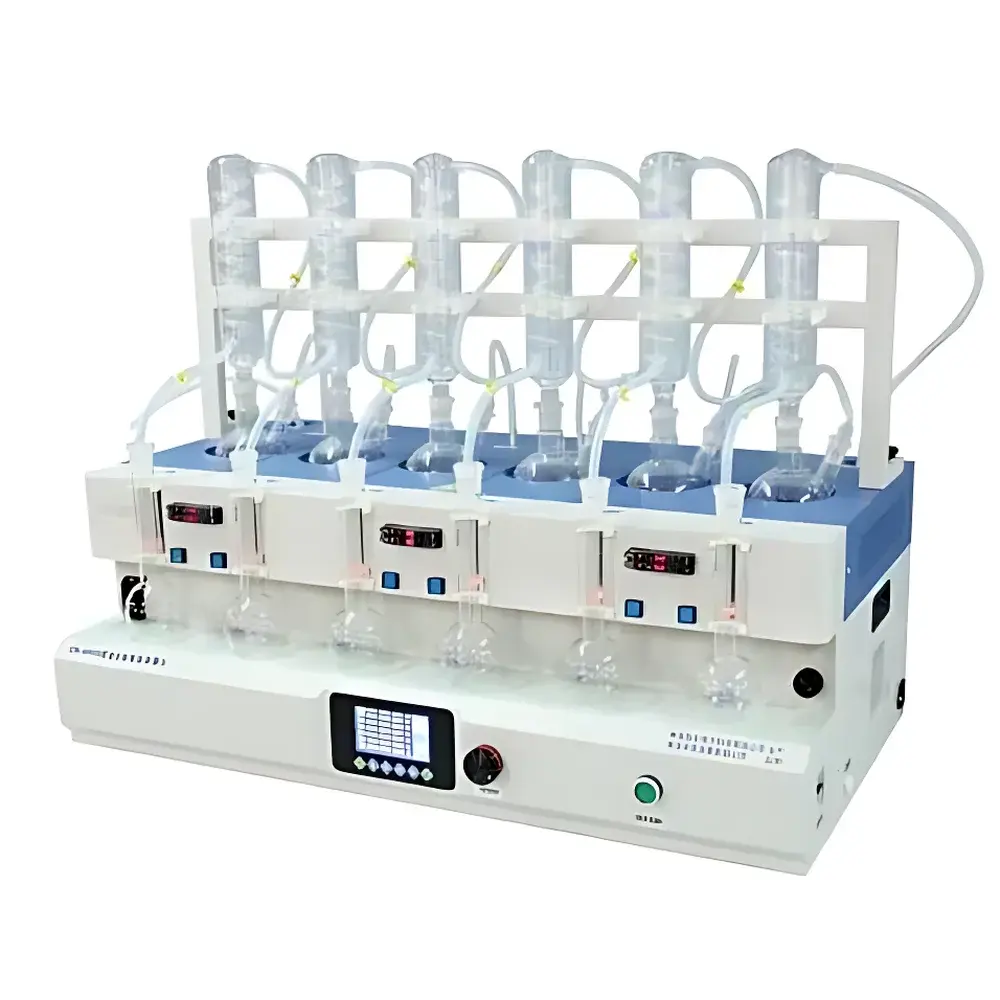
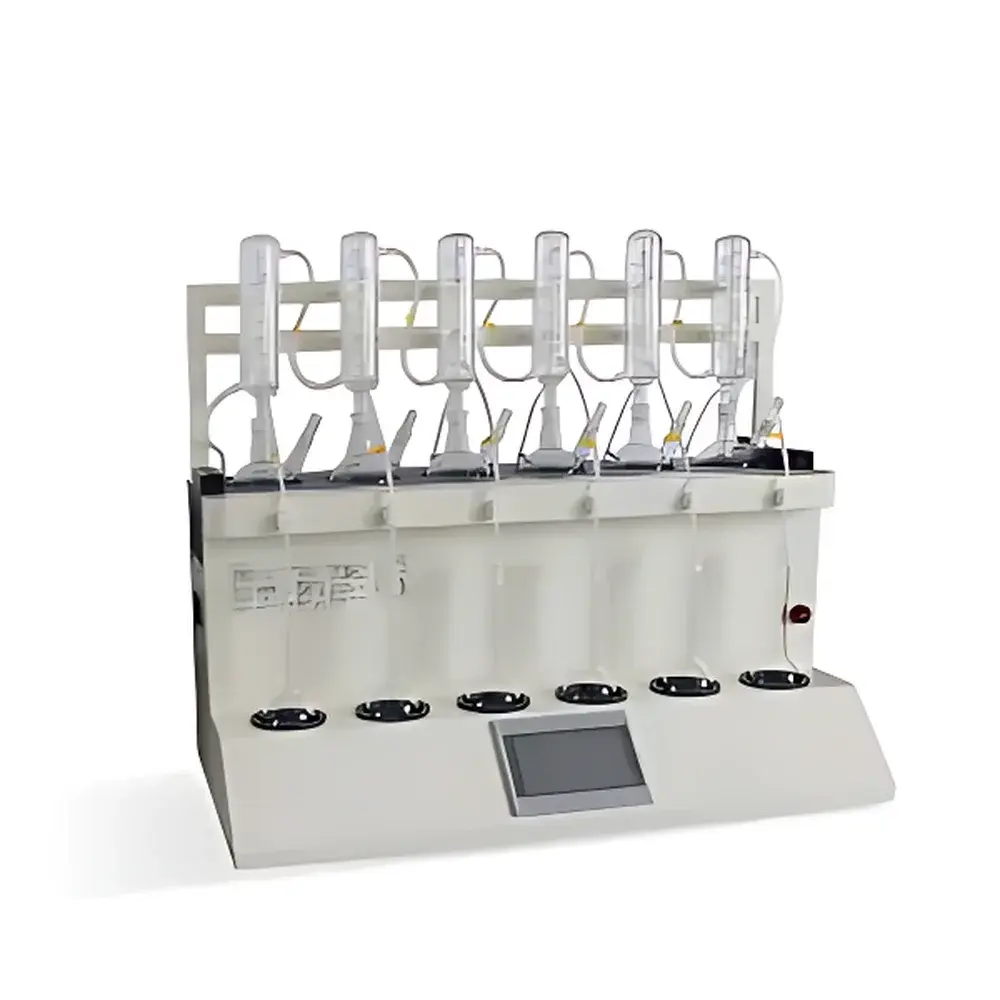
HKUANKONG CH-6000Pro Fully Automated Intelligent Distillation System
| Brand | HKUANKONG |
|---|---|
| Origin | Shandong, China |
| Manufacturer Type | Direct Manufacturer |
| Instrument Type | Quartz Glass Distillation Apparatus |
| Heating Module | Far-Infrared Radiant Ceramic/Aluminum Heating Block |
| Temperature Range | Ambient to 320 °C (per channel, independently adjustable) |
| Time Control | 0–300 min (per channel, independently adjustable) |
| Distillation Units | 2/4/6/12 configurable channels |
| Flask Capacity | 500 mL |
| Power Rating | 2600 W total for 6-channel configuration (400 W per channel, continuously adjustable) |
| Heating Ramp Time | ≤5 min to target temperature |
| Distillate Volume Control | Dual-mode digital fiber-optic liquid-level sensing + high-precision load-cell weighing |
| Volume Setpoint Range | 10–250 mL |
| Volume Accuracy | ±1 mL |
| Condensate Cooling | Closed-loop refrigerated recirculation system (compressor-cooled, stable at ≤20 °C) |
| Distillation Rate | 1–12 mL/min (continuously adjustable per channel) |
| Receiving Vessel Compatibility | Standard volumetric flasks, colorimetric tubes, or custom glassware |
| Anti-Suckback Protection | Integrated vacuum-break and pressure-equalization valve |
| Auto-Cleaning Function | On-line condenser tube rinse cycle |
| Optional Integration | LIMS-compatible barcode scanning module |
| COD Digestion Mode | Optional integrated reflux digestion module (6-position, per-channel temperature & timing control, compliant with GB/T 11914–1989) |
Overview
The HKUANKONG CH-6000Pro Fully Automated Intelligent Distillation System is an engineered solution for standardized, unattended distillation in environmental, food safety, and regulatory testing laboratories. It operates on the principle of controlled thermal separation—applying precise far-infrared radiant heating to sample-containing flasks while maintaining thermodynamic stability across the vapor path, condensation zone, and collection interface. Unlike conventional open-loop setups relying on external water supply and manual endpoint judgment, the CH-6000Pro integrates closed-loop refrigeration, dual-sensor distillate quantification, and real-time pressure-balanced anti-suckback protection. Its architecture conforms to core requirements of ISO/IEC 17025-accredited laboratories, supporting method validation for EPA 410.2, ISO 6439 (cyanide), ISO 6438 (phenols), ISO 5664 (ammonia nitrogen), and GB/T 5750.5–2023 (drinking water analysis). Designed for reproducibility under GLP/GMP conditions, it eliminates operator-induced variability in heating rate, condensation efficiency, and endpoint determination.
Key Features
- Fully independent per-channel control: Each distillation position features individual adjustment of heating power (0–400 W), temperature setpoint (ambient to 320 °C), time duration (0–300 min), and target distillate volume (10–250 mL).
- Dual-endpoint detection: Synchronized optical fiber liquid-level sensing and high-resolution load-cell weighing ensure ±1 mL volumetric accuracy without reliance on timed distillation alone.
- Far-infrared ceramic/aluminum heating block: Non-contact radiant heating eliminates hot spots, prevents localized boiling, and ensures uniform thermal transfer—critical for volatile analyte preservation in cyanide and phenol determinations.
- Hermetic refrigerated cooling loop: Compressor-based circulation maintains condenser inlet water at ≤20 °C regardless of ambient temperature, delivering consistent condensation efficiency across seasonal operation.
- Patented serpentine condenser design: Optimized internal geometry achieves >2× condensation efficiency versus standard Liebig units, minimizing vapor carryover and improving recovery of low-boiling compounds.
- Integrated anti-suckback and auto-purge: A pressure-regulated venting system activates upon distillation completion, preventing backflow into the digestion flask; post-cycle reverse-water purge evacuates residual coolant from condenser tubing.
- On-line condenser cleaning protocol: Programmable flush sequence delivers deionized water through the condenser path without disassembly—eliminating cross-contamination between runs and reducing maintenance downtime.
- Modular scalability: Configurable from 2 to 12 channels with physical and electrical isolation between units; optional COD reflux digestion module mounts directly onto the same chassis with shared control interface.
Sample Compatibility & Compliance
The CH-6000Pro accommodates aqueous matrices including drinking water, wastewater, soil leachates, solid waste extracts, and food digests. It supports all distillation-based methods requiring acid distillation (e.g., cyanide liberation at pH <2), steam distillation (e.g., volatile phenols), or alkaline distillation (e.g., ammonia nitrogen). All wetted components—including flasks, condensers, and receiving adapters—are constructed from borosilicate glass or quartz to resist corrosion from HCl, NaOH, and sulfuric acid reagents. The system meets mechanical safety standards per IEC 61010-1:2010 (Laboratory Equipment), includes overtemperature cut-off, ground-fault circuit interruption (GFCI), and IP22-rated enclosure protection. Data integrity complies with FDA 21 CFR Part 11 requirements when used with audit-trail-enabled software; electronic records retain full metadata including operator ID, timestamp, parameter logs, and sensor calibration status.
Software & Data Management
The embedded microcontroller runs a deterministic real-time OS with dual-mode HMI: intuitive rotary encoder navigation paired with tactile membrane keys. All method parameters—including heating profile, distillate volume threshold, cooling setpoint, and alarm thresholds—are stored as named protocols. USB export enables raw sensor data (temperature, weight, optical signal) in CSV format for third-party statistical analysis. Optional LIMS integration via RS-232 or Ethernet supports bidirectional communication: barcode-scanned sample IDs auto-populate run logs, and completion events trigger automatic result upload. Audit trails record every parameter change, user login/logout, and hardware fault event—with immutable timestamps traceable to NTP-synchronized network time.
Applications
This system is routinely deployed in accredited environmental labs performing EPA Method 410.2 (total cyanide), ISO 6438 (volatile phenols), ISO 5664 (ammonia nitrogen), and GB/T 7479–2008 (NH₃-N in surface water). In food testing, it supports AOAC 960.12 (formaldehyde in fish) and ISO 15512 (ethanol in dairy products). Its programmable distillation kinetics enable optimization for low-concentration analytes requiring extended collection times or high-recovery protocols for thermally labile species. When equipped with the COD digestion module, it executes fully automated reflux cycles per GB/T 11914–1989, eliminating manual flask transfer and enabling direct titration post-digestion.
FAQ
Does the CH-6000Pro support method-specific validation documentation?
Yes—factory-provided IQ/OQ documentation includes temperature uniformity mapping, distillate volume repeatability (n=6, RSD ≤1.2%), condenser cooling stability (±0.5 °C over 120 min), and endpoint detection linearity across the 10–250 mL range.
Can the system be validated for GLP-compliant studies?
Absolutely—the instrument’s firmware enforces user authentication, retains full electronic records with digital signatures, and supports 21 CFR Part 11-compliant audit trails when configured with password-protected administrator access and certificate-based encryption.
Is the quartz glass distillation apparatus compatible with hydrofluoric acid digestion residues?
No—quartz is susceptible to HF etching. For HF-containing samples, we recommend pre-neutralization or use of PTFE-lined receivers; the main distillation train remains borosilicate glass, rated for concentrations up to 6 M HCl and 4 M NaOH.
What maintenance intervals are recommended for long-term reliability?
Compressor oil and refrigerant levels require verification annually; optical sensors should be cleaned quarterly with ethanol-moistened lint-free swabs; heating blocks undergo emissivity calibration every 500 operational hours using NIST-traceable blackbody references.
How does the system handle variable atmospheric pressure during high-altitude operation?
The built-in barometric sensor dynamically adjusts heating power and condenser flow rate to maintain constant distillation velocity—ensuring method compliance from sea level to 3000 m elevation without manual recalibration.



