
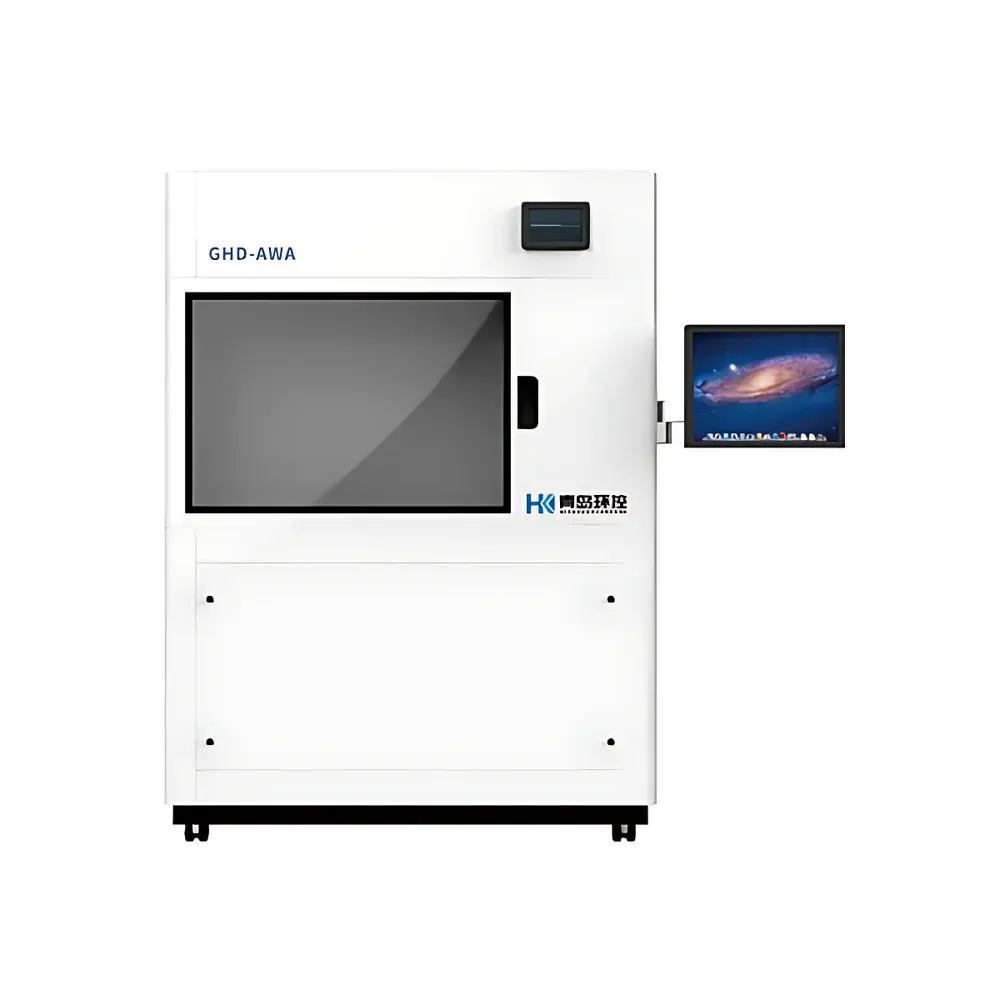
HUANKONG GHD-AWA Automated Temperature- and Humidity-Controlled Gravimetric System
| Brand | HUANKONG |
|---|---|
| Origin | Shandong, China |
| Manufacturer Type | Manufacturer |
| Origin Category | Domestic |
| Model | GHD-AWA |
| Pricing | Upon Request |
| Measurement Method | Membrane Gravimetry |
| Measured Parameters | PM₁₀ / PM₂.₅ |
Overview
The HUANKONG GHD-AWA Automated Temperature- and Humidity-Controlled Gravimetric System is an engineered solution for high-precision gravimetric analysis of atmospheric particulate matter in compliance with internationally referenced environmental monitoring protocols. Designed around the fundamental principle of controlled-environment gravimetry, the system operates within a tightly regulated climatic chamber (typically maintained at 20.0 ± 0.5 °C and 40–60% RH per HJ 618–2011 and HJ 656–2013), where mass stability of filter media—primarily 47 mm quartz or PTFE membranes and low-concentration sampling heads—is achieved prior to and during microgram-level weighing. The system eliminates operator-induced variability by automating sample handling, electrostatic neutralization, positional alignment, and sequential weighing—thereby fulfilling the metrological requirements for regulatory-grade source apportionment studies, ambient air quality monitoring, and stack emission compliance testing under fixed-source standards such as HJ 836–2017.
Key Features
- Triple-stage vibration isolation architecture: including precision damping mounts, granite counterweight base, and active mechanical decoupling of the analytical balance from chamber airflow and floor-borne disturbances.
- Fully automated robotic handling: six-axis articulated arm with laser displacement feedback, auto-homing capability, real-time positional error detection, and dynamic correction; equipped with anti-slip grippers and drop-detection logic for secure transport of low-concentration sampling heads.
- Integrated electrostatic neutralization: programmable ionizing air blower activated immediately before weighing to dissipate surface charge on filter substrates—critical for sub-10 µg repeatability.
- Intelligent sample identification: optical barcode/numeric code reader synchronized with sample tray indexing; each 47 mm filter or sampling head is registered with unique traceable ID upon loading.
- Hermetic, motorized anti-draft enclosure: transparent acrylic balance hood with automatic open/close sequencing, grounded conductive coating, and validated air-tightness to suppress internal turbulence (<0.05 m/s) during measurement.
- Self-calibrating analytical balance subsystem: automatic zero-point and span verification at user-defined intervals; internal calibration weights traceable to national metrology institutes.
- Dual-mode humidification: closed-loop recirculating water reservoir with integrated deionization, plus optional direct connection to purified municipal supply—ensuring long-term RH stability without condensation risk.
- Uninterruptible power support: UPS-backed operation enables safe robotic return-to-home and system state preservation during grid failure.
Sample Compatibility & Compliance
The GHD-AWA accommodates standard 47 mm filter discs (quartz fiber, Teflon®, cellulose ester) and HJ 836–2017–compliant low-concentration sampling heads—including those with integrated pre-separation nozzles and tapered collection cones. All contact surfaces (sample tray, gripper tips, carousel fixtures) feature gold-plated finishes with conformal anti-static polymer coatings to minimize triboelectric effects. The system conforms to the environmental conditioning, procedural sequence, and data integrity requirements of HJ 618–2011, HJ 656–2013, and HJ 836–2017. It supports GLP-aligned audit trails—including timestamped weight records, environmental parameter logs (T/RH/air velocity), operator actions, and calibration events—with exportable CSV/Excel reports suitable for regulatory submission.
Software & Data Management
Embedded control software provides intuitive workflow navigation, real-time environmental monitoring (temperature, relative humidity, internal air velocity), and automated generation of gravimetric curves, mass stabilization trends, and concentration calculations (µg/m³) based on volumetric flow and sampling duration inputs. All raw and derived data are stored locally with SHA-256 hashing and optional network backup. Audit logs record user logins, method changes, calibration events, and alarm triggers—supporting 21 CFR Part 11–compatible electronic signatures when deployed in validated environments. Data export complies with ISO/IEC 17025 documentation requirements for accredited laboratories.
Applications
- Ambient PM₂.₅ and PM₁₀ source apportionment studies requiring inter-laboratory comparability.
- Fixed emission source testing for low-concentration particulate matter (e.g., coal-fired boilers, waste incinerators, cement kilns) per HJ 836–2017.
- Quality assurance/quality control (QA/QC) of field-collected filter samples in central environmental monitoring labs.
- Reference method validation and intercomparison exercises coordinated by provincial or national environmental protection agencies.
- Long-term trend analysis of aerosol mass loading in urban, rural, and background monitoring stations.
FAQ
What environmental standards does the GHD-AWA comply with?
It fully implements the operational, climatic, and procedural requirements specified in HJ 618–2011, HJ 656–2013, and HJ 836–2017.
Can the system weigh both 47 mm filters and low-concentration sampling heads simultaneously?
Yes—the dual-format sample carousel allows concurrent placement and sequential weighing without hardware reconfiguration or tray swapping.
Is the balance calibration traceable to national standards?
Yes—internal calibration routines use certified reference masses with documented metrological traceability to CNAS-accredited providers.
Does the system support remote monitoring or integration with LIMS?
Data export via USB or Ethernet enables seamless ingestion into laboratory information management systems (LIMS); real-time environmental telemetry is available via Modbus TCP upon configuration.
What is the typical stabilization time per sample under standard conditions?
Average equilibration time is 90–120 minutes per filter at 20.0 °C / 45% RH, consistent with HJ 656–2013 recommendations for PM₂.₅ gravimetric analysis.
Related Products







