
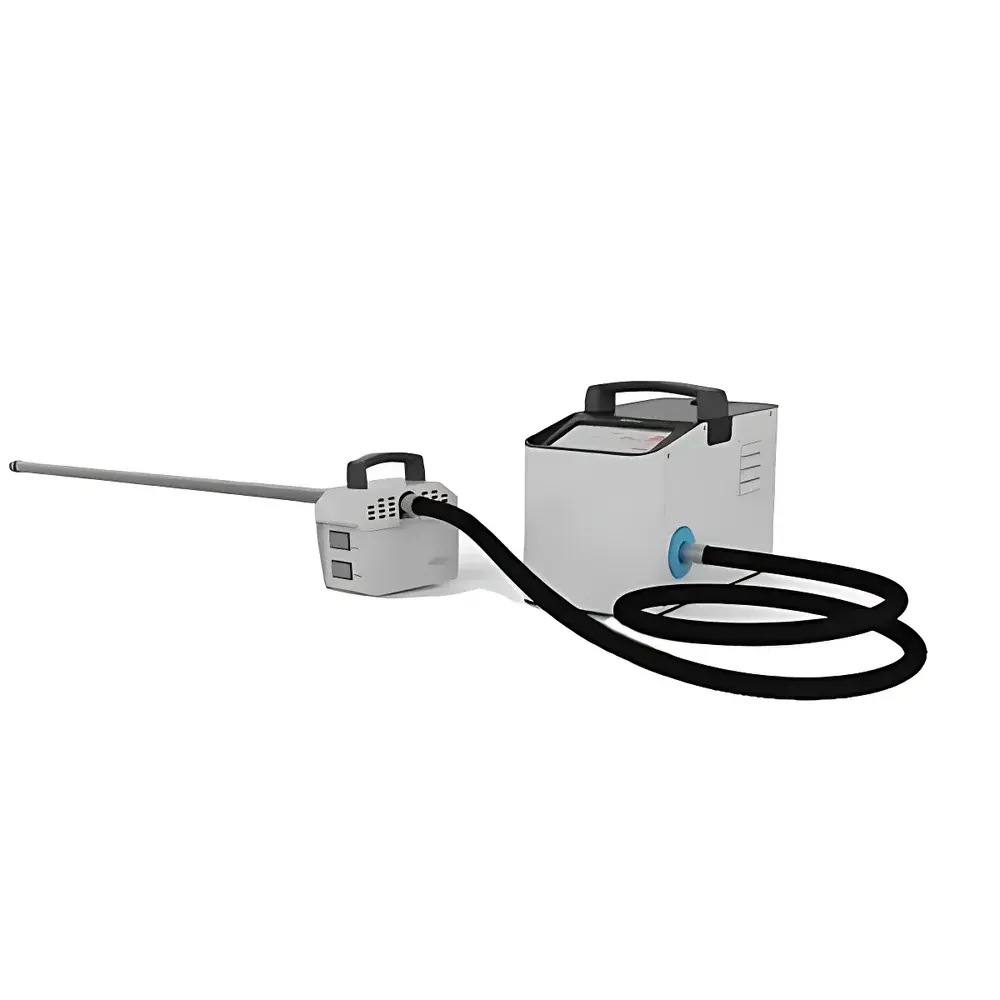
HUANKONG PreGASS-3500 Portable Ammonia Analyzer
| Brand | HUANKONG |
|---|---|
| Origin | Shandong, China |
| Manufacturer Type | OEM Manufacturer |
| Country of Origin | China |
| Model | 3500 |
| Instrument Type | Portable |
| Measurement Principle | Tunable Diode Laser Absorption Spectroscopy (TDLAS) at Near-Infrared Wavelength |
| Sampling Method | Heated Extractive Sampling (220 °C Full-Path Heating) |
| Compliance | DL/T 1916–2018 |
Overview
The HUANKONG PreGASS-3500 is a portable, field-deployable ammonia (NH₃) analyzer engineered for high-fidelity measurement in demanding industrial flue gas environments. It employs tunable diode laser absorption spectroscopy (TDLAS) in the near-infrared spectral region—specifically targeting a fundamental rotational-vibrational absorption line of NH₃ near 1512 nm—to deliver selective, interference-resistant quantification. Unlike electrochemical or metal-oxide semiconductor sensors, TDLAS provides absolute concentration measurement based on Beer–Lambert law physics, eliminating drift-related calibration dependency and enabling trace-level detection with inherent stability. The system implements wavelength modulation spectroscopy (WMS) with second-harmonic (2f) detection to extract weak absorption signals from broadband noise, significantly enhancing signal-to-noise ratio and measurement repeatability. Its fully heated extractive sampling architecture—maintaining the entire gas path (probe, filter, transport line, and cell) at 220 °C—prevents NH₃ adsorption on surfaces and inhibits ammonium salt formation (e.g., NH₄HSO₄, NH₄NO₃), which are common sources of bias in low-temperature sampling systems operating downstream of selective catalytic reduction (SCR) or selective non-catalytic reduction (SNCR) reactors.
Key Features
- Full-path heated sampling at 220 °C: Ensures representative gas-phase NH₃ integrity by suppressing wall deposition and thermally unstable salt condensation.
- Real-time spectral interference compensation: Advanced digital signal processing algorithms suppress cross-sensitivity from water vapor (H₂O), particulate matter (PM), and volatile organic compounds (VOCs) without requiring physical scrubbers or optical filters.
- On-site zero/span verification capability: Integrated dual-gas calibration port supports automated or manual injection of certified NH₃/N₂ standard gases for drift correction without instrument disassembly.
- Modular probe extension kit: Enables configurable probe lengths (up to 3 m) for spatially resolved “grid” sampling across duct cross-sections per EPA Method 7E and ISO 11469 guidance.
- Ruggedized field enclosure: IP65-rated housing with internal temperature stabilization ensures operational reliability under ambient conditions ranging from –10 °C to 50 °C and relative humidity up to 95% non-condensing.
Sample Compatibility & Compliance
The PreGASS-3500 is validated for continuous operation in flue gas streams characterized by high dust loading (≤10 g/Nm³), variable temperature (80–200 °C post-SCR), and elevated moisture content (10–25% v/v). It meets the performance criteria defined in DL/T 1916–2018 (“Technical Requirements for Portable Flue Gas Ammonia Escape Measurement Systems”), including accuracy (±10% of reading or ±0.5 ppm, whichever is greater), response time (T₉₀ ≤ 120 s), and zero drift (<±0.2 ppm over 24 h). While not certified to EN 15267 or US EPA PS-18, its design aligns with functional requirements for QA/QC applications under ISO/IEC 17025-accredited laboratories and supports data integrity practices consistent with GLP and GMP audit trails when paired with timestamped, encrypted data logging.
Software & Data Management
The embedded firmware supports real-time concentration display (ppm or mg/m³), automatic data stamping (UTC time + GPS coordinates if enabled), and local storage of ≥100,000 measurement records on removable microSD card. PC-based configuration and reporting software (Windows-compatible, USB-C interface) allows export of CSV/Excel files compliant with China’s national environmental monitoring data format standards (HJ 75–2017, HJ 76–2017). Audit logs capture all user-initiated events—including calibration actions, parameter changes, and alarm triggers—with immutable timestamps and operator ID fields, facilitating traceability during regulatory inspections.
Applications
- Ammonia slip quantification during SCR/SNCR commissioning, optimization, and routine performance audits.
- Ammonia distribution mapping across duct cross-sections to identify maldistribution and inform injector tuning.
- Stack testing for environmental compliance verification under China’s GB 13223–2011 and provincial emission standards.
- Third-party verification of ammonia removal efficiency in ammonia-based desulfurization (e.g., NH₃–FGD) processes.
- Emergency leak assessment in fertilizer production, refrigeration facilities, and wastewater treatment plants.
- Reference-grade validation of fixed CEMS NH₃ modules during quarterly performance evaluation (PE) tests.
FAQ
What is the lower detection limit (LDL) of the PreGASS-3500 under field conditions?
The practical LDL is 0.1 ppm (v/v) at 1-s integration time, improving to 0.03 ppm with 10-s averaging—validated per DL/T 1916–2018 Annex B using certified NH₃ permeation tubes.
Can the instrument measure NH₃ in wet, unfiltered flue gas?
Yes—the heated filtration stage removes particulates >1 µm while maintaining gas-phase NH₃ integrity; no external chillers or dryers are required.
Is remote data transmission supported?
Standard configuration includes USB-C and Bluetooth 5.0; optional 4G LTE module enables secure MQTT-based telemetry to cloud platforms (e.g., custom SCADA or EMS interfaces).
How often does the system require calibration verification?
DL/T 1916–2018 mandates daily zero check and weekly span verification; the PreGASS-3500’s onboard calibration port enables this without external hardware.
Does the analyzer comply with cybersecurity requirements for industrial IoT deployment?
Firmware v2.3+ implements TLS 1.2 encryption for wireless transfers and supports password-protected configuration access per IEC 62443-3-3 Level 1 guidelines.







