
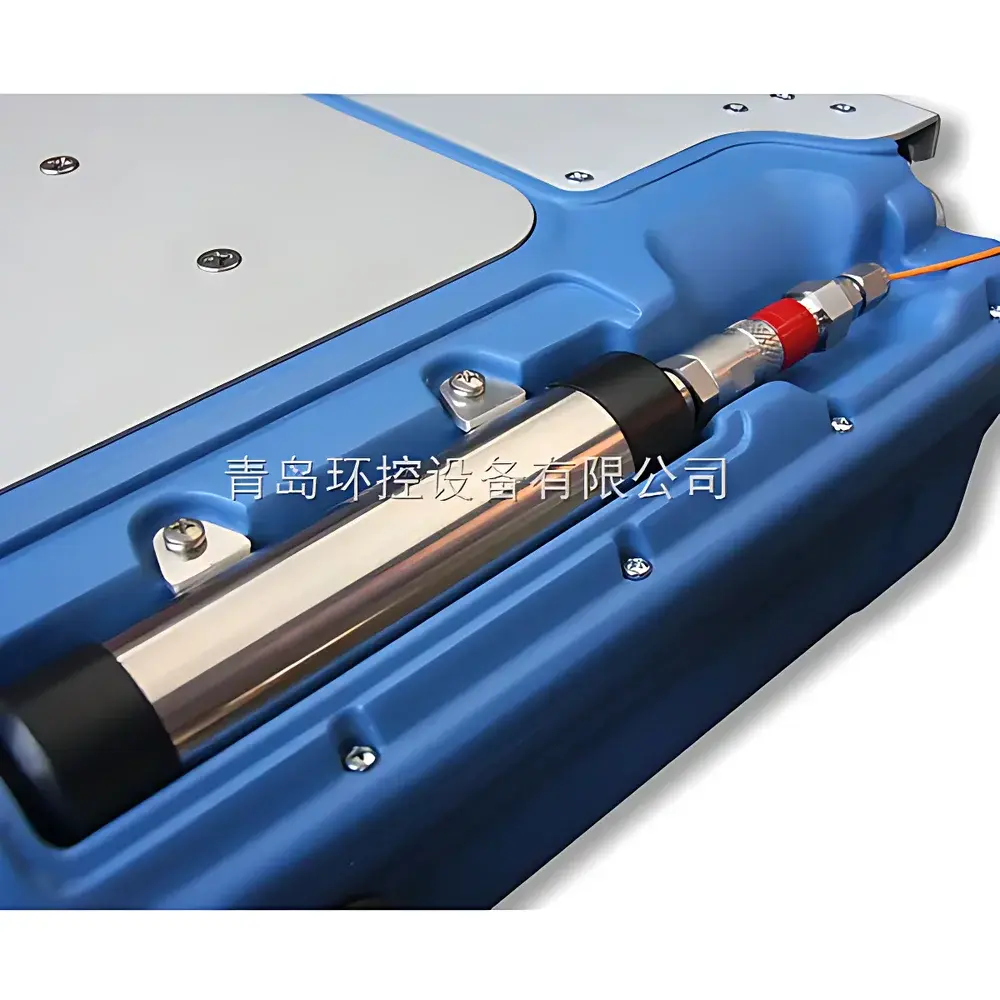
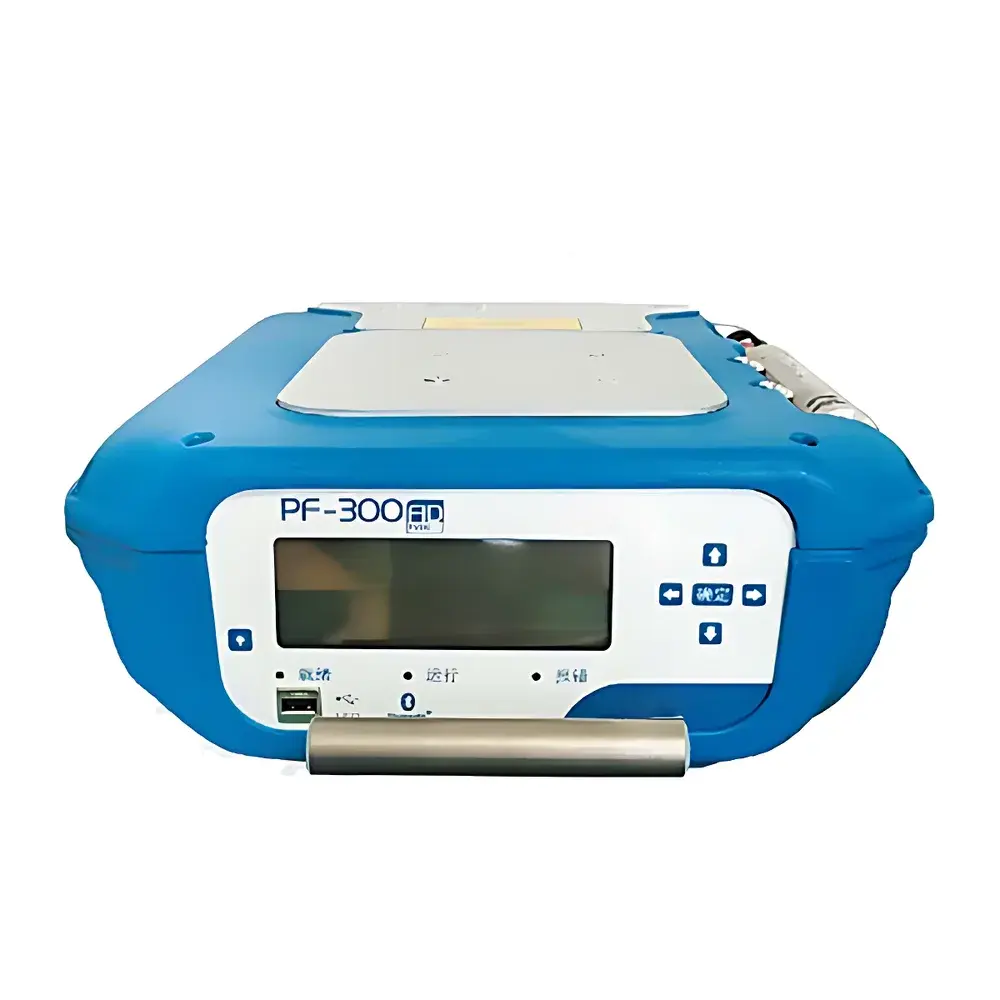
HUANKONG PF-300 Portable Total Hydrocarbon Analyzer (TOC-Compatible for Gaseous Samples)
| Brand | HUANKONG |
|---|---|
| Origin | Shandong, China |
| Manufacturer Type | Direct Manufacturer |
| Product Category | Domestic |
| Model | PF-300 |
| Instrument Type | Portable Total Hydrocarbon Analyzer |
| Detection Principle | Flame Ionization Detection (FID), compliant with HJ 1331–2023 and HJ 1012–2018 |
| Oxidation Method | High-Temperature Catalytic Combustion (for TOC-equivalent gaseous carbon quantification) |
| Measurement Range | Configurable and expandable via multi-range certified calibration gases |
| Sample Interface | Heated quantitative loop injection |
| Operating Environment | Fully heated system (≥200 °C) including FID detector, valves, and gas lines |
| Power Supply | AC/DC dual-mode |
| Data Storage | Internal memory for ≥30 days of continuous measurement data |
| Connectivity | Integrated Bluetooth 5.0 and USB 2.0 |
| Optional Module | Simultaneous flue gas parameter measurement (temperature, humidity, flow velocity, O₂) |
Overview
The HUANKONG PF-300 Portable Total Hydrocarbon Analyzer is a field-deployable analytical instrument engineered for the quantitative determination of total hydrocarbons (THC) — serving as a validated proxy for total organic carbon (TOC) in gaseous environmental matrices. Unlike aqueous TOC analyzers that rely on wet-chemical oxidation and CO₂ detection, the PF-300 implements flame ionization detection (FID) following high-temperature catalytic combustion, aligning with Chinese national standard methodologies HJ 1331–2023 and HJ 1012–2018. This architecture enables direct, real-time quantification of volatile and semi-volatile hydrocarbon species in ambient air, stack emissions, and fugitive emission plumes. The instrument is not intended for liquid-phase TOC analysis; rather, it delivers trace-level THC measurement (expressed as ppmv or mg/m³, as carbon) applicable to regulatory compliance monitoring, source identification, emergency response, and performance verification of continuous emission monitoring systems (CEMS). Its design prioritizes operational robustness under challenging field conditions — including high-humidity flue gas streams and variable ambient temperatures — through full thermal management of all critical fluidic and detection components.
Key Features
- Fully heated analytical train: All gas-contact surfaces — including the FID detector, catalytic oxidation unit, sample transfer lines, and solenoid valves — are maintained at ≥200 °C to eliminate condensation artifacts and ensure quantitative recovery of high-boiling-point hydrocarbons.
- Integrated hydrogen generation: A proprietary metal hydride-based hydrogen supply replaces conventional pressurized H₂ cylinders, enabling safe, compact, and uninterrupted operation for up to 30 hours without external gas sources.
- Self-contained calibration infrastructure: Onboard certified zero air (hydrocarbon-free air) and multiple range-certified hydrocarbon standards (e.g., methane, propane) are stored in sealed, non-refillable permeation sources, ensuring metrological traceability per ISO/IEC 17025 requirements.
- Quantitative loop sampling: A fixed-volume, thermally stabilized loop ensures precise, reproducible sample introduction independent of pressure fluctuations — critical for compliance-grade data integrity.
- Dual-mode power architecture: Operates seamlessly on AC mains or DC battery input (12–24 V), supporting extended unattended deployment in remote or mobile monitoring scenarios.
- Embedded data acquisition: Internal flash memory logs time-stamped concentration values, diagnostic parameters, and system status at user-defined intervals, retaining ≥30 days of continuous records without external storage.
Sample Compatibility & Compliance
The PF-300 is validated for gaseous samples within temperature ranges of −10 °C to 200 °C and relative humidity up to 95% RH (non-condensing). It accepts direct connection to heated sampling probes and is compatible with standard 1/4″ SS or PTFE tubing. When equipped with the optional flue gas module, it simultaneously measures stack temperature, moisture content (via chilled mirror or capacitive sensor), volumetric flow velocity (Pitot tube or thermal anemometry), and oxygen concentration (electrochemical cell), enabling automatic correction to dry, standard-cubic-meter basis per GB/T 16157 and EPA Method 2.
The instrument’s FID response is linear across five orders of magnitude (typically 0.01–10,000 ppmv C₁–C₁₀), with detection limits ≤10 ppbv (as methane) under optimized conditions. Calibration protocols adhere to HJ 1012–2018 for field instruments, and all onboard standards are accompanied by CNAS-accredited certificates of analysis. Data output conforms to HJ 75–2017 requirements for CEMS validation reports.
Software & Data Management
Data acquisition and configuration are managed via two interoperable platforms: the MCFID desktop application (Windows) and the HUANKONG FieldLink mobile app (iOS/Android). Both support real-time telemetry, remote parameter adjustment, spectral review, and PDF report generation. All measurements include embedded timestamps, GPS coordinates (when enabled), operator ID, and audit trail metadata. Data exports are provided in CSV and XML formats compatible with LIMS integration. The system supports 21 CFR Part 11–compliant electronic signatures when deployed in GLP/GMP-aligned environmental laboratories, with configurable user roles, password policies, and immutable log archiving.
Applications
- Regulatory stack testing for VOC/THC emissions from chemical, petrochemical, and pharmaceutical manufacturing facilities.
- Field verification and performance audit of installed CEMS and portable FID analyzers.
- Rapid-response monitoring during industrial leaks, spills, or odor complaints.
- Mobile ambient air quality surveys near landfills, wastewater treatment plants, and solvent-handling sites.
- Research-grade characterization of hydrocarbon speciation when paired with optional benzene-series modules (BTEX).
- Method development and inter-laboratory comparison studies under ISO 11843 and ASTM D6348 protocols.
FAQ
Is the PF-300 suitable for measuring TOC in water samples?
No. The PF-300 is designed exclusively for gaseous-phase total hydrocarbon analysis. It does not perform wet oxidation, NDIR CO₂ detection, or membrane conductivity measurement required for aqueous TOC determination.
Does the instrument require external compressed gas cylinders?
No. Zero air and calibration gases are integrated into the chassis using sealed, certified permeation sources and a solid-state hydrogen generator.
Can measurement data be exported to third-party environmental reporting platforms?
Yes. CSV and XML outputs are structured to meet the schema requirements of common regulatory portals, including China’s National Emission Permit Management Information Platform and EU E-PRTR-compatible systems.
What maintenance intervals are recommended for field operation?
FID jet cleaning and detector alignment are recommended every 200 operating hours; catalytic oxidizer replacement is scheduled at 12 months or 5,000 hours, whichever occurs first. Full diagnostics are accessible via the MCFID software.
Is the PF-300 certified for use in explosion-hazardous areas?
The base model is rated for general-purpose industrial environments (IP54). An ATEX/IECEx-certified variant (PF-300-EX) is available upon request, featuring intrinsically safe circuitry and flameproof enclosure.







