
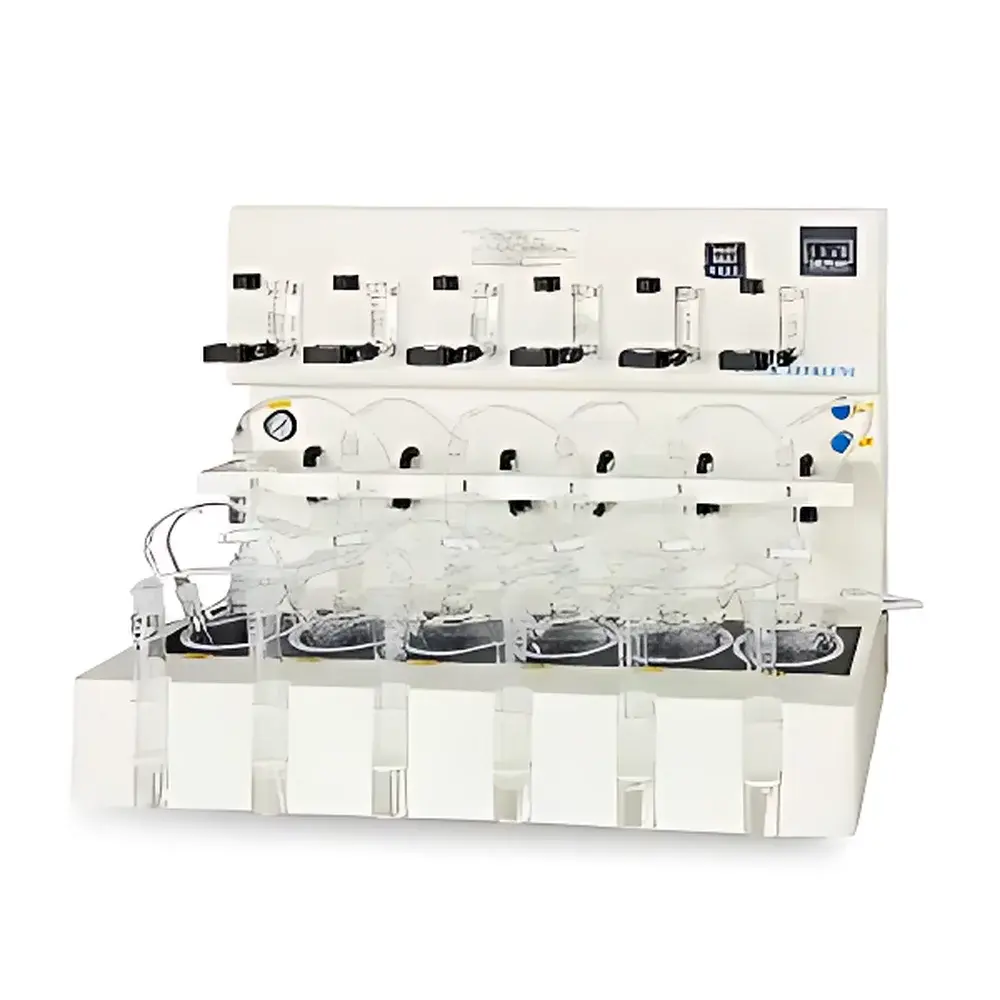
Sulfide Acidification and Purge Instrument HUANKONG Model 2000
| Brand | HUANKONG |
|---|---|
| Origin | Shandong, China |
| Manufacturer Type | Direct Manufacturer |
| Country of Origin | China |
| Model | 2000 |
| Heating Method | Water Bath |
| Gas Flow Rate | 50–500 mL/min |
| Sample Positions | 6 |
Overview
The HUANKONG Model 2000 Sulfide Acidification and Purge Instrument is a dedicated laboratory system engineered for the standardized pretreatment of sulfide (S²⁻) in aqueous environmental samples prior to quantitative analysis—typically by methylene blue spectrophotometry (per GB/T 16489–1996) or iodometric titration. It operates on the principle of acidification-driven volatile hydrogen sulfide (H₂S) generation, followed by inert gas (nitrogen) purging and quantitative trapping in an alkaline absorbent solution. This controlled, closed-loop methodology ensures high reproducibility, minimizes analyte loss due to oxidation or adsorption, and eliminates manual handling variability associated with open-vessel acidification. Designed specifically for compliance with Chinese national environmental monitoring standards, the instrument supports routine quality control in municipal water utilities, environmental testing laboratories, and industrial effluent monitoring facilities where trace sulfide quantification is critical for regulatory reporting and process optimization.
Key Features
- Six independent sample channels with fully isolated gas flow paths—each channel features individual digital flow control (50–500 mL/min range), enabling method flexibility across heterogeneous sample matrices without cross-contamination or pressure interference.
- Intelligent water bath heating system with PID temperature regulation (range: ambient to 95 °C, ±0.3 °C stability), integrated level sensor for automatic low-water alarm and optional auto-fill/drain sequencing to prevent dry-heating and ensure thermal uniformity.
- Corrosion-resistant manifold and gas delivery components—including PTFE-coated valves, borosilicate glass reaction tubes, and silicone-free gas lines—engineered for long-term exposure to acidic H₂S-laden atmospheres.
- Modular mechanical architecture with front-accessible service panels, tool-free tube holder replacement, and standardized 12-mm/16-mm tube compatibility—supporting rapid maintenance and method adaptation.
- Fail-safe design elements: over-temperature cutoff, gas flow timeout monitoring, and audible/visual alerts for abnormal conditions—aligned with GLP-aligned operational integrity requirements.
Sample Compatibility & Compliance
The Model 2000 accommodates standard 100 mL and 250 mL volumetric flasks, as well as custom absorption train configurations per GB/T 16489–1996 Annex A. It is validated for use with surface water, groundwater, domestic wastewater, and industrial effluents containing sulfide concentrations ranging from 0.02 mg/L to 2.0 mg/L (as S²⁻). While developed to meet GB/T 16489–1996, its operational parameters are consistent with analogous procedures in ISO 11733:2004 (water quality — determination of sulfides — iodometric method) and ASTM D4129–16 (standard test method for total sulfur in water by oxidative combustion and ion chromatography), facilitating international data comparability. The system’s design supports audit-ready documentation when paired with compliant laboratory information management systems (LIMS).
Software & Data Management
The instrument operates via embedded microcontroller firmware with local parameter storage (flow setpoints, temperature profiles, run duration) and non-volatile event logging—including start/stop timestamps, temperature deviations >±0.5 °C, and flow interruptions exceeding 10 s. While no proprietary PC software is bundled, all operational logs export via USB-C to CSV format for integration into validated LIMS or ELN platforms. Audit trail functionality meets basic GLP record-keeping expectations; for full 21 CFR Part 11 compliance, integration with third-party electronic signature and user access control modules is recommended during system validation.
Applications
- Regulatory environmental monitoring: sulfide screening in discharge permits, receiving water assessments, and landfill leachate characterization.
- Wastewater treatment plant process control: real-time evaluation of anaerobic digester performance and sulfide inhibition thresholds.
- Drinking water safety verification: detection of sulfate-reducing bacterial activity in distribution networks and storage reservoirs.
- Industrial hygiene testing: workplace air and scrubber solution analysis where H₂S exposure risk assessment is required.
- Research applications: kinetic studies of sulfide release under varying pH/temperature conditions and method development for speciated sulfur analysis (e.g., polysulfides, thiosulfate interference mitigation).
FAQ
Does the Model 2000 support alternative purge gases besides nitrogen?
Yes—it is compatible with argon and helium; however, nitrogen remains the recommended carrier gas per GB/T 16489–1996 due to cost-effectiveness, inertness, and minimal interference with downstream colorimetric detection.
Can the water bath be operated without active purging for standalone heating applications?
No—the system interlocks bath operation with gas flow initiation to prevent uncontrolled H₂S accumulation; this is a mandatory safety feature per IEC 61010-1:2010 Clause 10.4 for hazardous gas handling equipment.
Is calibration of individual flow channels required before first use?
Factory-calibrated mass flow controllers are supplied with NIST-traceable certificates; users should perform quarterly verification using a calibrated rotameter or bubble flowmeter per ISO 6145-4:2017.
What tube sizes are supported for sample digestion vessels?
Standard configuration accepts 100 mL and 250 mL volumetric flasks with ground-glass joints; custom adapters for 50 mL or 500 mL formats are available upon request.
How is carryover between runs mitigated?
Each channel includes a post-run nitrogen flush cycle (programmable duration), and the glass manifold is designed for complete drainage and solvent-rinse accessibility—validated to achieve <0.5% residual carryover under worst-case matrix conditions (e.g., high-suspended solids wastewater).



