
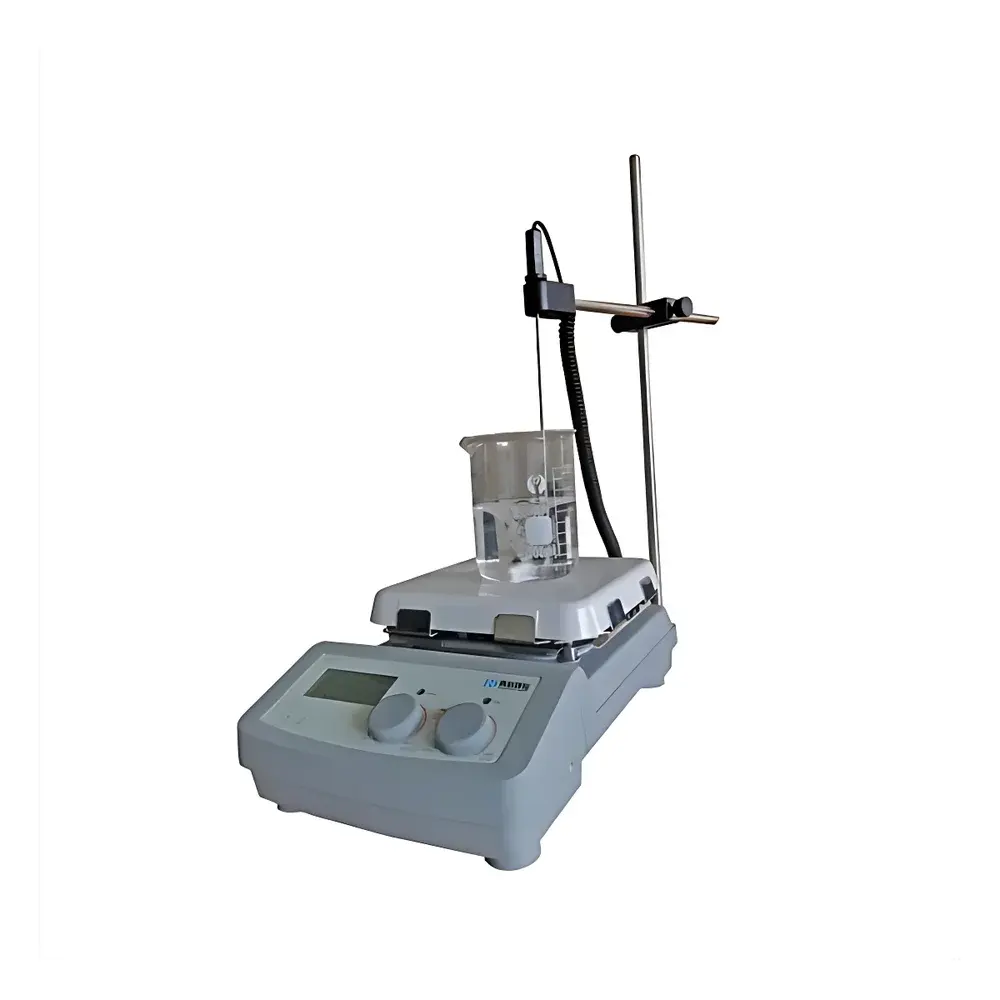
HUANKONG GHD-YC20 Intelligent Multi-Position Magnetic Hotplate Stirrer
| Brand | HUANKONG |
|---|---|
| Origin | Shandong, China |
| Manufacturer Type | Direct Manufacturer |
| Instrument Type | Magnetic Hotplate Stirrer |
| Heating Plate Material | Ceramic |
| Control Interface | Capacitive Touchscreen (iPad-style) |
| Independent Stations | 4–8 |
| Individual Station Control | Temperature, Speed, Timer |
| Heating Method | Resistive Ceramic Plate with Integrated Thermocouple |
| Stirring Principle | Permanent Magnet Coupling via Motor-Driven Rotating Magnet Array |
| Enclosure | Reinforced Powder-Coated Steel Chassis |
| Operating Orientation | Ergonomic Tilted Front Panel |
| Safety Features | Overheat Protection, Motor Stall Detection, No-Spark Operation |
| Display | High-Contrast Digital LCD with Real-Time Parameter Feedback |
| SOP Functionality | Programmable Sequence Storage (Up to 99 Protocols) |
| Noise Level | <45 dB(A) at 1 m |
| Compliance | Designed per IEC 61010-1:2010 for Laboratory Electrical Equipment |
Overview
The HUANKONG GHD-YC20 Intelligent Multi-Position Magnetic Hotplate Stirrer is an engineered solution for laboratories requiring precise, parallel thermal and mechanical control across multiple samples. It operates on the principle of magnetic coupling: a motor-driven permanent magnet array beneath the ceramic heating plate induces rotational motion in PTFE- or glass-coated magnetic stir bars immersed in vessels. Simultaneously, resistive heating elements embedded within the high-purity alumina ceramic plate deliver uniform thermal energy, while integrated type-K thermocouples provide closed-loop temperature feedback at the plate surface—not the solution—enabling accurate setpoint tracking under variable load conditions. Unlike conventional hotplate stirrers with shared thermal mass, the GHD-YC20 implements true per-station independence: each position features dedicated PID-controlled heating and digitally regulated DC motor drive, eliminating cross-talk between adjacent vessels during multi-sample protocols such as dissolution testing, buffer equilibration, or reagent synthesis.
Key Features
- 4–8 independently controllable stations, each with fully decoupled temperature (ambient to 300 °C), speed (0–1,500 rpm), and timer (0–99 h 59 min) settings
- Ceramic top plate engineered for chemical resistance, thermal stability, and non-porous cleanability—resistant to acids, alkalis, and organic solvents per ISO 17025-compliant lab maintenance protocols
- Capacitive touchscreen interface with iPad-style UI, supporting gesture-based navigation, real-time parameter overlays, and contextual help prompts
- Ergonomically tilted front panel (15° inclination) optimized for seated and standing operator postures, reducing cervical strain during extended use
- Programmable SOP mode: users define sequential steps (e.g., “heat to 60 °C → hold 10 min → ramp to 85 °C → stir at 400 rpm for 30 min”) and execute with one touch; up to 99 protocols stored locally with timestamped versioning
- Robust mechanical architecture: powder-coated steel chassis rated for continuous operation at ambient temperatures up to 40 °C; no brushed motors or sparking components—compliant with Class I, Division 2 hazardous location considerations per NEC Article 500
- Digital display with ±0.5 °C temperature resolution and ±2 rpm speed resolution; overshoot minimized via adaptive PID tuning with auto-tuning capability
Sample Compatibility & Compliance
The GHD-YC20 accommodates standard laboratory glassware including beakers (25–1,000 mL), Erlenmeyer flasks, and round-bottom reaction vessels placed directly on the ceramic surface. Stir bar compatibility spans diameters from 5 mm to 30 mm, with optimal performance observed using PTFE-coated bars rated for >200 °C. The instrument is designed and tested in accordance with IEC 61010-1:2010 (Safety Requirements for Electrical Equipment for Measurement, Control, and Laboratory Use), including dielectric strength, creepage/clearance, and thermal cutoff validation. While not intrinsically safe, its spark-free operation and overtemperature cut-off (activated at 320 °C plate surface reading) support use in general chemistry, pharmaceutical QC, and academic teaching labs adhering to GLP principles. Documentation packages include factory calibration certificates traceable to NIST standards.
Software & Data Management
The onboard firmware supports audit-ready data handling without external PC dependency. All parameter changes, alarm events (e.g., lid open, motor stall, sensor fault), and protocol executions are logged with ISO 8601 timestamps and stored in non-volatile memory for ≥12 months. Optional USB-C export enables CSV-formatted logs compatible with LIMS integration or statistical process control (SPC) software. Though no cloud connectivity is embedded, the system meets foundational requirements for FDA 21 CFR Part 11 compliance when deployed with institutional electronic signature policies—audit trails are immutable, user-access controlled via four-tier permission levels (Operator, Supervisor, QA, Admin), and all modifications generate automatic before/after records.
Applications
- Pharmaceutical: Dissolution testing per USP , buffer preparation for HPLC mobile phases, excipient blending under controlled thermal profiles
- Materials Science: Precipitation synthesis of metal oxides, polymerization initiation in solvent systems, nanoparticle dispersion stabilization
- Environmental Testing: BOD incubation support, extraction efficiency studies (Soxhlet pre-heating), standard solution aging protocols
- Academic Research: Kinetic studies requiring simultaneous multi-temperature reaction monitoring, undergraduate physical chemistry labs emphasizing reproducibility and parameter isolation
- Quality Control: Routine viscosity sample conditioning prior to rheometry, titrant standardization workflows, reference material homogenization
FAQ
Does the GHD-YC20 measure solution temperature directly?
No—it measures plate surface temperature via integrated thermocouple. Users must validate correlation between plate setpoint and actual solution temperature for their specific vessel geometry, volume, and medium viscosity.
Can stir bars from other manufacturers be used?
Yes, provided they are chemically inert, magnetically responsive, and dimensionally compatible with vessel size and required torque. HUANKONG recommends PTFE-coated bars with axial length ≥3× diameter for stable vortex formation.
Is calibration verification supported in-house?
Yes—two-point temperature verification (at 25 °C and 100 °C using certified reference thermometers) and speed verification (via optical tachometer) are supported using built-in service menus accessible with supervisor credentials.
What maintenance is required for long-term reliability?
Annual inspection of ceramic plate integrity, cleaning of ventilation grilles, and verification of thermocouple continuity. No lubrication or consumable replacement is required—the brushless DC motors have MTBF >50,000 hours.
How is thermal uniformity across the plate validated?
Per ISO/IEC 17025 Annex A.3, uniformity is specified as ±5 °C across 80% of the active heating area at 150 °C, verified during factory acceptance testing with 9-point grid mapping using calibrated thermal imaging.



