
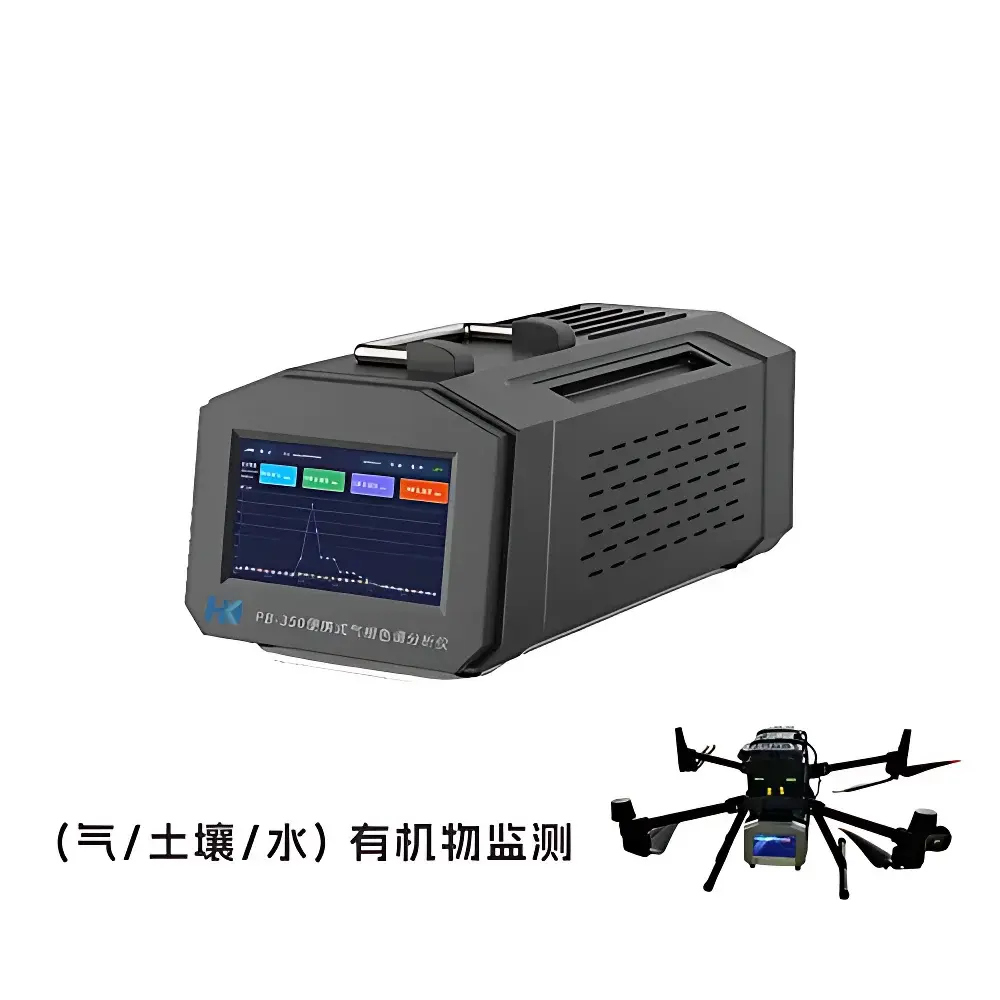
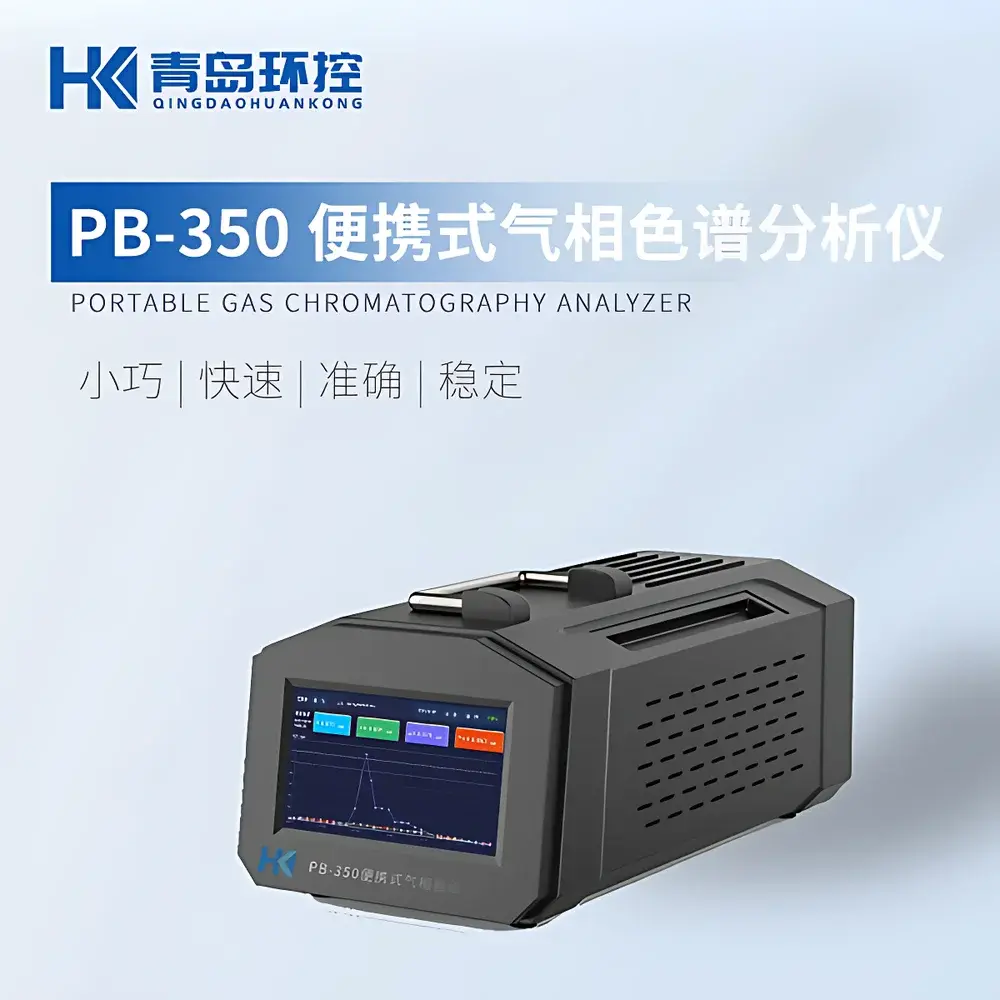
HUANKONG PB-350 Portable Micro Gas Chromatograph for Air, Water & Soil Analysis
| Brand | HUANKONG |
|---|---|
| Model | PB-350 |
| Origin | Shandong, China |
| Manufacturer Type | Direct Manufacturer |
| Detection Limit | <1 ppb (for target VOCs) |
| Repeatability | Compliant with ISO 8573-1 and ASTM D6420 standard requirements |
| Weight | ≤3.5 kg |
| Dimensions | 305 × 160 × 127 mm |
| Interface | USB 2.0, Ethernet, Bluetooth 5.0 |
| Power Supply | Internal Li-ion battery (≥8 h continuous operation), 12 V DC input |
Overview
The HUANKONG PB-350 is a field-deployable micro gas chromatograph engineered for real-time, on-site analysis of volatile organic compounds (VOCs) in ambient air, aqueous extracts, and soil headspace samples. It operates on the fundamental principle of capillary gas chromatography coupled with micro-electromechanical systems (MEMS)-based preconcentration and separation modules. Unlike benchtop GC systems requiring carrier gas cylinders and climate-controlled labs, the PB-350 integrates miniaturized thermal desorption, MEMS-fabricated micro-column arrays, and a low-power, high-stability micro-thermal conductivity detector (µTCD) or optional photoionization detector (PID) — enabling rapid, selective, and quantitative separation of benzene, toluene, ethylbenzene, xylenes (BTEX), trichloroethylene, tetrachloroethylene, cumene, and styrene under variable environmental conditions. Its architecture adheres to the physical constraints and operational demands of mobile environmental monitoring, delivering laboratory-grade chromatographic resolution within a handheld footprint.
Key Features
- MEMS-based preconcentrator and microfabricated capillary column: Enables sub-second thermal desorption and <10 s chromatographic separation cycles for key VOCs.
- Ultra-compact form factor (305 × 160 × 127 mm) and lightweight design (≤3.5 kg) optimized for backpack deployment, drone integration, or vehicle-mounted operation.
- Dual-mode sampling interface: Supports direct air aspiration, water-phase purge-and-trap via integrated sparger module, and soil headspace extraction using heated vial equilibration.
- Onboard ARM Cortex-M7 processor with embedded real-time OS: Executes full GC control logic — including oven ramping, valve sequencing, detector signal acquisition, and baseline correction — without external PC dependency.
- Multi-interface connectivity: USB 2.0 host/device mode, 10/100 Mbps Ethernet for networked data logging, and Bluetooth 5.0 for secure pairing with Android/iOS tablets.
- Internal rechargeable lithium-ion battery providing ≥8 hours of continuous operation at 25 °C; supports hot-swap capability during field use.
Sample Compatibility & Compliance
The PB-350 is validated for use across three primary environmental matrices: ambient air (0.1–10 L/min flow rate), aqueous samples (via EPA Method 502.2-compliant purge-and-trap adaptation), and solid-phase soil samples (per ISO 16017-1 headspace extraction protocol). All hardware components — including the MEMS column chip, stainless-steel sample lines, and inertized internal surfaces — meet USP Class VI biocompatibility and EPA SW-846 compatibility standards for trace-level VOC analysis. Firmware and data handling routines comply with GLP audit trail requirements, supporting time-stamped metadata logging, user authentication, and electronic signature capture per FDA 21 CFR Part 11 Annex 11 guidelines where configured in regulated environments.
Software & Data Management
The instrument is managed via the HUANKONG GC Cloud Suite — a cross-platform application supporting Windows, Android, and iOS. The software provides live chromatogram visualization, automated peak integration using iterative Gaussian deconvolution, retention time locking (RTL) calibration, and method-based quantification against NIST-traceable calibration curves. All raw chromatograms (in .cdf format), processed reports (.pdf/.csv), and system logs are stored locally on the device’s encrypted eMMC and synchronized to secure cloud storage via TLS 1.3. Remote firmware updates, method library distribution, and multi-instrument fleet monitoring are supported through role-based access control (RBAC) dashboards. Optional Bluetooth thermal printer integration enables immediate hardcopy generation of QA/QC reports and field validation certificates.
Applications
- Urban ambient air quality networks: Real-time BTEX monitoring at street-level intersections, underground parking garages, road tunnels, airport aprons, metro stations, and railway terminals.
- Indoor environmental quality assessment: Continuous VOC profiling in healthcare facilities, educational institutions, museums, and office buildings to support IAQ compliance with ASHRAE Standard 62.1 and WHO indoor air guidelines.
- Industrial emission surveillance: Fence-line monitoring for fugitive emissions, stack effluent screening (when paired with dilution probes), and leak detection and repair (LDAR) program support.
- Emergency response and hazmat operations: Rapid identification of chlorinated solvents and aromatic hydrocarbons following chemical spills, landfill leachate breaches, or groundwater contamination events.
- Research-grade field studies: Coupled with passive samplers or automated soil gas probes for spatial-temporal mapping of VOC plumes in heterogeneous geologies.
FAQ
What sample volumes are required for detection at sub-ppb levels?
For air: 100–500 mL at ambient pressure; for water: 10–50 mL via purge-and-trap; for soil: 2–5 g in 22-mL headspace vials.
Is the MEMS column replaceable in the field?
Yes — the cartridge-style MEMS column module is user-swappable without tools and certified for ≥200 thermal cycles before recalibration.
Does the system support external carrier gas sources?
It operates natively on compressed air or nitrogen from portable 99.999% purity cylinders (optional accessory); helium-free operation is fully supported.
Can multiple PB-350 units be synchronized for distributed sensing?
Yes — via Ethernet or LTE gateway, units can be time-aligned to ±50 ms using NTPv4 and share coordinated sampling triggers through HUANKONG’s MeshSync protocol.
What regulatory documentation is provided for audit readiness?
Each unit ships with Factory Acceptance Test (FAT) report, Certificate of Conformance (CoC), NIST-traceable calibration certificate, and full 21 CFR Part 11 configuration guide.






