
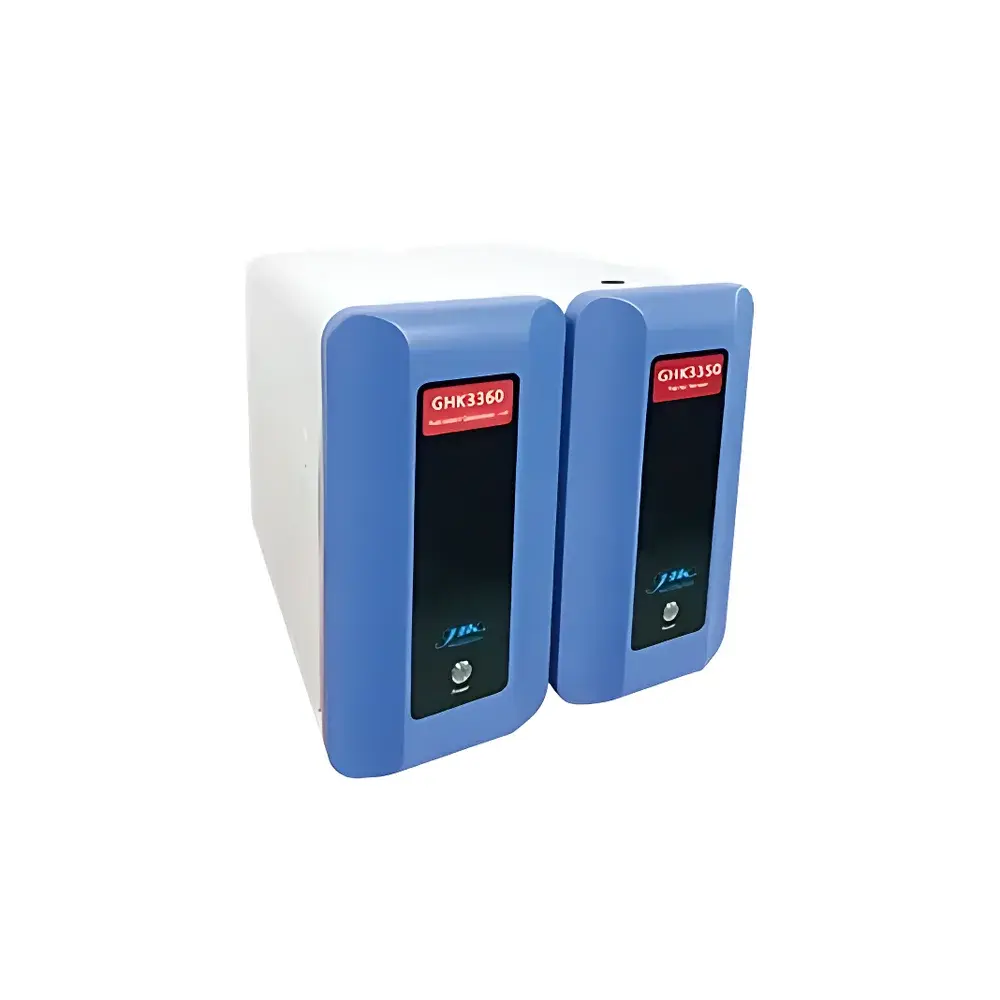
HUANKONG APK2300 Automated Two-Stage Thermal Desorber
| Brand | HUANKONG |
|---|---|
| Origin | Shandong, China |
| Manufacturer Type | Direct Manufacturer |
| Instrument Type | Two-Stage Thermal Desorber / Thermal Desorption Unit |
| Automation Level | Fully Automated |
| Primary Desorption Temperature Range | 100–400 °C |
| Secondary Desorption (Focusing Trap) Temperature | Up to 460 °C |
| Valve & Transfer Line Temperature Range | 50–200 °C |
| Cold Trap Temperature | −30 °C |
| Temperature Control Accuracy | ±1 °C |
| Analyte Recovery Rate | >90% |
| Sample Capacity | 24 adsorption tubes |
Overview
The HUANKONG APK2300 Automated Two-Stage Thermal Desorber is a high-precision sample introduction system engineered for trace-level volatile organic compound (VOC) analysis in ambient air and stationary source emissions. It operates on the principle of two-stage thermal desorption: first, analytes are thermally released from sorbent-packed sampling tubes under controlled inert gas flow; second, the evolved vapors are cryogenically focused in a low-temperature trap (−30 °C), then rapidly thermally desorbed at up to 460 °C directly into the GC or GC-MS inlet. This dual-stage approach achieves effective preconcentration, minimizes breakthrough and degradation, and delivers superior sensitivity—enabling reliable quantification down to ppt-level concentrations. The system is purpose-built to meet the stringent methodological requirements of Chinese environmental monitoring standards including HJ 644–2013 and HJ 734–2014, covering all 35 target VOCs in ambient air and 24 priority compounds in industrial exhaust streams.
Key Features
- Fully automated operation with 24-position tube carousel—supports unattended batch processing without manual intervention
- Independent temperature control zones: primary desorption oven (100–400 °C), secondary focusing trap (−30 °C to 460 °C), valve manifold (50–200 °C), and heated transfer lines (up to 200 °C)
- Mass flow controller (MFC)-regulated carrier gas delivery ensures reproducible flow rates and built-in leak detection for system integrity verification
- Entire gas path—including valves, traps, and tubing—features inert surface treatment (e.g., Siltek® or Sulfinert®-equivalent passivation) and active heating to eliminate adsorption artifacts and memory effects
- Modular architecture allows seamless integration with major GC and GC-MS platforms (Agilent, Thermo Fisher, Shimadzu, PerkinElmer) via standard pneumatic and electrical interfaces
- Compatible with all ISO/IEC 17025-compliant sorbent tubes (e.g., Tenax TA, Carbopack B/C, Carboxen 1000), including multi-bed configurations per HJ 644–2013
- APK Control Software provides centralized instrument management, method scheduling, real-time status monitoring, and audit-ready event logging
Sample Compatibility & Compliance
The APK2300 is validated for use with both stainless-steel and fused-silica sorbent tubes compliant with ISO 16017-1 and ASTM D6196. It supports direct analysis of samples collected via canisters, Tedlar® bags, and diffusion samplers when interfaced with optional gas-phase introduction modules. Regulatory alignment includes full support for HJ 583–2010 (benzene homologues), HJ 644–2013 (ambient VOCs), and HJ 734–2014 (stationary source VOCs). System design incorporates hardware and software features required for GLP-compliant laboratories, including electronic signatures, user-access controls, and configurable audit trails—facilitating readiness for CNAS accreditation and future alignment with FDA 21 CFR Part 11 requirements where applicable.
Software & Data Management
The APK Control Software is a Windows-based application offering intuitive method development, sequence programming, and real-time diagnostics. Each run generates timestamped metadata logs—including temperature profiles, MFC setpoints, trap cooling/heating cycles, and valve actuation events—stored in encrypted SQLite databases. Raw method files (.apk) are human-readable XML structures supporting version control and cross-laboratory method exchange. Export options include CSV and PDF reports compatible with LIMS integration. All software updates are delivered via secure HTTPS channels with SHA-256 signature verification.
Applications
- Ambient air monitoring for photochemical ozone precursors (e.g., isoprene, monoterpenes, C2–C10 alkanes/alkenes/aromatics)
- Stack emission testing of VOCs from chemical manufacturing, coating operations, and printing facilities
- Indoor air quality assessment in schools, hospitals, and office buildings per GB/T 18883–2022
- Soil vapor intrusion studies using passive or active sampling followed by thermal desorption-GC/MS
- Method development and validation for emerging contaminants such as halogenated VOCs and oxygenated organics (e.g., MEK, acetone, acetaldehyde)
FAQ
What sorbent tubes are supported by the APK2300?
All standard 6-mm OD stainless-steel or glass tubes packed with single- or multi-bed sorbents (e.g., Tenax TA + Carbopack B + Carbopack C) meeting HJ 644–2013 specifications.
Does the system support dynamic headspace or direct gas injection?
Yes—optional accessories enable quantitative transfer from Tedlar bags or SUMMA canisters using calibrated pressure-controlled loops.
Is remote monitoring or network deployment possible?
The APK Control Software supports LAN-based access for supervisory monitoring; however, remote desktop or cloud connectivity requires local IT infrastructure configuration per organizational cybersecurity policy.
How is system performance verified during routine operation?
Built-in diagnostic routines include cold trap cooldown verification, MFC linearity checks, and temperature ramp validation against NIST-traceable reference sensors.
Can the APK2300 be used for non-environmental applications?
Yes—applications in polymer off-gassing, pharmaceutical residual solvent analysis (per ICH Q3C), and flavor & fragrance profiling have been documented in peer-reviewed literature using identical thermal desorption protocols.






