
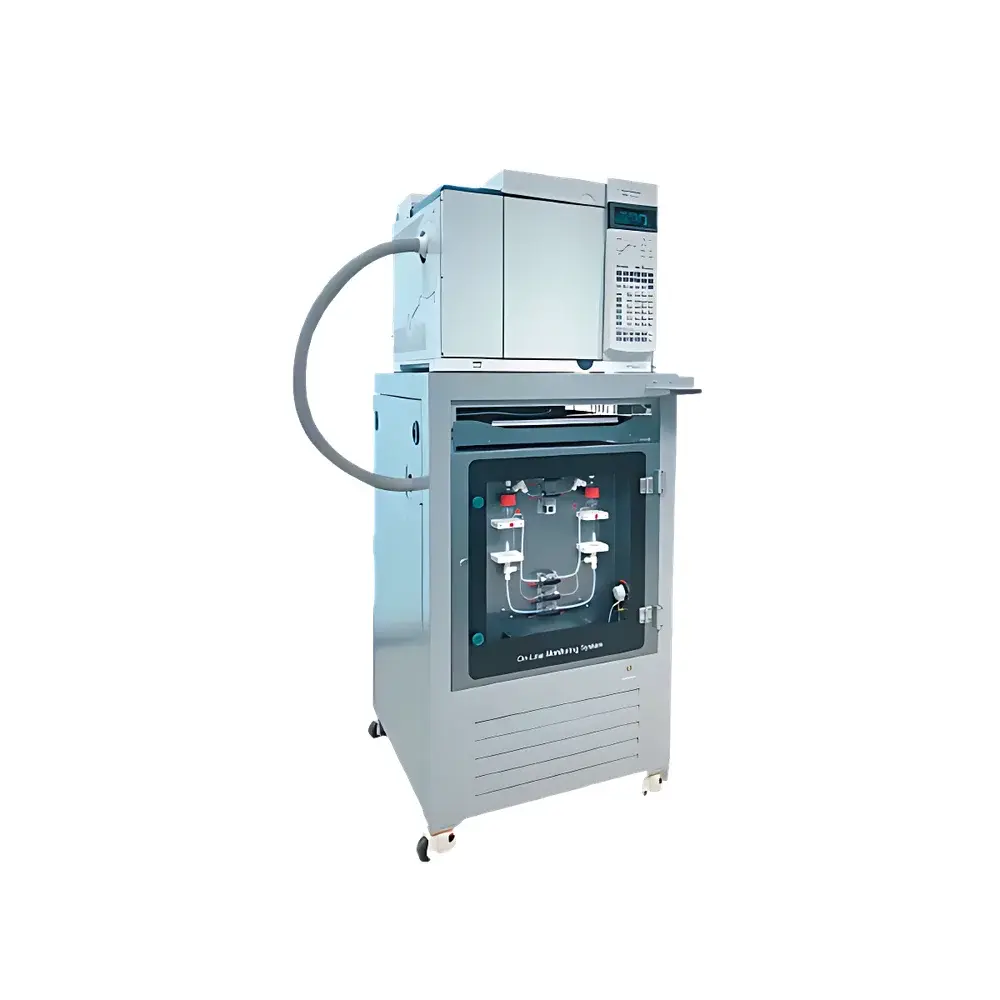
KHK 650W Online VOCs Monitoring System
| Brand | HUANKONG |
|---|---|
| Origin | Shandong, China |
| Manufacturer Type | Original Equipment Manufacturer (OEM) |
| Country of Origin | China |
| Model | KHK 650W |
| Pricing | Available Upon Request |
| Detection Principle | Membrane Extraction / Purge-and-Trap Coupled with Capillary Gas Chromatography |
| Detection Targets | Hydrocarbons, Halogenated Hydrocarbons |
| Detection Limit | Sub-ppt (parts-per-quadrillion) range |
| Cooling Method | Peltier Thermoelectric Cooling |
| Interface | Modular Analytical Unit Expansion Port |
| Automation Level | Fully Unattended Operation |
Overview
The KHK 650W Online VOCs Monitoring System is a fully automated, laboratory-grade environmental instrumentation platform engineered for continuous, real-time quantification of volatile organic compounds (VOCs) in aqueous matrices. It operates in strict alignment with U.S. EPA Method 524.2—“Measurement of Purgeable Organic Compounds in Water by Capillary Column Gas Chromatography/Mass Spectrometry”—and supports dual, switchable sample introduction pathways: hydrophobic membrane extraction (ME) and purge-and-trap (P&T). This dual-path architecture enables method selection based on analyte volatility, matrix complexity, and concentration range—ensuring robustness across diverse water types including surface water (rivers, lakes), industrial effluents, groundwater, and wastewater influents/effluents. The system employs capillary gas chromatography (GC) with configurable detectors—including electron capture detector (ECD) for halogenated hydrocarbons and flame ionization detector (FID) for total hydrocarbons—delivering trace-level sensitivity, high reproducibility, and long-term stability without manual intervention.
Key Features
- Dual independent VOC preconcentration modules: switchable between hydrophobic membrane extraction and purge-and-trap, each optimized for specific water quality conditions and target compound classes.
- Membrane extraction module utilizes a selective polymeric membrane that permits only nonpolar VOCs to permeate while rejecting water vapor, inorganic ions, and particulate matter—effectively eliminating humidity-related interference and column contamination.
- Purge-and-trap subsystem features dual inert-gas purge lines with precision mass flow control and microbubble dispersion technology, enhancing VOC desorption efficiency from low-concentration or high-turbidity samples.
- Integrated Peltier thermoelectric cooling system eliminates reliance on consumable cryogenic refrigerants (e.g., liquid nitrogen or CO₂), reducing operational cost and enabling stable trap desorption at −30 °C to +50 °C.
- Modular analytical interface allows seamless integration with external GC–MS, GC–FID, or GC–ECD systems; supports future upgrades to multi-analyte configurations (e.g., SVOCs, semi-volatiles) via standardized I/O and digital communication protocols (RS-485, Modbus TCP).
- Fully automated sequence control: unattended operation up to 30 days per maintenance cycle; includes auto-calibration, leak diagnostics, pressure monitoring, and scheduled system validation using certified standard solutions.
Sample Compatibility & Compliance
The KHK 650W accepts raw, unfiltered water samples with turbidity ≤ 100 NTU and total suspended solids (TSS) ≤ 50 mg/L. It complies with key regulatory frameworks governing environmental monitoring data integrity, including ISO/IEC 17025:2017 (general requirements for competence of testing and calibration laboratories), ASTM D5059–22 (standard test methods for determination of volatile organic compounds in water), and EU Water Framework Directive (WFD) Annex IX parameters. All analytical sequences support audit-ready electronic records aligned with FDA 21 CFR Part 11 requirements, including user authentication, electronic signatures, and immutable audit trails for method parameters, calibration history, and raw chromatographic data.
Software & Data Management
The embedded Windows-based control software provides intuitive configuration of sampling intervals (1–24 h), method switching logic, calibration schedules, and alarm thresholds. Data output conforms to IEEE C37.118 and EPA SW-846-compliant formats (e.g., .csv, .cdf, .xml), with optional OPC UA server integration for SCADA and LIMS connectivity. All chromatograms, peak tables, and QC metrics are timestamped, digitally signed, and archived locally on encrypted SSD storage (≥ 2 TB capacity). Remote access is enabled via TLS 1.2–secured web interface supporting role-based permissions (operator, supervisor, administrator).
Applications
- Real-time surveillance of drinking water intake sources for early detection of accidental or illicit VOC releases (e.g., benzene, chloroform, tetrachloroethylene).
- Compliance monitoring at municipal wastewater treatment plant (WWTP) outfalls under NPDES permits requiring VOC reporting.
- Industrial process water monitoring in petrochemical, pharmaceutical, and semiconductor manufacturing facilities.
- Long-term trend analysis in ambient surface waters under national water quality assessment programs (e.g., USGS NAWQA, China’s National Surface Water Monitoring Network).
- Support for emergency response deployments during chemical spills, where rapid deployment and field-deployable power options (110–240 VAC or 24 VDC) ensure operational continuity.
FAQ
Does the KHK 650W meet U.S. EPA Method 524.2 requirements for regulatory reporting?
Yes—the system implements all critical procedural elements defined in EPA Method 524.2, including internal standard addition, surrogate recovery tracking, method blanks, and laboratory control samples. Full method validation documentation is provided upon request.
Can the system operate continuously without operator intervention?
Yes—it supports unattended operation for ≥720 hours (30 days) with automated calibration, system checks, and remote diagnostics. Scheduled maintenance intervals are configurable and logged in the audit trail.
What is the lowest detectable concentration for chlorinated solvents such as trichloroethylene?
Under optimal P&T conditions with ECD detection, the method detection limit (MDL) is ≤0.008 µg/L (8 ng/L), equivalent to sub-ppt levels in drinking water matrices.
Is third-party certification available for ISO/IEC 17025 accreditation support?
Yes—factory calibration certificates traceable to NIST SRMs are included. Optional on-site performance verification and IQ/OQ documentation packages are available for GLP/GMP environments.
How is data security ensured during remote transmission?
All network communications use AES-256 encryption and TLS 1.2+ handshaking. Local data storage employs full-disk encryption (FDE) compliant with NIST SP 800-111 standards.







