
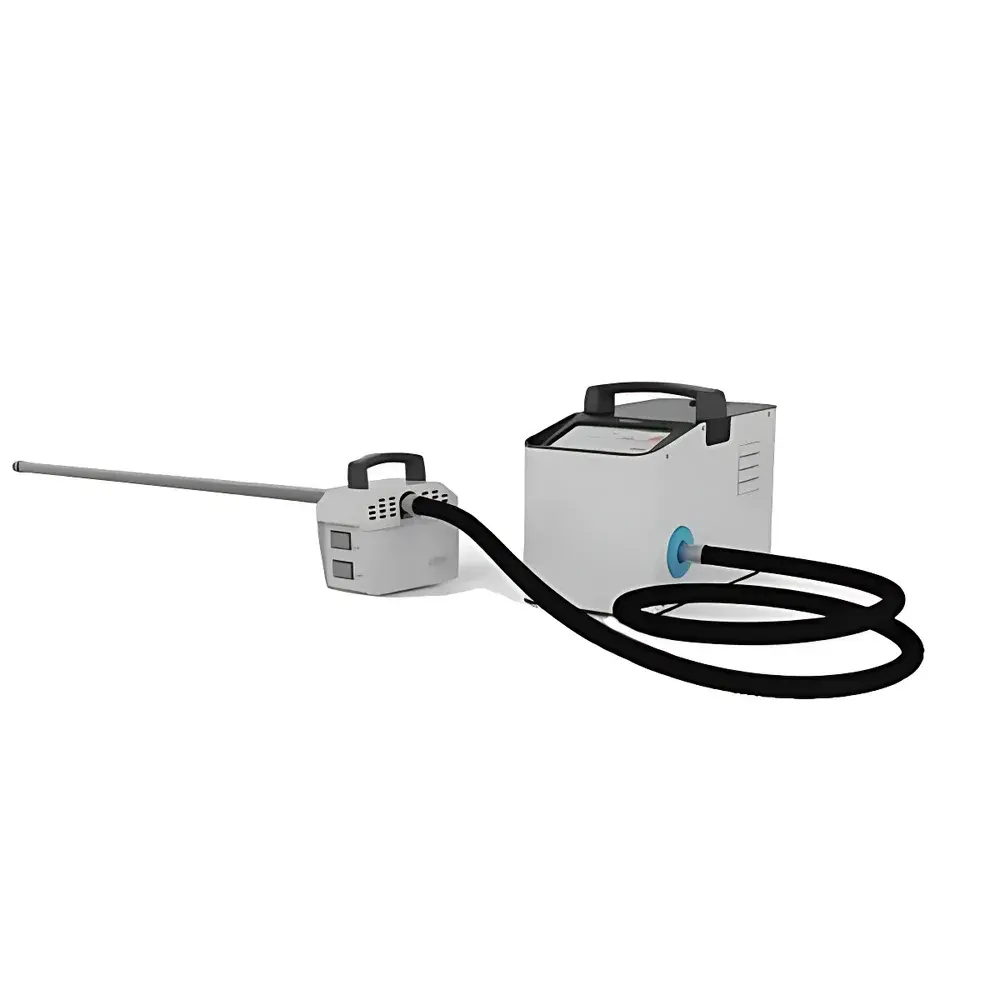
HUANKONG PreGASS-3500 Portable Ammonia Analyzer
| Brand | HUANKONG |
|---|---|
| Origin | Shandong, China |
| Manufacturer Type | OEM Manufacturer |
| Country of Origin | China |
| Model | PreGASS-3500 |
| Instrument Type | Portable |
| Compliance | DL/T 1916–2018 |
Overview
The HUANKONG PreGASS-3500 Portable Ammonia Analyzer is an engineered solution for in-situ and stack-based measurement of ammonia (NH₃) concentration in flue gas streams under demanding industrial conditions. It operates on the principle of Tunable Diode Laser Absorption Spectroscopy (TDLAS) in the near-infrared (NIR) spectral region, specifically targeting a fundamental rotational-vibrational absorption line of NH₃ near 1512 nm. By implementing wavelength modulation spectroscopy (WMS) with second-harmonic (2f) detection, the instrument achieves high selectivity and sensitivity while suppressing baseline drift and broadband interference. The system employs a direct extractive sampling methodology with full-path high-temperature heating (220 °C) — from probe tip through sample line to optical cell — ensuring quantitative transfer of gaseous NH₃ without adsorption loss or ammonium salt deposition (e.g., NH₄HSO₄, NH₄Cl), which are common failure modes in low-temperature sampling systems.
Key Features
- Full-path heated sampling at 220 °C from probe to analyzer cell, eliminating NH₃ condensation, surface adsorption, and thermally unstable ammonium salt formation
- Advanced WMS-TDLAS detection architecture with real-time harmonic signal processing for ppm-level NH₃ quantification (detection limit ≤ 0.5 ppm, typical)
- Integrated multi-parameter compensation algorithms to correct for spectral interferences from water vapor (H₂O), particulate scattering, and volatile organic compounds (VOCs) commonly present in coal-fired, biomass, and waste incineration flue gases
- Onboard zero/span calibration capability using certified gas standards or built-in permeation sources, supporting traceable drift correction per regulatory QA/QC protocols
- Modular design comprising a ruggedized front-end sampling unit (ceramic filter, heated probe, PTFE-lined transport line) and a compact main analyzer chassis with embedded optical bench and thermal management
- Extendable heated probe assembly enabling grid-based spatial profiling of NH₃ distribution across duct cross-sections — critical for SCR/SNCR injection optimization and compliance mapping
Sample Compatibility & Compliance
The PreGASS-3500 is validated for use in high-dust (>10 g/Nm³), high-moisture (>15% vol), and wide-temperature (−10 °C to 200 °C ambient; >220 °C sample path) environments typical of coal-fired power plants, coke ovens, cement kilns, glass furnaces, and steel sintering facilities. It meets the technical requirements specified in DL/T 1916–2018 “Technical Specification for Portable Ammonia Slip Measurement Systems” — the national standard governing performance criteria, calibration procedures, and uncertainty reporting for NH₃ slip analyzers in China’s power generation sector. While not certified to EU EN 15267 or US EPA PS-18, its measurement methodology aligns with ISO 14956:2022 (air quality — performance criteria for automated measuring systems) and supports data integrity practices consistent with GLP and ISO/IEC 17025 laboratory accreditation frameworks.
Software & Data Management
The analyzer runs embedded firmware with a Linux-based real-time OS and communicates via RS-485 (Modbus RTU), Ethernet (TCP/IP), or optional Bluetooth 5.0. Data logging is performed internally (≥30 days at 1-second intervals) and synchronized to external PCs or cloud platforms via USB or SD card export. The accompanying PC software provides time-series visualization, spectral overlay diagnostics, calibration history tracking, and automated report generation compliant with Chinese environmental monitoring templates (e.g., HJ/T 397, HJ 75). Audit trails include user login logs, parameter change timestamps, and calibration event metadata — supporting internal QA audits and regulatory inspection readiness.
Applications
- Ammonia slip verification during SNCR and SCR system commissioning, performance testing, and routine operation
- Grid-based NH₃ concentration mapping across ducts to identify injection non-uniformity and optimize reagent dosing
- Stack testing for environmental compliance verification (e.g., CEMS validation, quarterly stack testing per local EPAs)
- Process troubleshooting in ammonia-based desulfurization (e.g., ammonia–sulfite process) and catalytic reduction units
- Field reference measurements for sensor cross-validation and portable analyzer intercomparison studies
- Emergency response screening following suspected NH₃ release incidents in industrial zones
FAQ
What is the minimum detectable NH₃ concentration under field conditions?
Typical lower limit of detection (LOD) is 0.3–0.5 ppm (v/v) with 1σ noise level over 60 seconds, depending on optical path length and gas matrix composition.
Does the system require external cooling water or compressed air?
No — it is self-contained with thermoelectric coolers and passive heat dissipation; no auxiliary utilities are required for operation.
Can the analyzer be used for continuous unattended monitoring?
Yes, though designed as portable, it supports 24/7 operation when deployed with external power and data telemetry; battery runtime is ~4 hours (optional extended-life pack available).
How is calibration traceability maintained?
Calibration uses NIST-traceable NH₃ gas standards (certified by CNAS-accredited labs); onboard zero gas is generated via catalytic scrubbing or synthetic zero-air modules.
Is the optical cell accessible for cleaning or maintenance in the field?
Yes — the dual-beam TDLAS cell features quick-release optics mounts and quartz windows compatible with IPA-based cleaning protocols without disassembly of the laser alignment.







