
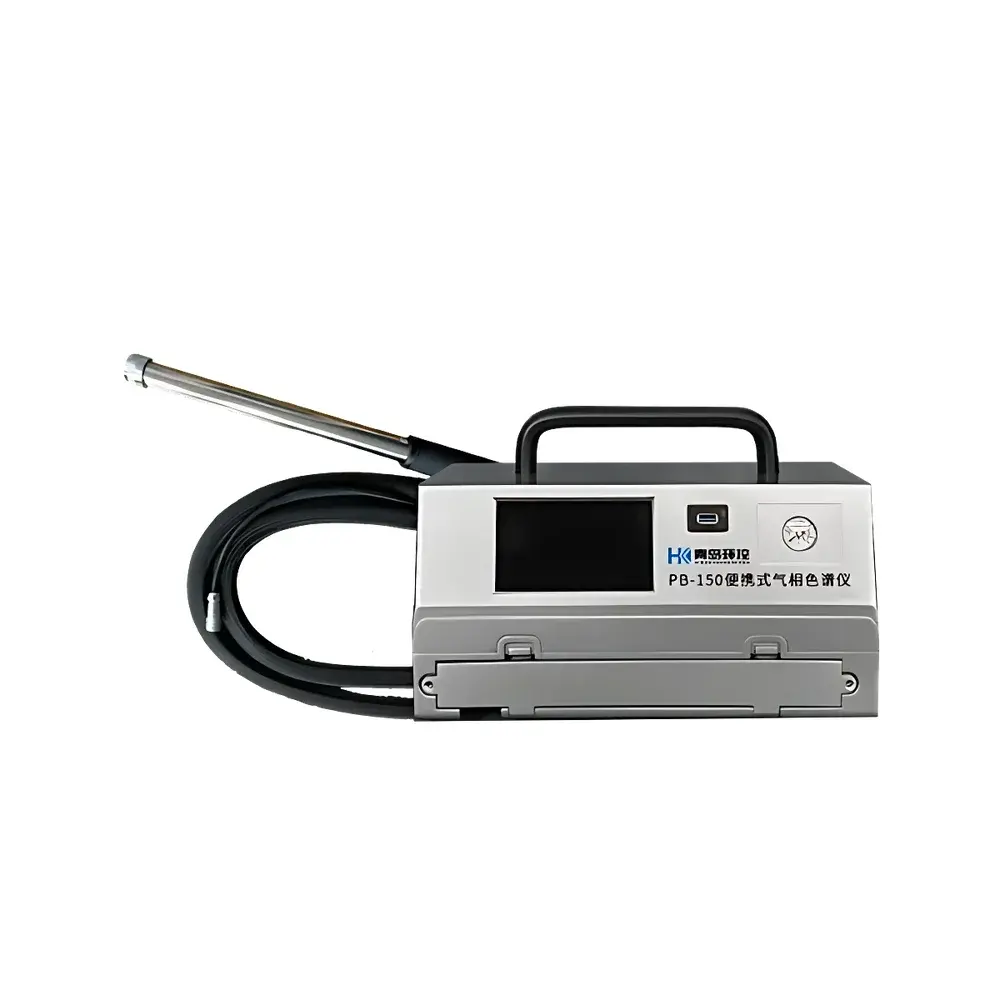
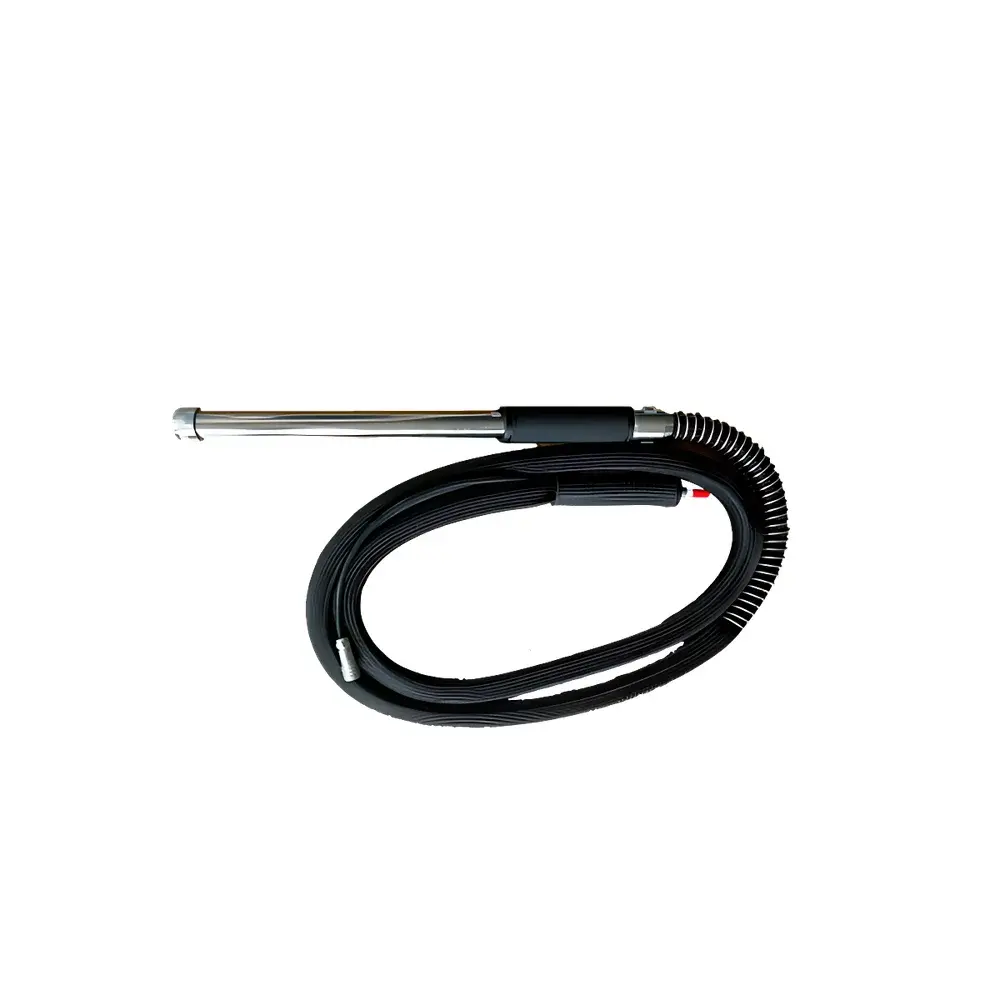
HUANKONG PB-150 Portable Gas Chromatograph
| Brand | HUANKONG |
|---|---|
| Origin | Shandong, China |
| Manufacturer Type | Direct Manufacturer |
| Country of Origin | China |
| Model | PB-150 |
| Detection Limit | Low |
| Repeatability | ≤5% F.S. |
| Weight | ≤4.5 kg |
| Dimensions | 170 × 165 × 310 mm |
Overview
The HUANKONG PB-150 Portable Gas Chromatograph is a field-deployable analytical instrument engineered for rapid, on-site qualitative and quantitative analysis of volatile organic compounds (VOCs) in ambient air, stack emissions, soil headspace, and water vapor extracts. It operates on the fundamental principle of gas chromatography—separation of analytes based on differential partitioning between a mobile gaseous phase (carrier gas) and a stationary phase coated inside a capillary column—coupled with selective detection. The system integrates MEMS-fabricated micro-column technology and a miniaturized high-sensitivity detector to achieve sub-minute separation cycles and robust performance under variable environmental conditions. Unlike benchtop GC systems requiring temperature-stabilized laboratories and external gas supplies, the PB-150 is fully self-contained: it incorporates an integrated high-vacuum sampling pump, heated sample pathway, internal carrier gas reservoir, and real-time data acquisition architecture—enabling immediate deployment without pre-conditioning or external infrastructure.
Key Features
- Integrated high-negative-pressure sampling pump capable of drawing representative samples from low-flow emission sources, ducts, or ambient air without flow compensation hardware
- Zero-wait-time detector activation: no ignition sequence, no filament warm-up, no column oven equilibration required prior to injection
- Fully heated sample train—from inlet valve through transfer lines to detector—preventing condensation of semi-volatile VOCs (e.g., naphthalene, styrene) and minimizing adsorption losses
- Onboard ultra-pure carrier gas supply eliminates ambient air contamination and baseline drift associated with external cylinder dependency
- Multi-stage particulate filtration (0.3 µm pre-filter + sintered metal guard + chemical scrubber) protects the micro-column and detector from moisture, aerosols, and reactive matrix interferences
- MEMS-based microfabricated capillary column with optimized stationary phase chemistry for enhanced resolution of BTEX (benzene, toluene, ethylbenzene, xylenes), chlorinated ethylenes, and alkylbenzenes
- Wireless remote operation via dedicated Android/iOS application supporting live chromatogram streaming, method parameter adjustment, and alarm-triggered data capture
Sample Compatibility & Compliance
The PB-150 is validated for direct analysis of gaseous matrices—including fixed-source exhaust, fugitive emissions, indoor air, landfill gas, and soil vapor—and indirectly compatible with aqueous and solid-phase samples when coupled with standard headspace or purge-and-trap interfaces (not included). Its design aligns with core requirements of EPA Method TO-17 (for sorbent tube desorption) and ASTM D6196–22 (for VOC monitoring in ambient air), though final regulatory acceptance depends on site-specific validation per ISO/IEC 17025:2017. All firmware and data handling protocols support audit-ready metadata logging—including operator ID, GPS coordinates, ambient T/P, and calibration traceability—facilitating GLP-compliant reporting. While not certified for Class I Div 1 hazardous locations, its ingress protection rating (IP54) ensures operational reliability in outdoor industrial environments.
Software & Data Management
Instrument control and data processing are managed through the HUANKONG GC Connect mobile application, which communicates via Bluetooth 5.0 or Wi-Fi. The software provides real-time chromatographic visualization, peak integration using adaptive baseline algorithms, retention time locking for compound identification, and customizable reporting templates compliant with ISO 14001 environmental management documentation. Raw data (.cdf) and processed reports (.pdf/.xlsx) are stored locally on-device and optionally synced to secure cloud storage with role-based access control. Audit trail functionality records all user actions—including method edits, calibration events, and result overrides—with timestamps and digital signatures, satisfying foundational elements of FDA 21 CFR Part 11 for non-GMP field applications.
Applications
- Real-time benzene series monitoring at refinery flare stacks, paint manufacturing lines, and solvent recovery units
- Fugitive emission surveys across petrochemical plant perimeters, storage tank farms, and loading docks
- Soil vapor intrusion assessment in brownfield redevelopment projects
- Emergency response screening for VOC leaks following transportation incidents or process upsets
- Compliance verification against local VOC emission limits (e.g., China’s GB 37822–2019, EU Industrial Emissions Directive 2010/75/EU)
- Process optimization support via trend analysis of VOC profiles during catalyst regeneration or distillation column operation
FAQ
Does the PB-150 require external carrier gas cylinders?
No—the instrument contains a sealed, refillable internal carrier gas reservoir rated for ≥50 analyses per charge.
Can the PB-150 quantify benzene at sub-ppbv levels?
Its detection limit is system- and matrix-dependent; typical method detection limits (MDLs) for benzene range from 0.5 to 2 ppbv under optimized field conditions with pre-concentration.
Is calibration traceable to NIST standards?
Yes—factory calibration uses certified gas standards traceable to NIST SRM 1860a (BTEX in air); users may perform field calibrations with portable multi-gas standards.
What is the maximum operating temperature range for outdoor use?
The device is rated for continuous operation between –10 °C and +50 °C, with active thermal management maintaining column and detector stability across this span.
How is data integrity ensured during wireless transmission?
All Bluetooth/Wi-Fi communications employ TLS 1.2 encryption; raw chromatograms are digitally signed at acquisition to prevent post-hoc tampering.
Related Products






