
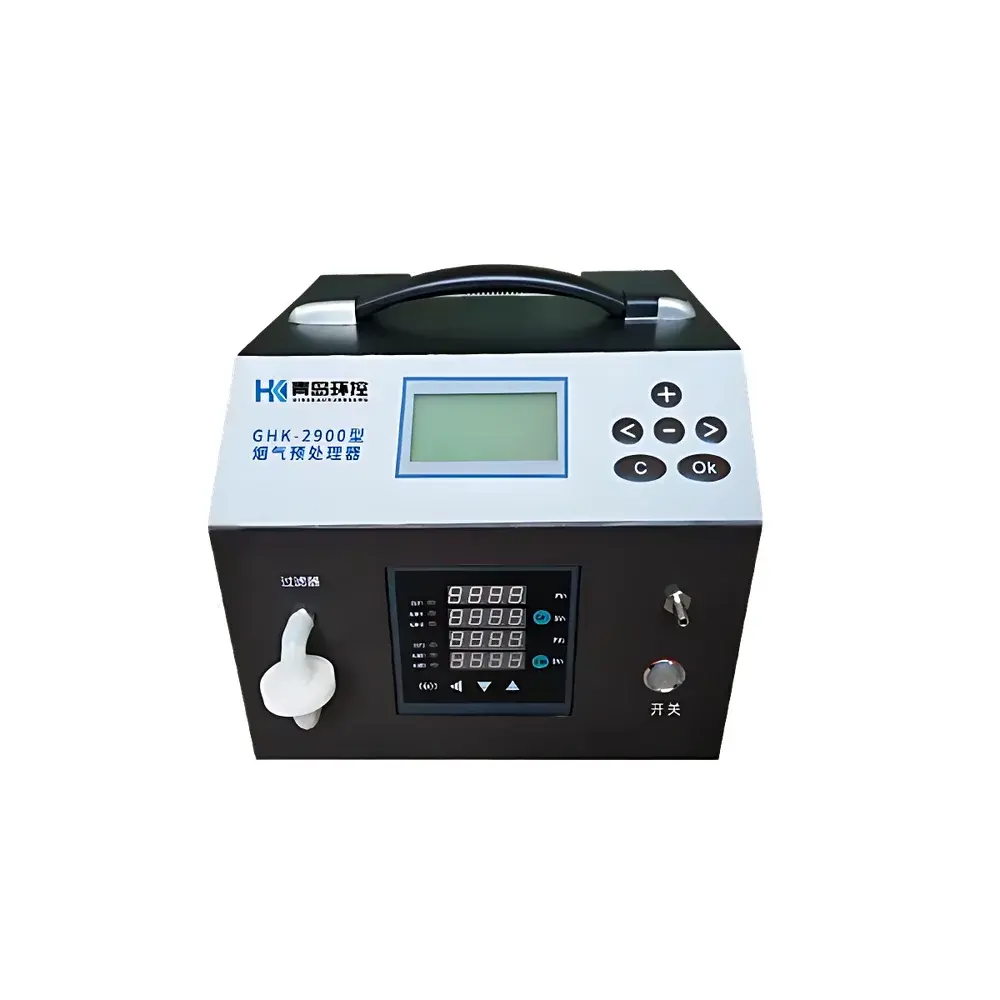
GHK-2900 Flue Gas Preconditioner by HUANKONG
| Brand | HUANKONG |
|---|---|
| Origin | Shandong, China |
| Manufacturer Type | Direct Manufacturer |
| Country of Origin | China |
| Model | GHK-2900 |
| Instrument Type | Flue Gas Sampling Preconditioner |
| Dehumidification Technology | Integrated Peltier Cooling + Nafion® Membrane Permeation |
| Filtration | Dual-stage particulate filtration (≤0.3 µm) |
| Temperature Control | PID-regulated heating & cooling (±0.8 °C stability) |
| Condensate Management | Programmable peristaltic pump drainage |
| Sample Line | Fully heated sampling probe and PTFE-lined transport tubing |
| Real-time Monitoring | Displayed dew point temperature and absolute humidity (g/m³) |
Overview
The GHK-2900 Flue Gas Preconditioner is an engineered solution for accurate, stable, and compliant flue gas sampling in continuous emission monitoring systems (CEMS) and stack testing applications. Designed to meet the technical requirements specified in HJ/T 47–1999 “Technical Specifications for Flue Gas Samplers”, this preconditioner addresses two primary interferences in hot, wet flue gas streams: water vapor condensation and particulate carryover. It employs a dual-mechanism conditioning strategy—combining high-capacity thermoelectric (Peltier) cooling with selective water-permeable Nafion® membrane dehydration—to achieve deep, non-absorptive moisture removal while minimizing loss of water-soluble analytes such as SO₂, NH₃, HCl, and HF. Unlike simple refrigerated coil dryers, the Nafion® stage operates without phase change or surface adsorption, preserving analyte integrity and enabling trace-level quantification under stringent regulatory protocols.
Key Features
- Dual-stage dehumidification: High-power Peltier cooling (−5 °C to +5 °C dew point range) followed by Nafion® membrane permeation ensures >95% water removal efficiency with minimal solute loss.
- Dual particulate filtration: Stainless-steel pre-filter + hydrophobic PTFE membrane filter (cut-off ≤0.3 µm) prevents dust ingress into analyzers and extends sensor lifetime.
- PID-controlled thermal management: Independent PID loops govern both cooling and heating subsystems, maintaining setpoint stability within ±0.8 °C across ambient temperatures from −20 °C to +50 °C.
- Automated system purging: Upon power-up, the unit initiates high-flow inert gas (e.g., zero air or N₂) purge to evacuate residual moisture from internal tubing and valves—critical for baseline reproducibility.
- Integrated flow control: Built-in diaphragm vacuum pump and digital mass flow controller enable precise sample draw rates (adjustable from 0.5 to 2.0 L/min), traceable via onboard calibration certificate.
- Intelligent condensate handling: Programmable peristaltic pump evacuates condensed water at user-defined intervals; pump and drain lines feature active heating (up to +60 °C) to prevent freezing in sub-zero environments.
- Heated sampling train: Full-length heated probe (settable 120–180 °C) and PTFE-lined transfer lines eliminate wall adsorption and cold-spot condensation—essential for reactive or polar compounds.
- Real-time environmental metrics: Onboard sensors continuously report processed gas dew point (±0.5 °C) and absolute humidity (±0.1 g/m³), providing immediate verification of conditioning performance.
Sample Compatibility & Compliance
The GHK-2900 is validated for use with common flue gas matrices from coal-fired boilers, waste incinerators, cement kilns, and industrial furnaces. It supports sampling of gases containing up to 20% O₂, <1000 ppm SO₂, <500 ppm NOₓ, <200 ppm CO, and particulate loadings ≤50 mg/m³. Its design conforms to Chinese national standard HJ/T 47–1999 and aligns with functional equivalency requirements of ISO 12141 (stationary source emissions — manual sampling of flue gases), ASTM D6784 (Ontario Hydro method), and EPA Method 5/17. The absence of chemical desiccants and reliance on physical separation mechanisms ensure compatibility with EPA-compliant analyzers (e.g., UV-DOAS, FTIR, CLD, and electrochemical cells) and avoid cross-interference during multi-analyte measurement campaigns.
Software & Data Management
The GHK-2900 features an embedded ARM-based controller with RS-485 Modbus RTU and optional Ethernet (TCP/IP) interfaces for integration into SCADA or CEMS host systems. All operational parameters—including setpoints, real-time dew point, flow rate, pump status, and heater duty cycle—are logged at 1-second resolution and stored locally (≥30 days). Audit-trail functionality records operator actions, parameter changes, and system alarms with timestamps—supporting GLP/GMP-aligned data integrity practices. Optional firmware upgrade enables 21 CFR Part 11-compliant electronic signatures and role-based access control when deployed in regulated QA/QC laboratories.
Applications
- Regulatory stack testing per HJ 75–2017 and HJ 76–2017 (China’s CEMS performance verification standards)
- Source testing for SO₂, NOₓ, CO, O₂, and volatile organic compounds (VOCs) in compliance with local environmental protection bureaus
- Calibration and validation of in-situ gas analyzers requiring dry, particle-free sample streams
- Research-grade flue gas characterization in combustion efficiency studies and pollutant formation kinetics
- Mobile emission testing units where thermal stability, low maintenance, and field-deployable reliability are critical
FAQ
What is the maximum allowable flue gas temperature at the inlet?
The GHK-2900 accepts inlet gas up to 200 °C when using the standard heated probe; optional high-temp probe configurations support up to 300 °C.
Does the unit require external zero-air or nitrogen for purging?
Yes—automatic startup purge requires connection to a clean, dry gas source (zero air or N₂, 0.2–0.4 MPa); this is not supplied with the instrument.
Can the GHK-2900 be used for ammonia (NH₃) sampling without significant loss?
Yes—the combined Peltier/Nafion® approach minimizes NH₃ dissolution and adsorption, achieving recovery rates ≥92% at 10–50 ppmv concentrations, as verified per HJ 533–2009.
Is the firmware upgradable in the field?
Yes—firmware updates are delivered via USB flash drive or Ethernet, with checksum validation and rollback capability.
What certifications does the GHK-2900 hold for electromagnetic compatibility and safety?
It complies with GB/T 18268.1–2010 (EMC for laboratory equipment) and GB 4793.1–2007 (electrical safety), with CE marking documentation available upon request.







