
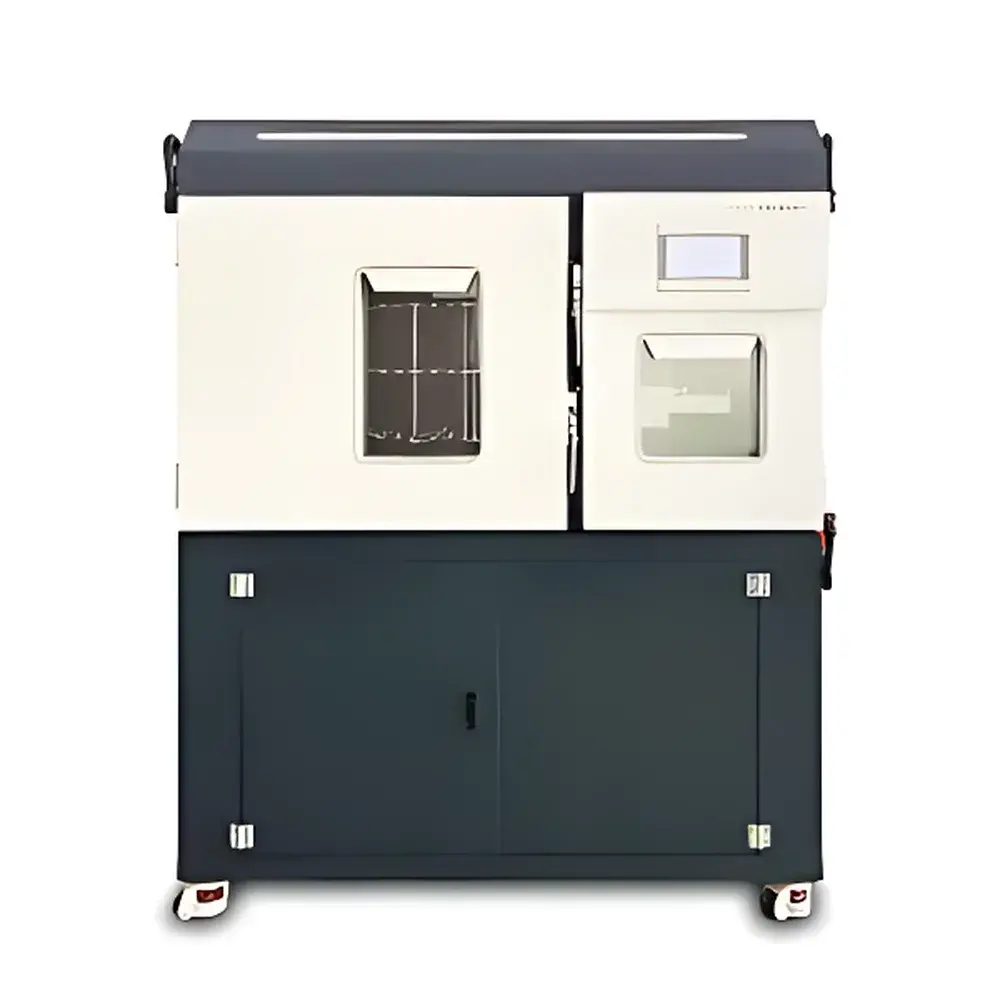
HUANKONG 4000A Automated Evaporation and Constant-Weight Analysis System
| Brand | HUANKONG |
|---|---|
| Origin | Shandong, China |
| Manufacturer Type | Direct Manufacturer |
| Country of Origin | China |
| Model | 4000A |
| Pricing | Available Upon Request |
Overview
The HUANKONG 4000A Automated Evaporation and Constant-Weight Analysis System is an integrated laboratory instrument engineered for precise, repeatable determination of total dissolved solids (TDS), moisture content, dry matter, ash residue, and suspended solids in environmental, food, pharmaceutical, and industrial samples. It implements gravimetric analysis based on standardized thermal evaporation followed by controlled cooling and sequential weighing—fully compliant with the fundamental principles of ASTM D5907, ISO 2561, USP <731>, and multiple Chinese national standards including GB/T 5750.13 (TDS in drinking water), GB/T 11901 (suspended solids in water), and GB/T 15265 (total dustfall in ambient air). Unlike manual or semi-automated workflows, the 4000A eliminates human intervention between drying, desiccation, and weighing steps by integrating a thermally isolated high-temperature evaporation chamber, a precision microbalance module, and a programmable sample handling mechanism—all housed within a single robust enclosure. This architecture minimizes mass drift caused by ambient temperature fluctuations, air currents, or mechanical transfer errors, thereby improving inter-batch reproducibility and reducing operator-induced variability.
Key Features
- Automated multi-step gravimetric workflow: programmed heating (up to 200 °C), forced-air cooling, desiccator-equivalent stabilization, and high-resolution weighing (0.01 mg resolution typical) without manual sample relocation.
- Modular sample carrier system supporting standard labware—including glass fiber filters (e.g., GF/F), porcelain crucibles, aluminum weighing dishes, stainless steel filter tubes, and borosilicate evaporation pans—configured for batch sizes up to 24 units per run.
- Thermally segregated dual-zone design: independent high-temp evaporation chamber (electrically insulated from balance cavity) and climate-stabilized weighing zone with active humidity control (<30% RH).
- Motorized lift barrier separating thermal and metrological zones ensures zero cross-contamination of heat transfer to the balance sensor during weighing cycles.
- Real-time safety monitoring: overtemperature cutoff (dual-stage thermal fuses), ground-fault circuit interruption (GFCI), door interlock, and audible/visual alerts for abnormal weight drift or chamber pressure deviation.
- GLP-compliant audit trail: timestamped event logging for all critical operations (heat ramp profiles, dwell times, balance calibration status, user logins, and error codes).
Sample Compatibility & Compliance
The 4000A accommodates aqueous, slurry, digested, and particulate-laden matrices across environmental monitoring (wastewater, surface water, airborne dust), agricultural testing (soil moisture, feed dry matter), and quality control labs (pharmaceutical excipients, food powders, polymer additives). It supports direct analysis of pre-filtered samples on certified filters per GB/T 11901 and EPA Method 160.2, as well as open-dish evaporation per GB/T 5750.13 and ISO 27827 for TDS quantification. All operational parameters—including temperature setpoints, hold durations, cooling thresholds, and convergence criteria for constant weight (±0.05 mg over two consecutive weighings at 30-min intervals)—are configurable to meet method-specific requirements under ISO/IEC 17025-accredited environments. The system’s firmware and data export structure align with FDA 21 CFR Part 11 readiness (electronic signatures, role-based access control, and immutable record retention).
Software & Data Management
Controlled via a dedicated Windows-based application with intuitive touchscreen interface, the system enables method-driven operation with customizable SOP templates. Each analytical run generates a structured XML dataset containing raw weight sequences, thermal profiles, environmental logs, and metadata (sample ID, operator, date/time, instrument serial number). Export formats include CSV (for LIMS integration), PDF analytical reports with digital signature fields, and encrypted SQLite databases for internal QA review. Audit trails are retained for ≥12 months and support forensic replay of any weighing cycle. Optional network connectivity allows centralized deployment in multi-instrument laboratories with remote diagnostics and firmware update capability.
Applications
- Determination of total dissolved solids (TDS) and total suspended solids (TSS) in potable, wastewater, and groundwater per GB/T 5750 and ISO 11923.
- Moisture and dry matter content analysis in food products, animal feed, and botanical extracts per AOAC 925.09 and GB 5009.3.
- Quantification of total dustfall and soluble salts in ambient air monitoring programs aligned with GB/T 15265 and EPA Method 201A.
- Residue-on-evaporation testing for solvents, injectables, and cleaning validation swabs in GMP-regulated facilities.
- Preparation of gravimetric standards for elemental analysis (e.g., ICP-MS calibration stock solutions requiring ultra-low blank containers).
FAQ
Does the 4000A comply with ISO/IEC 17025 requirements for accredited testing laboratories?
Yes—the system provides traceable calibration certificates for its integrated balance, full environmental logging, and electronic records meeting ISO/IEC 17025:2017 Clause 7.7 and Clause 8.4 requirements.
Can the system handle volatile organic compounds (VOCs) during evaporation without compromising accuracy?
The high-efficiency exhaust manifold with activated carbon filtration prevents VOC accumulation in the chamber and avoids condensation-related weighing artifacts; however, highly volatile analytes require method-specific validation per ISO 5667-3.
Is external desiccator use required before or after automated runs?
No—the built-in cooling and stabilization protocol replicates desiccator performance using controlled low-humidity airflow, eliminating need for off-instrument conditioning steps.
What maintenance intervals are recommended for long-term metrological stability?
Balance recalibration every 30 days (or per SOP), chamber cleaning after every 100 runs, and annual thermocouple verification against NIST-traceable reference standards.



