
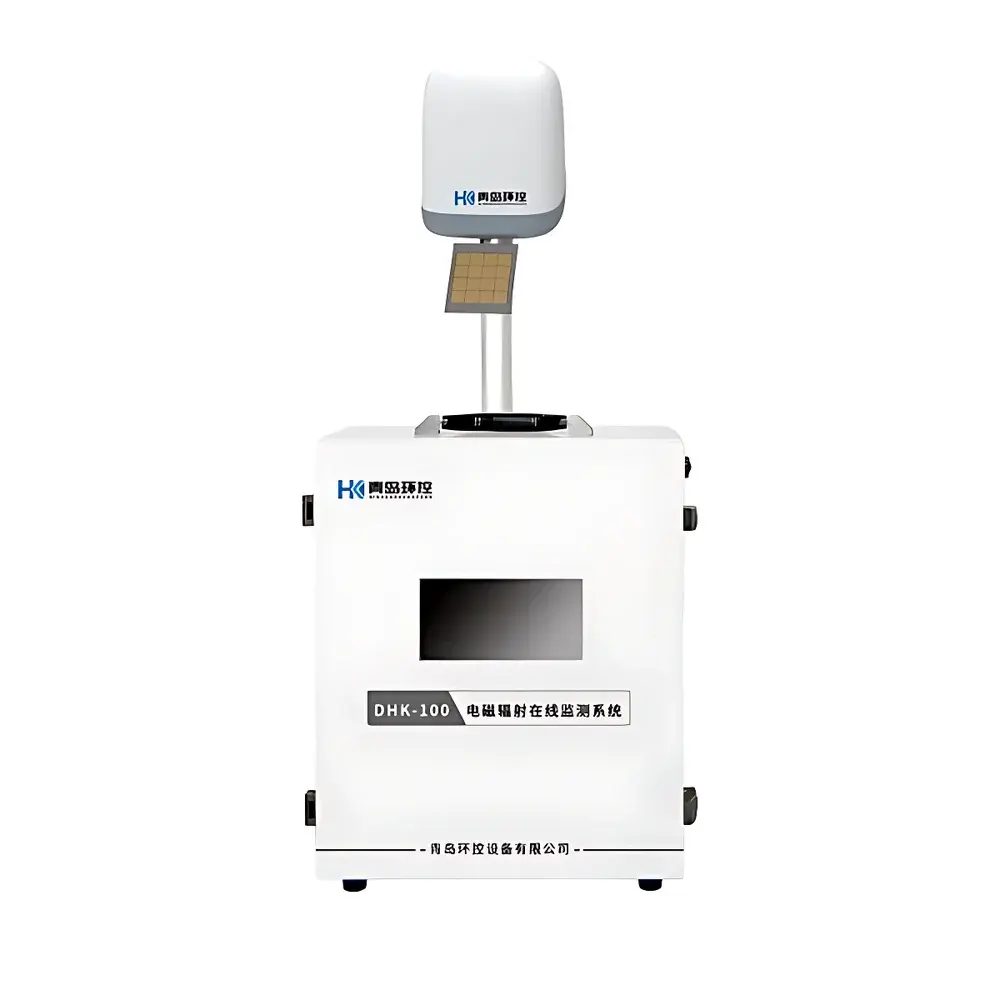
HUANKONG DHK-100 Electromagnetic Radiation Online Monitoring System
| Brand | HUANKONG |
|---|---|
| Origin | Shandong, China |
| Manufacturer Type | Original Equipment Manufacturer (OEM) |
| Country of Origin | China |
| Model | DHK-100 |
| Frequency Range | 1 Hz – 6 GHz (typical operational coverage per probe configuration) |
| Measurement Accuracy | ±0.5 dB (calibrated reference conditions) |
| Electric Field Strength Range | 0.1 V/m – 1000 V/m (dependent on probe selection) |
Overview
The HUANKONG DHK-100 Electromagnetic Radiation Online Monitoring System is a purpose-built, continuous-duty environmental monitoring platform engineered for long-term, unattended measurement of electromagnetic field (EMF) strength in compliance with national and internationally aligned regulatory frameworks. Operating on the principle of broadband isotropic field sensing—utilizing triaxial orthogonal electric and magnetic field probes—the system captures time-synchronized E-field (V/m) and H-field (A/m) data across defined frequency bands. Its architecture supports real-time spectral assessment within configurable sub-bands (e.g., 50 Hz–100 kHz for power-frequency fields; 100 kHz–6 GHz for RF emissions), enabling conformance verification against exposure limits specified in GB8702-2014 and supplementary technical guidance documents including HJ972–2018 and HJ1151–2020. Designed for deployment in heterogeneous environments—including substations, high-voltage transmission corridors, 5G base station perimeters, and urban ambient monitoring networks—the DHK-100 integrates hardware resilience with traceable metrology, ensuring data integrity under variable climatic and electromagnetic interference conditions.
Key Features
- Triaxial isotropic probe architecture with automatic orientation compensation, delivering vector-summed field magnitude without manual alignment
- Modular probe interface supporting hot-swappable sensor heads: low-frequency (LF) field mill probes for DC/AC high-voltage environments; broadband dipole-based RF probes for 100 kHz–6 GHz coverage
- IP67-rated outdoor enclosure with UV-stabilized polycarbonate housing, integrated lightning surge protection (IEC 61000-4-5 Level 4), and anti-vandal mechanical locking
- Hybrid power architecture: dual-input capability (12–48 VDC primary + optional solar panel input with MPPT charge controller), extended runtime via sealed lead-acid or LiFePO₄ battery bank (72 h autonomy at full duty cycle)
- Onboard environmental sensing: calibrated temperature (±0.3 °C), relative humidity (±2 %RH), GPS geolocation (±2.5 m CEP), and barometric pressure (±0.1 hPa)
- Real-time threshold alerting with user-defined alarm levels per frequency band, configurable hysteresis, and multi-channel notification (SMS/email/SNMP trap)
- Secure data transmission via TLS 1.2-encrypted MQTT or HTTPS protocols; optional DTLS support for constrained-edge deployments
Sample Compatibility & Compliance
The DHK-100 is validated for continuous operation in electromagnetic environments characterized by complex modulation schemes (e.g., OFDM in 5G NR, TDMA in legacy cellular, PWM harmonics from inverters). Probe calibration certificates are traceable to CNAS-accredited laboratories (ISO/IEC 17025), with annual recalibration intervals recommended per HJ/T 10.2–1996. The system complies with Chinese national standards GB8702-2014 (public and occupational exposure limits), HJ681–2013 (AC transmission line monitoring methodology), and HJ1151–2020 (5G-specific measurement procedures). While not certified to EU RED Directive 2014/53/EU or FCC OET Bulletin 65, its measurement methodology aligns with IEC 62110:2019 (measurement of electric and magnetic fields from AC power systems) and IEEE Std 1308–2013 (recommended practice for EMF measurements near wireless communication sites).
Software & Data Management
The centralized Data Management Platform operates as a web-accessible SCADA-grade application hosted on hardened Linux servers (RHEL 8.x or Ubuntu 22.04 LTS), supporting role-based access control (RBAC) and audit logging compliant with GLP principles. All raw measurements are timestamped with NTP-synchronized UTC and stored in PostgreSQL databases with automated daily partitioning and WAL archiving. The platform provides ISO/IEC 17025-aligned uncertainty estimation per measurement point, generates PDF reports conforming to HJ/T 10.3–1996 formatting requirements, and exports CSV/NetCDF datasets for third-party analysis. Audit trails record all configuration changes, user logins, and alarm acknowledgments—fully compatible with FDA 21 CFR Part 11 electronic signature requirements when deployed in regulated utility or telecom infrastructure audits.
Applications
- Regulatory compliance monitoring for power utilities: real-time assessment of magnetic flux density (µT) and electric field strength (kV/m) adjacent to 220 kV–1000 kV AC/±800 kV HVDC transmission infrastructure
- Telecom site licensing and post-deployment verification: spatially resolved RF field mapping around macrocell and small-cell installations operating in n78 (3.5 GHz), n41 (2.6 GHz), and n79 (4.9 GHz) bands
- Environmental impact assessment (EIA) baseline studies and long-term trend analysis for urban electromagnetic background noise (0.1–30 MHz AM/LW broadcast, 88–108 MHz FM, 470–790 MHz DTT)
- Industrial hygiene surveillance in manufacturing facilities utilizing induction heating, RF plasma etching, or microwave drying equipment
- Public information kiosks: front-end display integration enables real-time visualization of measured values versus GB8702-2014 reference levels, with color-coded status indicators and historical trend graphs
FAQ
What frequency bands does the DHK-100 support out-of-the-box?
The standard configuration covers 1 Hz–6 GHz via interchangeable probes; LF field mill probes handle DC–100 kHz, while calibrated broadband antennas cover 100 kHz–6 GHz. Band-specific firmware profiles are preloaded.
Is remote firmware update supported?
Yes—over-the-air (OTA) updates are delivered via signed binary packages through the secure management portal, with rollback capability and SHA-256 integrity verification.
How is measurement traceability maintained?
Each probe carries a unique serial number linked to its factory calibration certificate (including amplitude and phase response curves); calibration metadata is embedded in every data packet transmitted to the platform.
Can the system integrate with existing SCADA or GIS platforms?
Yes—via RESTful API, Modbus TCP, or OPC UA interfaces; georeferenced measurement points can be exported to ESRI ArcGIS or QGIS in GeoJSON format.
What is the minimum reporting interval for continuous monitoring?
Configurable down to 1-second sampling with 1-minute averaged outputs; raw waveform capture (for FFT analysis) is available on-demand per probe channel.
Related Products







