
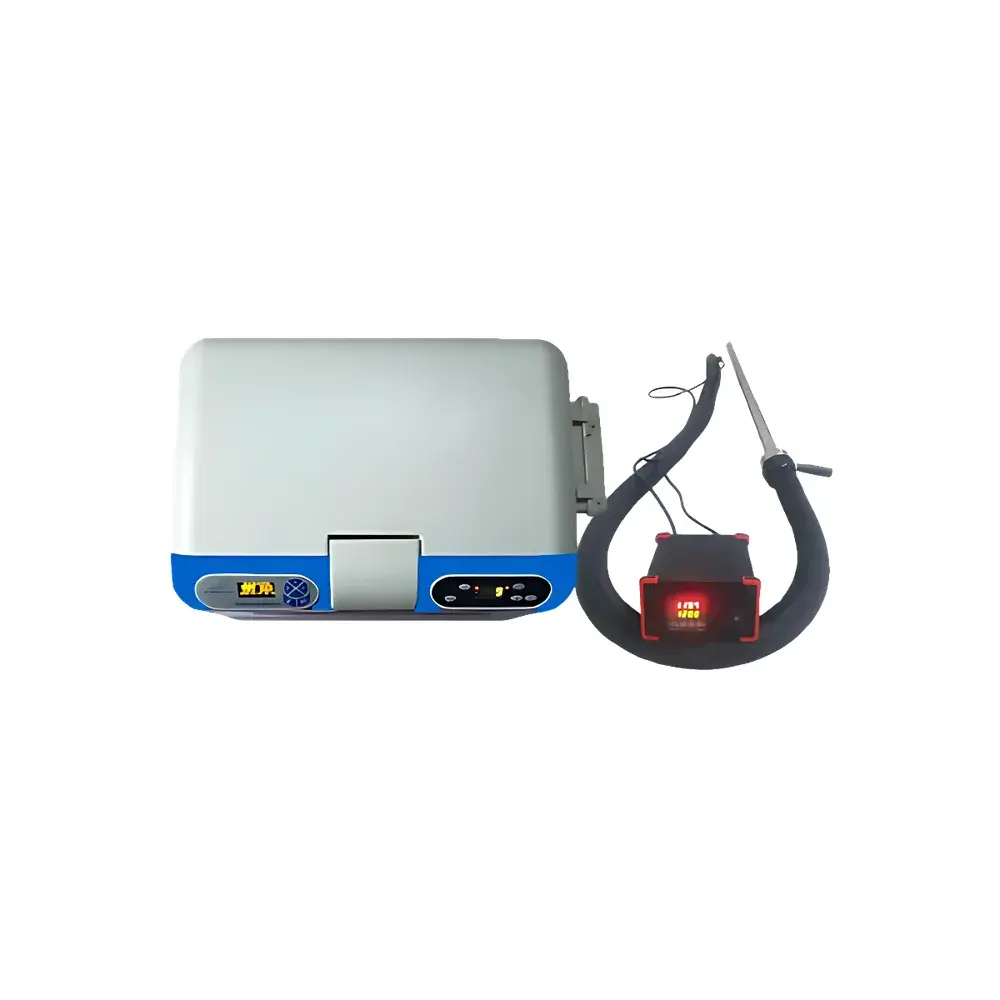
HUANKONG GHK-2000L HCl Emission Sampling System
| Brand | HUANKONG |
|---|---|
| Origin | Shandong, China |
| Manufacturer Type | Direct Manufacturer |
| Country of Origin | China |
| Model | GHK-2000L |
| Instrument Category | Flue Gas Sampling System |
| Target Analyte | Hydrogen Chloride (HCl) |
| Compliance Standards | HJ 547–2017, HJ 548–2016, HJ 549–2016 |
| Sampling Configuration | Heated Probe + PTFE Filter Cartridge + Temperature-Controlled Absorption Bottles + Condensation Management Unit |
| Heating Range | 0–60 °C |
| Temperature Control Accuracy | ±2 °C |
| Absorption Bottle Capacity | 6 positions (including blank and sample) |
| Filter Medium | Cellulose Acetate Microporous Membrane |
| Tubing Material | Fluorosilicone Insulated Tubing with Anti-Adsorption Lining |
| Internal Probe Liner | PTFE (non-adsorptive) |
| Filter Housing & Support Mesh | PTFE-coated |
Overview
The HUANKONG GHK-2000L HCl Emission Sampling System is a purpose-built, field-deployable flue gas sampling instrument engineered for the quantitative collection of hydrogen chloride (HCl) from stationary emission sources—such as industrial boilers, waste incinerators, chemical process stacks, and metallurgical furnaces. It operates on the principle of isokinetic or controlled-flow sampling, integrating active aspiration with precisely regulated thermal management to prevent condensation, adsorption loss, and phase separation of gaseous HCl during transit. Unlike generic gas samplers, the GHK-2000L addresses the unique physicochemical challenges posed by HCl: its high polarity, strong surface affinity, tendency to form aerosols at low temperatures, and co-presence with particulate chlorides and acidic condensates. The system complies with three key Chinese environmental monitoring standards—HJ 547–2017 (iodometric titration for chlorine), HJ 548–2016 (silver nitrate titration for HCl), and HJ 549–2016 (ion chromatography)—ensuring methodologically traceable data acquisition suitable for regulatory reporting and compliance verification.
Key Features
- Modular, integrated architecture combining vacuum pump, mass-flow-controlled sampling circuit, heated PTFE-lined probe (0–60 °C), PTFE filter cartridge with active heating, fluorosilicone-insulated transfer lines, thermostatically stabilized absorption bottle manifold, and dual-mode condensation control (air/liquid/thermal bath).
- Non-adsorptive fluid path: Entire sample train—from probe tip through filter support mesh to absorption bottle inlet—is constructed of inert polytetrafluoroethylene (PTFE), minimizing HCl retention and memory effects.
- Heated filter housing enables thermally assisted desorption of particle-bound chloride species, converting adsorbed or condensed HCl into measurable gaseous form prior to absorption—critical for accurate total HCl quantification per HJ 549–2016.
- Precision temperature regulation: Digital PID controllers maintain setpoint stability within ±2 °C across all heated zones (probe, filter, transfer line), validated under variable ambient conditions from −20 °C to +45 °C.
- Multi-environment absorption chamber: Six-position thermostatic condensation box accommodates both sample and procedural blank absorption bottles, supporting air-bath, liquid-bath, or heated-bath operation to match stack temperature profiles and prevent premature acid deposition.
- Optimized filtration: 0.45 µm cellulose acetate microporous membrane removes particulate chloride interferences without degrading HCl recovery—validated against ISO 10156 and EPA Method 26A performance criteria.
Sample Compatibility & Compliance
The GHK-2000L is validated for use in flue gas matrices containing up to 20 % O₂, <15 % CO₂, <10 % H₂O (v/v), and particulate loadings ≤100 mg/m³. It supports sampling at flow rates from 0.3 to 1.0 L/min, with isokinetic nozzle options available for velocity-matched extraction. All operational parameters—including flow rate, temperature setpoints, sampling duration, and probe insertion depth—are documented in accordance with GLP principles and align with data integrity requirements of CNAS-CL01:2018 (equivalent to ISO/IEC 17025). Raw output data (flow logs, temperature traces, pump runtime) are timestamped and exportable for audit-ready recordkeeping. While not FDA 21 CFR Part 11 certified (as it is a field sampling device, not a clinical or pharmaceutical analyzer), its configuration meets the procedural rigor expected for environmental compliance under China’s Ministry of Ecology and Environment (MEE) enforcement frameworks.
Software & Data Management
The GHK-2000L operates via embedded microcontroller firmware with local LCD interface—no external PC dependency required for standard operation. Real-time parameters (instantaneous flow, probe/filter/bath temperatures, cumulative sampling volume) are displayed and logged at 10-second intervals to internal non-volatile memory (≥10,000 records). Data export is supported via USB-C interface in CSV format, compatible with LIMS platforms and statistical analysis tools (e.g., R, Python pandas, Minitab). Firmware supports user-defined calibration tables for flow sensor drift compensation and includes password-protected configuration lockout to preserve method integrity during multi-user deployments.
Applications
- Regulatory stack testing for HCl emissions from coal-fired power plants and cement kilns (per GB 16297–1996 and DB37/2375–2013).
- Pre-compliance screening of waste-to-energy facilities prior to continuous emission monitoring system (CEMS) integration.
- Method validation studies comparing ion chromatography (HJ 549–2016) vs. titrimetric approaches (HJ 548–2016) under identical sampling conditions.
- Source apportionment investigations where HCl speciation (gaseous vs. particulate chloride) informs process optimization in chlor-alkali or PVC manufacturing units.
- Field intercomparison campaigns between portable samplers and reference-grade FTIR or QCL analyzers.
FAQ
Does the GHK-2000L support automated isokinetic sampling?
Yes—when paired with optional pitot tube and differential pressure sensor modules, the system calculates and maintains isokinetic flow based on real-time stack velocity profiles.
Can absorption bottles be replaced mid-sampling without interrupting thermal control?
Yes—the six-position condensation chamber allows hot-swap capability; temperature stabilization resumes within 90 seconds after bottle replacement.
Is the cellulose acetate filter compatible with alkaline absorption solutions (e.g., NaOH or Na₂CO₃)?
Yes—cellulose acetate exhibits no measurable degradation or leaching when exposed to 0.1 M NaOH for durations up to 24 hours, as verified per HJ 549–2016 protocol.
What maintenance intervals are recommended for long-term field deployment?
PTFE probe liner inspection every 200 hours; flow sensor recalibration every 6 months or after 500 sampling cycles; pump diaphragm replacement every 12 months under continuous operation.
Does the system provide electronic audit trails for QA/QC documentation?
Yes—each sampling event generates a timestamped metadata file including operator ID, calibration certificate ID, ambient conditions, and deviation flags (e.g., temperature excursion >±3 °C), compliant with MEE Document No. 122–2020.







