
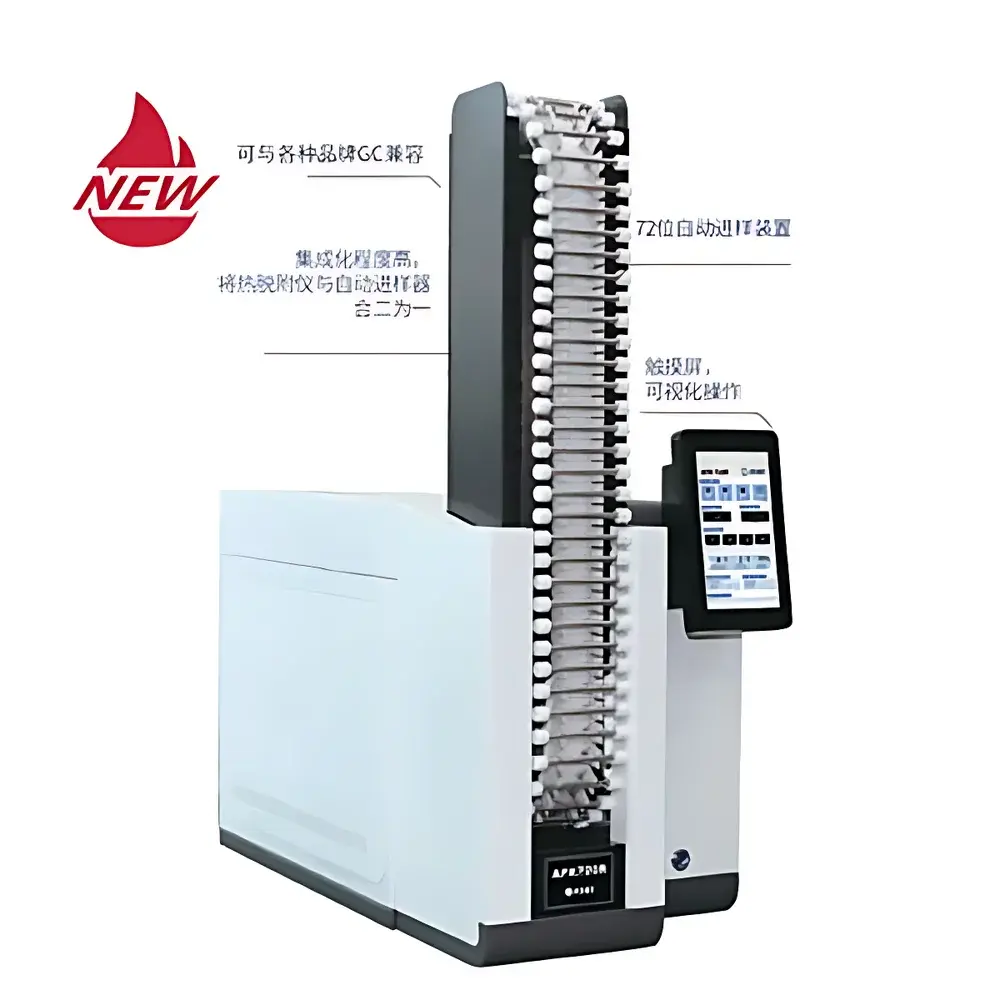
HUANKONG APK720R Fully Automated Two-Stage Thermal Desorber
| Brand | HUANKONG |
|---|---|
| Origin | Shandong, China |
| Manufacturer Type | Direct Manufacturer |
| Product Category | Domestic |
| Model | APK720R |
| Instrument Type | Two-Stage Thermal Desorber |
| Automation Level | Fully Automated |
| Valve Injection Zone Temperature Range | 50–400 °C |
| Transfer Line Temperature Range | Ambient to 200 °C |
| Cold Trap Temperature Range | −30 °C |
| Sample Capacity | 72 adsorption tubes |
| Desorption Recovery Efficiency | High |
| Cooling Mechanism | Peltier-based cryofocusing (no liquid cryogens required) |
| Compatibility | GC systems from Agilent, Thermo Fisher, Shimadzu, PerkinElmer, and others |
| Regulatory Alignment | Designed for compliance with EPA TO-14A, TO-15, ASTM D6196, ISO 16017-1, and EU EN 13670 |
Overview
The HUANKONG APK720R Fully Automated Two-Stage Thermal Desorber is an integrated sample introduction platform engineered for high-sensitivity, quantitative analysis of volatile and semi-volatile organic compounds (VOCs and SVOCs) in environmental, occupational health, and industrial hygiene applications. It operates on the principle of two-stage thermal desorption: first, analytes are thermally released from sorbent-packed tubes under controlled inert gas flow; second, they are cryogenically focused in a Peltier-cooled cold trap at −30 °C before rapid, narrow-band injection into a gas chromatograph (GC). This dual-stage process enables trace-level enrichment—down to sub-ppt (ng/m³) concentrations—while minimizing breakthrough, carryover, and thermal degradation. Unlike single-stage desorbers, the APK720R’s closed-loop heating architecture ensures precise thermal ramping across all zones (valve, transfer line, and cold trap), preserving analyte integrity and maximizing reproducibility across sequential runs.
Key Features
- Fully automated 72-position carousel for standard 6 mm OD × 89 mm sorbent tubes (e.g., Tenax TA, Carbopack B/C, Carboxen 1000), supporting unattended overnight operation and high-throughput laboratory workflows.
- Peltier-based cold trap capable of stable −30 °C operation without liquid nitrogen or compressed CO₂, reducing operational cost, safety risk, and infrastructure dependency.
- Independent temperature control for three critical zones: valve manifold (50–400 °C), heated transfer line (ambient to 200 °C), and cold trap—each calibrated and validated per ISO/IEC 17025 traceable procedures.
- Integrated GC interface compatible with split/splitless inlets across major GC platforms; supports both electronic pressure control (EPC) and mechanical carrier gas regulation.
- High-resolution color LCD touchscreen with intuitive icon-driven navigation, method storage (≥100 user-defined methods), and real-time system status monitoring including temperature profiles, valve actuation logs, and trap cooling performance.
- Optional integration with the APK2600 gas bag autosampler for direct analysis of Tedlar® (polyvinyl fluoride) and FlexFoil® bags—enabling field-collected air samples to be processed without manual transfer or dilution errors.
Sample Compatibility & Compliance
The APK720R is validated for use with EPA Method TO-14A (determination of VOCs in ambient air), TO-15 (sum of C2–C12 hydrocarbons), and Compendium Method IP-10 (indoor air quality). It meets instrumental requirements outlined in ASTM D6196 (selection of sorbents for air sampling), ISO 16017-1 (indoor air—determination of VOCs), and EN 13670 (workplace air—sampling and analysis of VOCs). Sorbent tube configurations—including multi-bed traps (e.g., Carbopack X + Carbosieve SIII + Carboxen 1000)—are fully configurable to extend linear dynamic range and improve recovery of polar, low-boiling, and reactive species (e.g., formaldehyde, acetaldehyde, isoprene). All thermal protocols adhere to GLP data integrity principles, with audit-trail-enabled method parameters and run history stored locally and exportable via USB or Ethernet.
Software & Data Management
The embedded firmware supports full method definition—including pre-desorption bake-out, primary desorption ramp rate, cold trap focusing time/temperature, analytical trap desorption pulse width, and post-run cleaning cycles. Raw instrument logs (temperature setpoints, valve timing, pressure events) are timestamped and stored with cryptographic hashing to prevent tampering. Data export conforms to ASTM E1382-compliant CSV and XML formats, ensuring seamless ingestion into LIMS platforms and chromatography data systems (CDS) such as OpenLab CDS, Chromeleon, and Analyst. Remote diagnostics and firmware updates are supported via secure HTTPS connection; no cloud-hosted data processing is performed—ensuring full data sovereignty.
Applications
The APK720R serves as a core front-end for regulatory and research-grade VOC analysis in multiple domains: ambient air monitoring networks (e.g., urban smog studies, background station profiling), indoor air quality assessments (schools, hospitals, office buildings), industrial emissions verification (fugitive source testing per EPA Method 325), and product emission screening (building materials, furniture, automotive interiors per CA Section 01350 or ISO 16000-9). Its ability to resolve complex mixtures—including BTEX (benzene, toluene, ethylbenzene, xylenes), PAMS (Photochemical Assessment Monitoring Stations) compounds, halogenated solvents, and oxygenated VOCs—makes it suitable for source apportionment modeling and toxicological exposure assessment.
FAQ
Does the APK720R support EPA Method TO-15 validation?
Yes—the system meets all hardware and procedural specifications defined in TO-15, including minimum trapping temperature (≤−10 °C), maximum desorption time (≤5 min), and requirement for internal standard addition prior to desorption.
Can custom sorbent beds be installed in the cold trap?
Yes—cold trap cartridges are user-replaceable and available in standard and application-specific configurations (e.g., graphitized carbon black for C2–C5 aliphatics, silica gel for polar carbonyls).
Is method transfer possible between different GC vendors?
Yes—thermal desorption parameters (temperatures, timings, flow rates) are vendor-agnostic; only inlet configuration (e.g., split ratio, liner type) requires GC-specific optimization.
What maintenance intervals are recommended for routine operation?
Valve seals and O-rings should be inspected every 500 runs; cold trap frits cleaned quarterly; and system performance verified monthly using certified VOC calibration standards (e.g., Supelco TO-14/TO-15 mix).




