
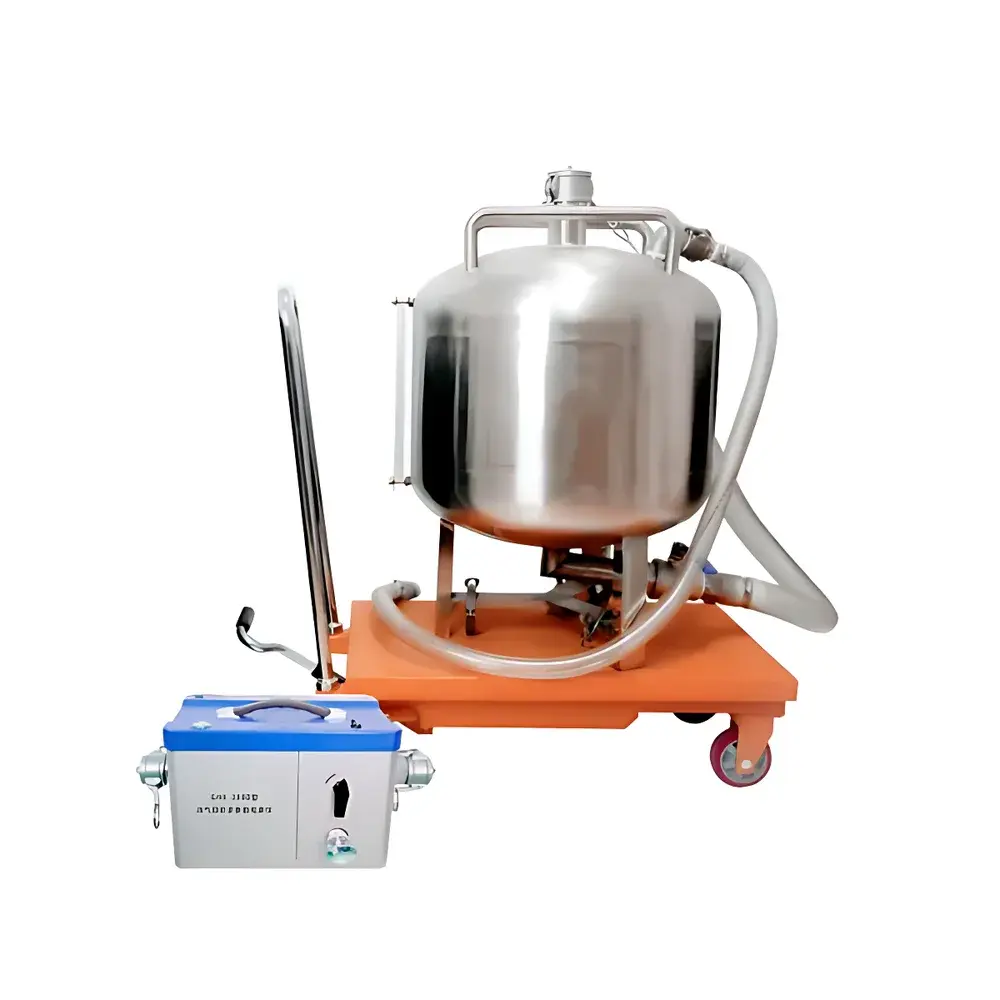
HUANKONG GHK-2600 Multi-Parameter Vapor Recovery Testing Instrument
| Brand | HUANKONG |
|---|---|
| Origin | Shandong, China |
| Manufacturer Type | Direct Manufacturer |
| Country of Origin | China |
| Model | GHK-2600 |
| Pricing | Available Upon Request |
| Explosion-Proof Certification | Certified per GB 3836.1/GB 3836.4 (Ex ib IIB T4 Gb) |
| Compliance Standard | GB 20952–2020 Emission Standard for Atmospheric Pollutants from Gasoline Filling Stations |
| Environmental Sensors | Integrated temperature, relative humidity, and barometric pressure measurement |
| Connectivity | Bluetooth, USB-C, USB-A (data export & firmware update), U disk interface |
| Positioning | Built-in BeiDou GNSS module + manual coordinate entry |
| Power Options | AC adapter or optional rechargeable Li-ion battery (≥8 h runtime) |
| Control Interface | Intrinsically safe explosion-proof handheld controller (wireless, ATEX/IECEx-equivalent certified for Zone 1/21) |
Overview
The HUANKONG GHK-2600 Multi-Parameter Vapor Recovery Testing Instrument is a field-deployable, intrinsically safe analytical platform engineered for regulatory compliance verification of gasoline vapor recovery systems at retail fueling stations. It operates on established physical measurement principles: differential pressure decay for system tightness (leak detection), calibrated orifice-based flow resistance assessment for liquid resistance (liquid line pressure drop), and mass flow–based volumetric ratio calculation for vapor-to-liquid (V/L) ratio evaluation. Designed in strict alignment with the technical requirements of GB 20952–2020 — China’s national standard governing atmospheric pollutant emissions from gasoline filling stations — the GHK-2600 enables quantitative, repeatable verification of three critical performance parameters: system密闭性 (system integrity), 液阻 (liquid line hydraulic resistance), and 气液比 (vapor-to-liquid ratio). Its architecture integrates real-time environmental metrology (temperature, relative humidity, ambient pressure) to support standardized correction of flow and pressure readings per GB 20952–2020 Annex B protocols.
Key Features
- Intrinsically safe design certified to GB 3836.1 and GB 3836.4 (Ex ib IIB T4 Gb), permitting operation in classified hazardous locations including Zone 1 (gas) and Zone 21 (combustible dust) environments common at fueling facilities.
- Dual-mode operation: supports both manual field testing of standalone vapor recovery systems and comparative validation against permanently installed online monitoring systems (e.g., for V/L ratio and static pressure drift).
- Self-diagnostic capability for instrument-level airtightness verification prior to field deployment, ensuring measurement traceability and eliminating false negatives due to internal leakage.
- Wireless human-machine interface via explosion-proof handheld controller with OLED display, tactile keypad, and encrypted bidirectional communication — enabling remote configuration, real-time parameter viewing, and on-device pass/fail decision logic per GB 20952–2020 thresholds.
- Multi-channel data acquisition and storage: records timestamped test sequences with environmental metadata, supports local retrieval via controller UI, and enables bulk export via USB flash drive (FAT32 formatted) or direct USB-C cable connection.
- Integrated BeiDou satellite positioning module provides geotagged test records; latitude/longitude may also be manually entered where GNSS signal is obstructed (e.g., underground tank areas).
- Type-C universal charging interface with intelligent power management; optional high-capacity lithium-ion battery delivers ≥8 hours of continuous operation under mixed-use conditions (pressure cycling, wireless comms, sensor polling).
Sample Compatibility & Compliance
The GHK-2600 is validated for use across all common gasoline dispensing infrastructure configurations, including Stage II vapor recovery systems (vacuum-assisted and passive), submerged fill systems, and modern Stage III closed-loop vapor return networks. It interfaces directly with standard API RP 1621-compliant test ports and ASTM D7720-specified sampling manifolds. All measurement algorithms adhere to the procedural definitions, calibration intervals, and uncertainty allowances stipulated in GB 20952–2020. The instrument’s intrinsic safety certification satisfies jurisdictional requirements for installation and operation within Class I, Division 1 / Zone 1 hazardous locations as defined by GB 50160 and CNEX guidelines. Data output formats comply with provincial ecological environment monitoring center reporting templates (e.g., Shandong MEP Form VR-2022).
Software & Data Management
Field-collected datasets are structured in CSV format with ISO 8601 timestamps, WGS-84 coordinates, and SI-unit-aligned values (kPa, °C, %RH, kPa·s/m³, L/L). Firmware supports over-the-air updates via USB-C, with version-controlled release packages signed using SHA-256 cryptographic hashing. Audit trails record all configuration changes, calibration events, and user logins (role-based access via PIN). While not FDA 21 CFR Part 11 compliant by default, optional firmware modules enable electronic signature capture, immutable audit logs, and user authentication — facilitating integration into GLP/GMP-aligned environmental QA workflows upon customer request and site-specific validation.
Applications
- Regulatory inspection: Routine compliance audits conducted by municipal ecological environment bureaus per GB 20952–2020 enforcement schedules.
- Environmental impact assessment (EIA): Pre-commissioning verification for new, renovated, or expanded fueling stations during project approval phases.
- Commissioning & acceptance testing: Final validation of vapor recovery system installation integrity prior to operational handover.
- Preventive maintenance diagnostics: Trend analysis of liquid resistance growth or V/L ratio deviation to identify failing vapor pumps, clogged canisters, or degraded hose permeability.
- Third-party verification: Independent environmental consulting firms performing due diligence for financial institutions or corporate sustainability programs.
FAQ
Does the GHK-2600 meet international explosion protection standards such as ATEX or IECEx?
It complies with Chinese national explosion-proof standards GB 3836.1 and GB 3836.4 (Ex ib IIB T4 Gb), which are technically equivalent to IEC 60079-0 and IEC 60079-11 for Zone 1 applications. Formal ATEX or IECEx certification requires separate EU/UKCA or global conformity assessment — contact HUANKONG for region-specific certification pathways.
Can test data be imported into LIMS or enterprise environmental management platforms?
Yes — CSV exports contain structured fields compatible with common LIMS ingestion protocols. Custom API integration or middleware adapters are available under NDA for enterprise-scale deployments.
Is calibration traceable to national metrological institutes?
All factory calibrations are performed using reference standards accredited to CNAS (China National Accreditation Service) under ISO/IEC 17025, with certificates listing measurement uncertainty budgets per parameter.
What is the recommended recalibration interval?
Annual recalibration is advised per GB 20952–2020 Clause 8.3. Field verification of instrument airtightness must be performed before each daily test session.
Does the device support remote firmware updates over cellular networks?
No — firmware updates require physical USB-C or USB-A connection to ensure integrity verification and prevent unauthorized modification.





