
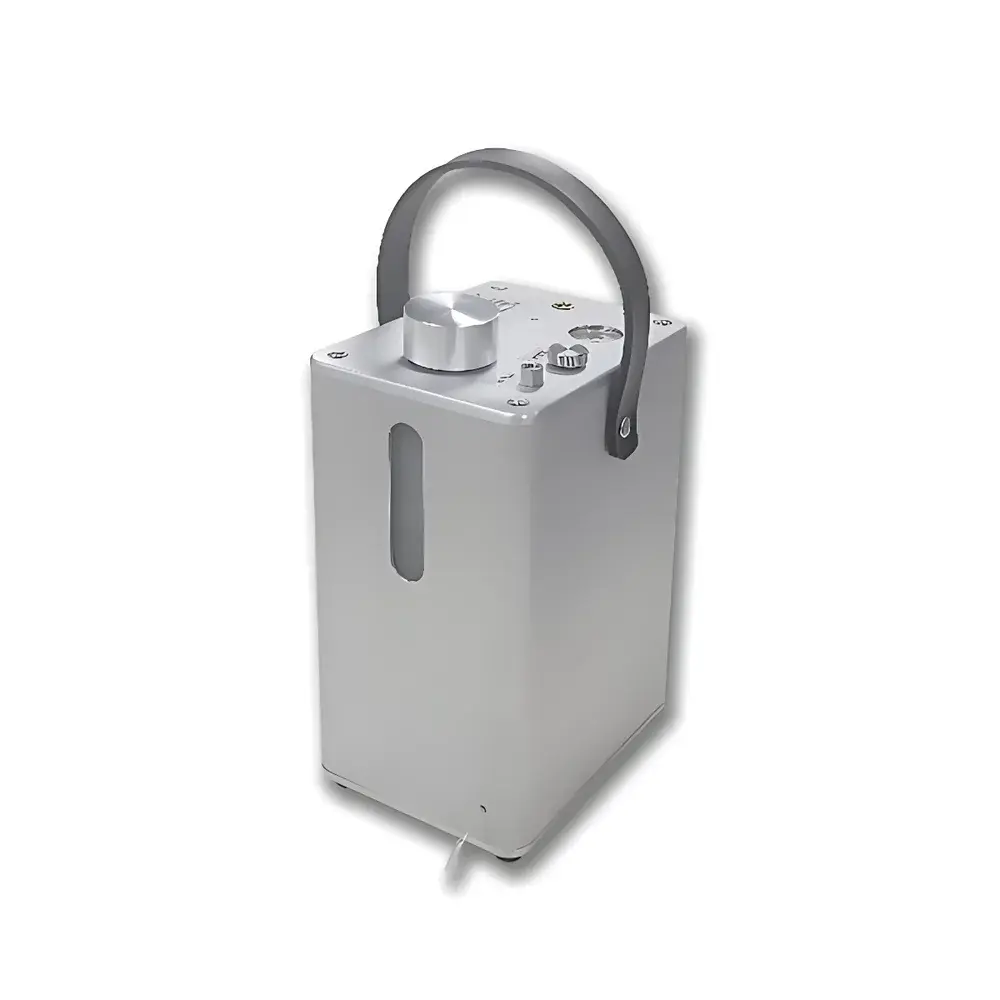
HUANKONG PF-300 Portable PEM Hydrogen Generator
| Brand | HUANKONG |
|---|---|
| Origin | Shandong, China |
| Manufacturer Type | Direct Manufacturer |
| Model | PF-300 |
| Hydrogen Generation Principle | Pure Water Electrolysis via Proton Exchange Membrane (PEM) |
| Output Flow Rate | 0–100 mL/min |
| Hydrogen Purity | ≥99.999% |
| Maximum Output Pressure | 3 MPa |
| Construction Materials | Titanium & 316L Stainless Steel Pressure Components |
| Power Supply | DC Input (Voltage/Current Specifications Configurable per Mobile Power Unit) |
| Gas Separation | Integrated PEM-based H₂/O₂ Membrane Separation |
| Safety Features | Auto-pressure Cutoff, High-Integrity Swagelok®-Type Fittings, Overpressure Relief Valve |
| Moisture Management | High-Pressure Gas-Liquid Separator (No Desiccant or Maintenance Required) |
Overview
The HUANKONG PF-300 is a compact, portable hydrogen generator engineered for field-deployable and benchtop applications requiring ultra-high-purity hydrogen gas at regulated pressure and flow. It employs proton exchange membrane (PEM) electrolysis of deionized water—eliminating the need for alkaline electrolytes, corrosive chemicals, or external drying media. Unlike conventional alkaline or solid polymer electrolyte systems, the PF-300 integrates a DuPont™ Nafion™-based PEM stack with platinum-group metal catalysts on both anode and cathode electrodes, enabling selective hydrogen ion conduction and complete electrochemical separation of H₂ and O₂ within the cell. This architecture ensures continuous generation of hydrogen with purity ≥99.999% (5.0 grade), meeting ASTM D7606–22 and ISO 8573-1 Class 1 requirements for instrumental gas supply in analytical applications such as GC-FID, portable NMHC analyzers, and hydrogen fueling of small-scale metal hydride storage units. The system delivers hydrogen at pressures up to 3 MPa (435 psi), directly compatible with commercial 100–300 bar metal hydride cylinders and low-volume pressurized reservoirs—without intermediate compression stages.
Key Features
- PEM-based electrolysis using ultrapure water (≥15 MΩ·cm resistivity) as sole feedstock—no KOH, no consumables, no chemical handling.
- Integrated high-pressure gas-liquid separator eliminates need for desiccants, traps, or maintenance-intensive dryers.
- All wetted and pressure-retaining components fabricated from titanium and ASTM A240 316L stainless steel—rated for continuous operation at 3 MPa with fatigue-resistant sealing.
- Intelligent pressure regulation: real-time monitoring via piezoresistive transducer; automatic electrolyzer shutdown upon reaching user-set pressure threshold (default 3 MPa).
- DC power architecture supports integration with lithium-ion mobile power stations (e.g., 24 V / 10 A nominal input), enabling true off-grid operation in remote sampling or emergency response scenarios.
- Zero baseline drift in GC-FID applications due to consistent purity, absence of hydrocarbon impurities (<0.1 ppm total HC), and negligible oxygen crossover (<5 ppm O₂).
Sample Compatibility & Compliance
The PF-300 is designed for use with analytical instruments requiring carrier or fuel gas meeting stringent purity specifications—including gas chromatographs equipped with flame ionization detectors (GC-FID), portable non-methane hydrocarbon (NMHC) analyzers, and laboratory-scale hydrogen storage validation rigs. Its output complies with ISO 8573-1:2010 Class 1 for particulate, water, and oil content, and satisfies USP and EP 2.5.27 criteria for pharmaceutical-grade hydrogen. While not certified to UL/CE for standalone medical or industrial process use, the unit adheres to IEC 61000-6-3 (EMC emissions) and IEC 61000-6-2 (immunity) standards. All safety-critical hardware—including pressure relief valves, burst discs, and leak-tested fittings—meets ASME B31.8 and PED 2014/68/EU design margins when installed per manufacturer torque and alignment protocols.
Software & Data Management
The PF-300 operates in fully autonomous mode without embedded firmware or digital interface. Pressure setpoint, runtime status, and fault indicators are communicated via analog LED array and mechanical pressure gauge—ensuring electromagnetic compatibility in RF-sensitive environments (e.g., near NMR or mass spectrometers). For traceability in GLP/GMP-regulated workflows, optional analog-to-digital converter modules (sold separately) enable 4–20 mA pressure and current output signals, compatible with SCADA, LabVIEW™, or DeltaV™ DCS platforms. Audit trails for pressure events and runtime hours can be logged externally via connected data acquisition systems—supporting FDA 21 CFR Part 11 compliance when paired with validated electronic record software.
Applications
- Fuel gas supply for portable and benchtop GC-FID systems used in environmental air monitoring (e.g., EPA Method TO-15, ASTM D6420).
- On-site recharging of low-capacity metal hydride storage cartridges (e.g., FeTi-, LaNi₅-based) in field-deployable hydrogen sensors and calibration rigs.
- Carrier gas source for micro-GC and MEMS-based hydrogen sensors requiring stable 99.999% H₂ at ≤100 mL/min and ≥2 MPa delivery pressure.
- Lab-scale validation of hydrogen permeation through polymeric membranes and catalytic reformer effluent conditioning.
- Replacement for high-pressure hydrogen cylinders in ISO-classified cleanrooms where cylinder logistics and residual O₂ risk are operationally prohibitive.
FAQ
What type of water is required for optimal operation?
Deionized water with resistivity ≥15 MΩ·cm and total organic carbon (TOC) <10 ppb is mandatory. Tap, distilled, or RO-only water will cause rapid PEM fouling and irreversible performance loss.
Can the PF-300 be used continuously for >8 hours per day?
Yes—thermal management and duty-cycle control allow uninterrupted operation under rated load (≤100 mL/min at 3 MPa) provided ambient temperature remains between 10–35°C and ventilation exceeds 0.5 m³/h.
Is oxygen venting safe in enclosed spaces?
Oxygen byproduct is exhausted through a dedicated vent line; accumulation must be prevented per OSHA 1910.103 and local building codes. Use only in well-ventilated areas or with active exhaust ducting.
Does the unit require periodic calibration or certification?
No routine calibration is needed. However, annual verification of pressure transducer accuracy (±0.5% FS) and leak integrity (≤1×10⁻⁸ mbar·L/s He) is recommended for GxP environments.
How does the PF-300 compare to traditional alkaline hydrogen generators?
It eliminates caustic electrolyte handling, reduces startup time from >30 min to <90 sec, achieves higher purity without post-purification, and avoids carbonate precipitation-induced clogging—making it suitable for unattended overnight GC runs.



