
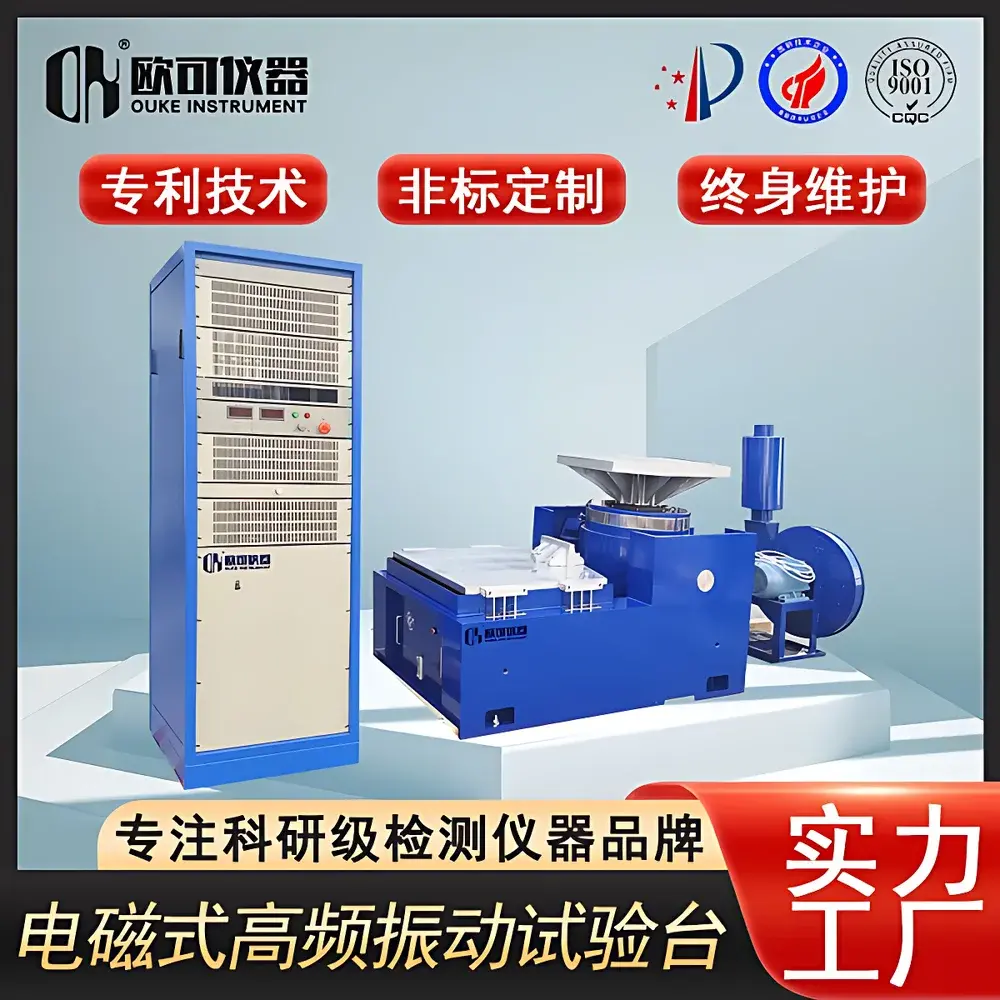
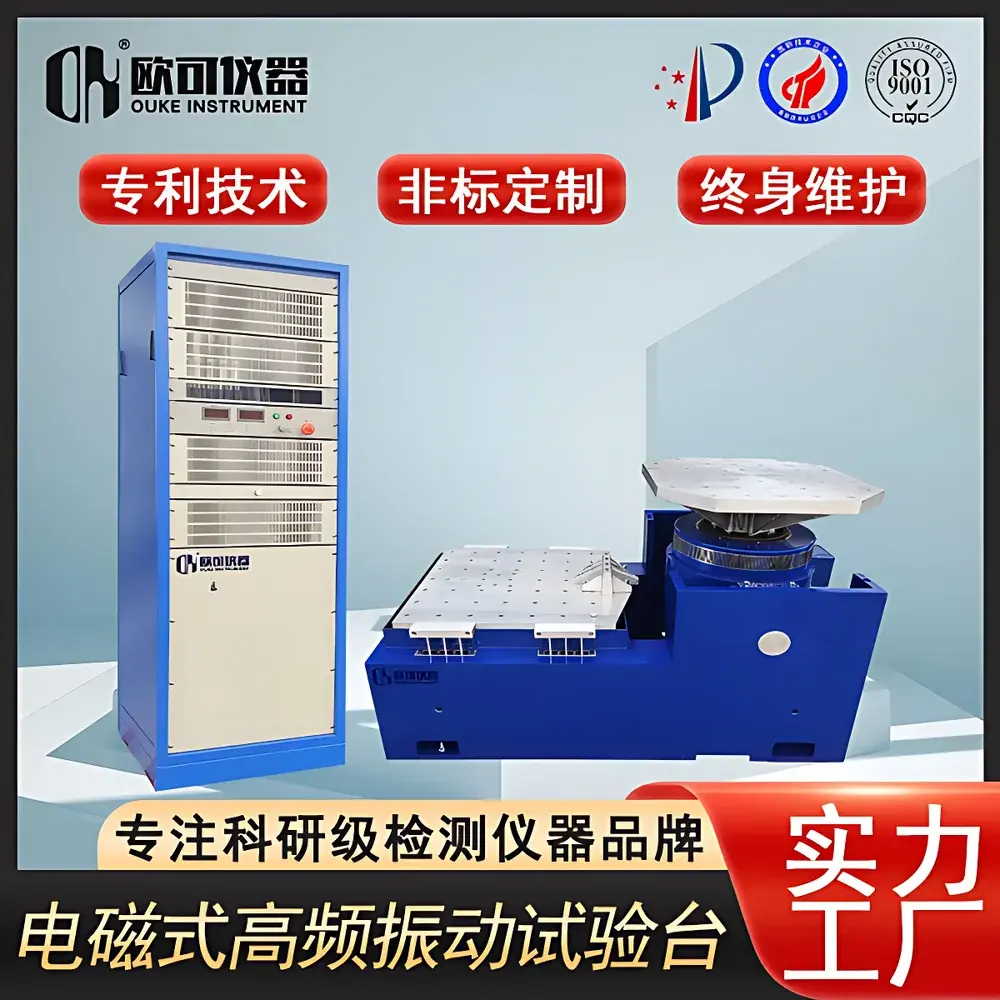
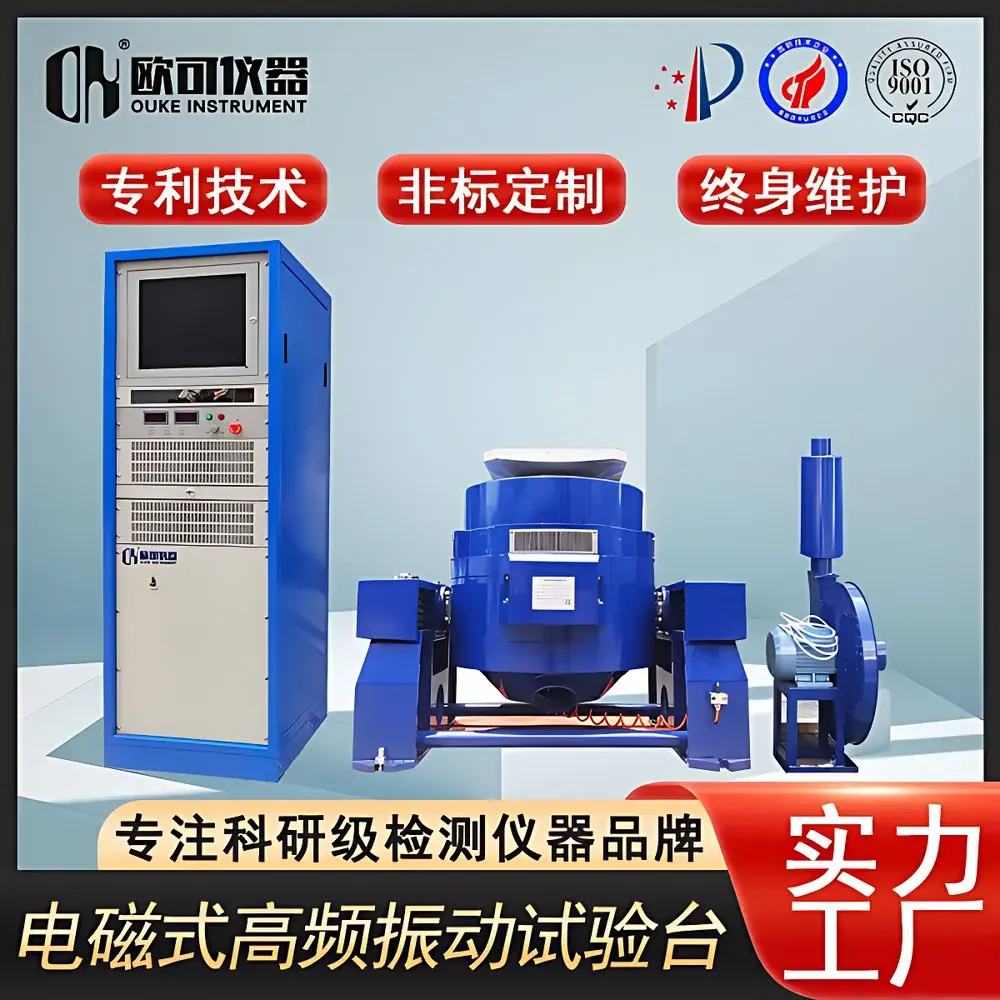
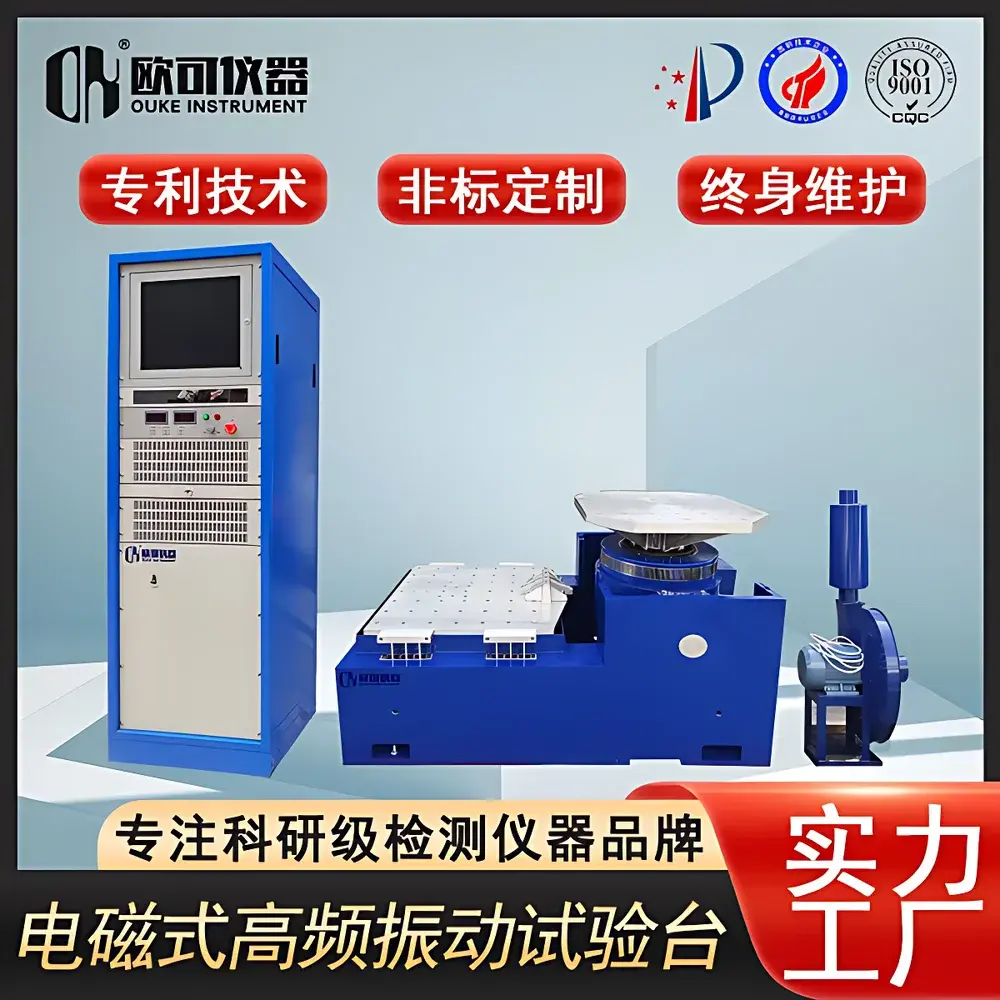
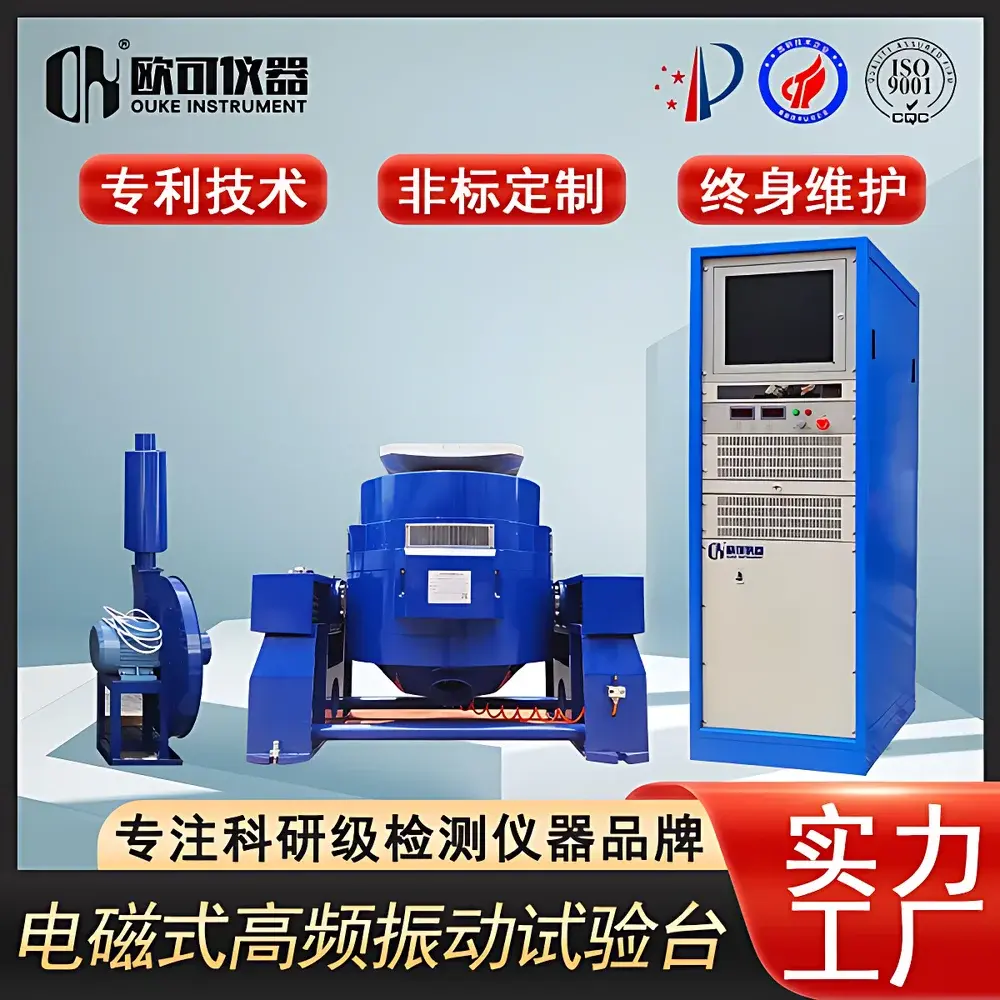
OK-ES-3.5 High-Frequency Electromagnetic Vibration Shaker
| Brand | OK Instruments |
|---|---|
| Origin | Guangdong, China |
| Manufacturer Type | OEM/ODM Manufacturer |
| Country of Origin | China |
| Model | OK-ES-3.5 |
| Instrument Type | Electrodynamic Vibration Shaker |
| Rated Force | 1.98 kN |
| Frequency Range | 5–5000 Hz |
| Maximum Test Load | 70 kg |
| Table Surface Dimensions | 300 × 300 × 30 mm |
| Peak Acceleration | 10 g |
Overview
The OK-ES-3.5 High-Frequency Electromagnetic Vibration Shaker is an engineered electrodynamic test system designed for precision dynamic excitation in the 5 Hz to 5,000 Hz frequency band. It operates on the principle of Lorentz-force actuation: alternating current applied to a lightweight moving coil within a high-intensity magnetic field generates controlled mechanical vibration at the table surface. Unlike general-purpose shakers optimized for broad-spectrum environmental simulation, the OK-ES-3.5 prioritizes high-frequency fidelity, structural rigidity, and acceleration linearity—making it suitable for modal analysis, high-cycle fatigue testing, component-level reliability validation, and calibration of high-bandwidth accelerometers. Its design conforms to fundamental constraints of high-frequency dynamics: displacement amplitude diminishes quadratically with increasing frequency (per x ∝ a/ω²), necessitating ultra-stiff, low-mass moving elements to sustain 10 g peak acceleration while maintaining waveform integrity up to 5 kHz. The system is not intended for transportation simulation or low-frequency shock testing; rather, it targets applications where resonant behavior, transient response, or material fatigue under sustained high-frequency loading must be quantified under laboratory-controlled conditions.
Key Features
- Electrodynamic actuation with optimized beryllium-copper alloy voice coil and high-coercivity neodymium magnet assembly for extended high-frequency bandwidth and thermal stability
- Rigid, monolithic aluminum table (300 × 300 × 30 mm) machined from solid stock to suppress parasitic modes; first bending mode > 12 kHz (verified via impact modal analysis)
- Digital servo controller with real-time adaptive feedback loop, supporting sine, random, shock, and resonance dwell profiles per ISO 10816, ASTM D4728, and MIL-STD-810H Annex G
- Integrated force transducer and table-mounted reference accelerometer for closed-loop control validation and traceable acceleration monitoring
- Thermally managed power amplifier with ≥100 kHz signal bandwidth and <0.5% harmonic distortion across full operating range
- Modular mounting interface compliant with ISO 5344 and DIN 45673-2 for repeatable fixture integration and alignment verification
Sample Compatibility & Compliance
The OK-ES-3.5 accommodates test specimens up to 70 kg mass, provided their first structural resonance lies well above 5,000 Hz—or, more critically, that the combined fixture-specimen assembly maintains a fundamental flexural mode ≥15 kHz (i.e., ≥3× upper test frequency). This requirement mandates finite element modeling (FEM) of custom fixtures prior to qualification testing. Compatible specimen categories include turbine blade segments, MEMS packaging substrates, optical mount assemblies, piezoelectric transducers, and miniature inertial sensors. The system supports compliance workflows aligned with DO-160 Section 8 (Aerospace), IEC 60068-2-6 (Environmental Testing), and USP (Analytical Instrument Qualification) when paired with validated control software and audit-trail-enabled data acquisition. All mechanical interfaces meet RoHS and REACH directives; electromagnetic emissions comply with EN 61326-1 Class A.
Software & Data Management
Control and analysis are performed via OK-VibControl™ v4.2—a Windows-based application certified for FDA 21 CFR Part 11 compliance (electronic signatures, role-based access, immutable audit trails). The software enables real-time spectrum editing, PSD synthesis, resonance search-and-dwell, and automated sweep rate optimization based on specimen impedance estimates. Raw time-history data is recorded in IEEE 1159-compliant binary format (.tdms), with metadata embedding test configuration, calibration certificates, and environmental logs. Export options include MATLAB (.mat), CSV, and HDF5 for third-party post-processing. Optional modules support GLP/GMP-compliant report generation (PDF/A-2), cross-channel coherence analysis, and modal parameter estimation (PolyMAX algorithm).
Applications
- Aerospace: Blade flutter testing of compressor/turbine airfoils; high-frequency NVH characterization of avionics enclosures; qualification of inertial measurement units (IMUs) under acoustic-vibration coupling
- Microelectronics: Reliability screening of RF MEMS switches, SAW/BAW filters, and crystal oscillators at operational resonance frequencies
- Materials Science: Ultra-high-cycle fatigue (UHCF) studies (>10⁷ cycles) on Ti-6Al-4V, nickel superalloys, and carbon-fiber laminates under controlled stress ratio and temperature
- Precision Engineering: Dynamic stiffness mapping of machine tool spindles and linear stages; calibration of reference-grade piezoelectric accelerometers per ISO 16063-21
- Defense & Security: Shock survivability assessment of seeker heads, laser rangefinders, and miniaturized guidance electronics subjected to launch- and detonation-induced broadband vibration
FAQ
What is the maximum usable frequency for a 70 kg load?
The rated 5–5000 Hz range assumes optimal fixture design and proper mass distribution. With a 70 kg rigid, symmetric load directly bolted to the center of the table using ISO 4014 grade 12.9 fasteners, the practical upper limit remains 5 kHz—provided the combined system’s first bending mode exceeds 15 kHz (confirmed by pre-test hammer modal survey).
Does the system support random vibration testing per MIL-STD-810H Method 514.8?
Yes. The digital controller implements real-time error minimization with convergence thresholds per MIL-STD-810H Figure 514.8C-1, including kurtosis control (up to 7.0) and phase-randomized synthesis for non-Gaussian spectra.
Is third-party calibration certification included?
Each unit ships with NIST-traceable factory calibration certificate (acceleration sensitivity, force output, and frequency response) valid for 12 months. On-site re-calibration services are available through OK Instruments’ ISO/IEC 17025-accredited metrology lab.
Can the shaker be integrated into a climatic chamber?
Yes—via optional feedthrough-equipped environmental chamber adapters (IP54-rated, 0–85°C, 10–95% RH non-condensing). Chamber integration requires revised fixture FEA and thermal derating of continuous force output.
What maintenance intervals are recommended?
Biannual inspection of coil centering, suspension integrity, and amplifier cooling performance is required. Annual recalibration and bearing lubrication (if applicable) are advised. Full service documentation and spare parts kits are supplied with purchase.



