
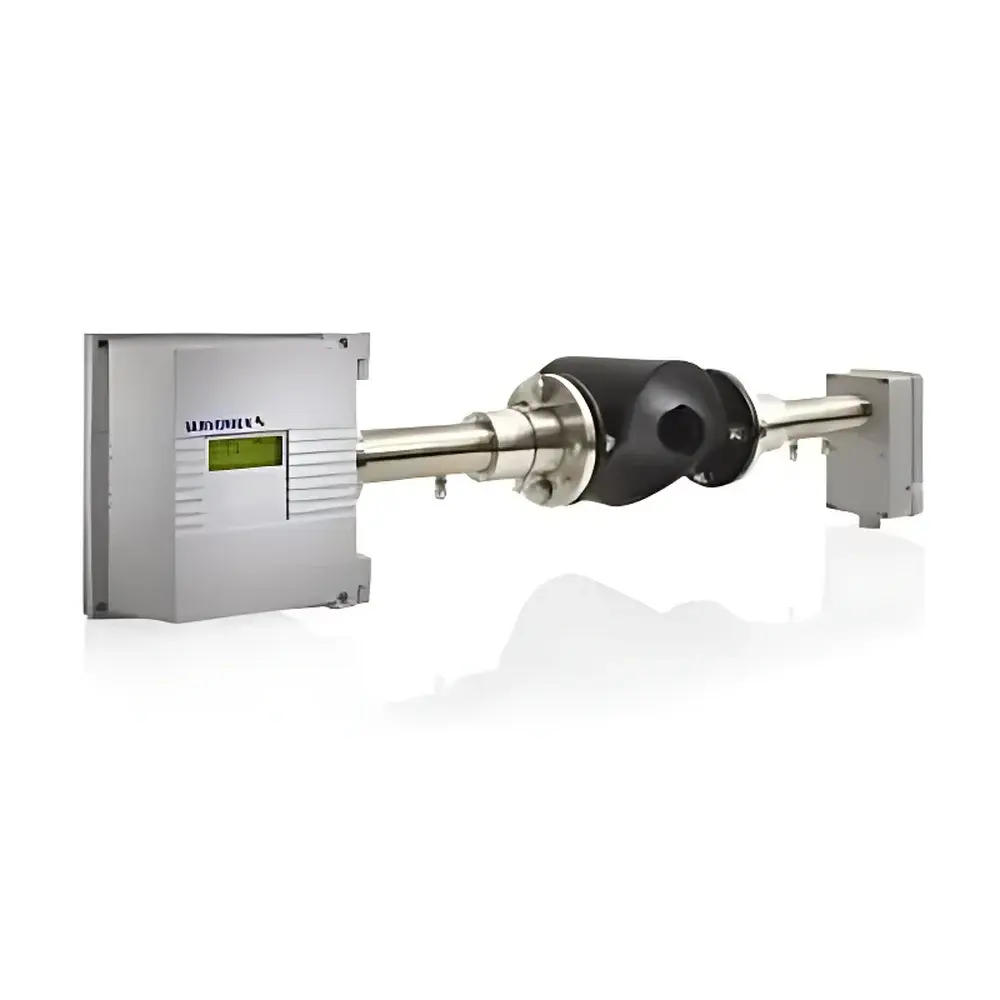
Servomex Servotough Laser 2900 Series In-Situ and Extractive Tunable Diode Laser Absorption Spectroscopy (TDLAS) Gas Analyzer
| Brand | Servomex |
|---|---|
| Origin | United Kingdom |
| Model | Laser 2900 |
| Measurement Principle | Tunable Diode Laser Absorption Spectroscopy (TDLAS) |
| Optical Path Length | 0.5–15 m |
| Response Time | <2 s |
| Zero Drift | <2% FS/6 months |
| Span Drift | <4% FS/6 months |
| Analog Outputs | Dual isolated 4–20 mA loops (500 Ω max each) |
| Digital Interfaces | RS232, 10/100 Base-T Ethernet (optional), ASCII over fiber (optional) |
| Relay Outputs | Three SPST relays (1 A, 30 V DC/AC |
| Analog Inputs | Optional 4–20 mA inputs for process temperature & pressure compensation |
| Calibration Interval | Recommended every 6–12 months |
| Installation Modes | In-situ (direct flange-mounted), extractive (sample cell), or bypass configuration |
Overview
The Servomex Servotough Laser 2900 Series is an industrial-grade, in-situ and extractive gas analyzer engineered for continuous, real-time measurement of specific gas species in demanding process and emissions monitoring applications. It employs Tunable Diode Laser Absorption Spectroscopy (TDLAS), a highly selective and sensitive optical technique based on the fundamental principle that target gas molecules absorb laser light at precisely defined wavelengths in the near-infrared (NIR) region. By modulating the laser wavelength across a narrow absorption line and detecting the resulting attenuation using a photodetector, the analyzer quantifies gas concentration via the Beer–Lambert law—without interference from overlapping spectral features of background gases. This physics-based approach eliminates cross-sensitivity issues common in electrochemical or catalytic bead sensors, delivering inherently stable, calibration-resistant performance under dynamic process conditions.
Key Features
- In-situ capability: Direct flange-mounting onto ducts, stacks, or reactors enables true real-time measurement without sample extraction, conditioning, or transport delay.
- Robust single-beam TDLAS architecture: Transmitter–receiver configuration with collimated semiconductor laser source and high-stability detector ensures reliable operation across optical path lengths from 0.5 to 15 meters.
- High environmental tolerance: Rated for operation in ambient temperatures up to 65 °C, with optional air-purge or water-cooled housings for extreme thermal or particulate-laden environments (e.g., steel reheating furnaces, cement kiln inlets).
- Zero chemical consumption: Non-contact, non-destructive measurement eliminates consumables, reagents, or sample conditioning systems—reducing lifecycle cost and maintenance frequency.
- Low detection limits and high specificity: Achieves sub-ppm detection for gases such as O₂, CO, CO₂, CH₄, NH₃, H₂O, HCl, HF, and SO₂, depending on configured laser wavelength and path length.
- Integrated diagnostics and self-monitoring: Continuous signal-to-noise ratio tracking, beam alignment verification, and internal reference channel validation support predictive maintenance and regulatory compliance reporting.
Sample Compatibility & Compliance
The Laser 2900 supports both in-situ and extractive sampling configurations, making it compatible with heterogeneous process streams—including high-temperature (up to 1800 °C with appropriate probe design), high-dust (>10 g/m³), and corrosive (e.g., HCl, HF, SO₂ in flue gas) environments. Its optical measurement principle is unaffected by gas matrix composition, pressure fluctuations (within specified range), or condensable vapors when properly purged. The system meets key international standards for industrial emission monitoring, including EN 15267-3 (QAL1 certification readiness), MCERTS (UK), EPA Methods 3A and 7E (US), and ISO 14064-1 for GHG quantification. All firmware and data handling protocols are designed to support GLP/GMP audit trails and can be configured for FDA 21 CFR Part 11 compliance when paired with validated software platforms.
Software & Data Management
The analyzer operates with Servomex’s LaserView™ configuration and diagnostic software, accessible via RS232 serial interface for commissioning and troubleshooting. For enterprise integration, optional Ethernet connectivity enables Modbus TCP or OPC UA communication, allowing seamless data ingestion into DCS, SCADA, or cloud-based analytics platforms. All analog outputs (primary and secondary 4–20 mA) are fully scalable and linearized per user-defined engineering units. Internal data logging (with timestamped event records for alarms, faults, and calibrations) supports traceability requirements. ASCII output over fiber optic link provides noise-immune transmission for long-distance installations in electrically noisy plant environments.
Applications
- Combustion optimization and safety monitoring in power generation (coal, gas, biomass boilers)
- Ammonia slip control in SCR systems for NOₓ abatement
- Process gas purity verification in hydrogen production, syngas processing, and petrochemical cracking units
- Continuous emissions monitoring (CEMS) for regulated pollutants (CO, NO, SO₂, NH₃) in waste incineration and cement manufacturing
- Leak detection and fugitive emission quantification in LNG terminals and natural gas transmission infrastructure
- Real-time furnace atmosphere control in heat treatment and metal annealing lines
FAQ
What gases can the Laser 2900 measure?
It measures gases with distinct NIR absorption lines—common configurations include O₂, CO, CO₂, CH₄, NH₃, H₂O, HCl, HF, and SO₂. Specific gas selection depends on laser wavelength module installed.
Is sample conditioning required for in-situ use?
No—its non-contact optical path eliminates the need for filters, dryers, or pumps. Optional purge air or cooling may be used to protect optics in high-particulate or high-temperature ducts.
How often does the system require calibration?
Servomex recommends verification every 6–12 months using certified span gas introduced either directly into the optical path (in-situ) or via an external calibration cell (extractive mode). Drift performance typically remains within ±2% zero and ±4% span over six months.
Can the Laser 2900 operate in explosive atmospheres?
Yes—ATEX-certified versions (II 2G Ex db IIB T4 Gb / II 2D Ex tb IIIC T135°C Db) and IECEx equivalents are available for Zone 1/21 hazardous locations.
What is the minimum detectable concentration for CO in a 5-meter stack?
Typical detection limit is ≤0.5 ppmv (3σ) for CO at 5 m path length with standard transmitter/receiver assembly—subject to installation alignment, dust loading, and signal averaging settings.





