
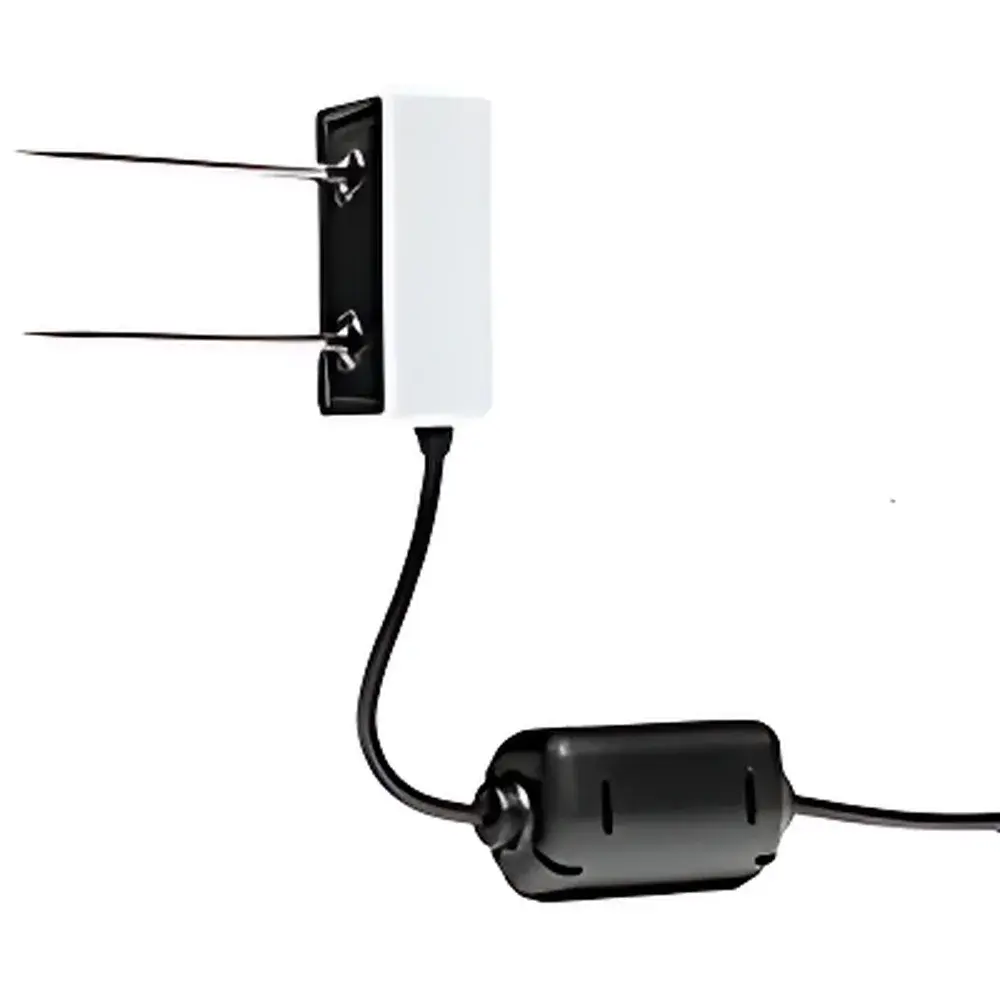
METER TEROS 10 Volumetric Water Content Sensor
| Brand | METER |
|---|---|
| Origin | USA |
| Manufacturer | METER Group, Inc. |
| Model | TEROS 10 |
| Measurement Principle | 70 MHz Frequency Domain Reflectometry (FDR) |
| Output | Analog Voltage (1,000–2,500 mV) |
| VWC Range | 0–64% (soil), 0–70% (non-soil media) |
| Resolution | 0.001 m³/m³ |
| Accuracy | ±0.03 m³/m³ (±3.0% VWC) in mineral soils with EC < 8 dS/m using generic calibration |
| Dielectric Constant Range | 1–80 |
| Accuracy of εₐ | ±1 εₐ (1–40), ±15% of reading (40–80) |
| Operating Temperature | −40 to +60 °C |
| Probe Length | 5.4 cm |
| Housing Dimensions | 5.1 × 2.4 × 7.5 cm (L×W×H) |
| Cable Length | Standard 5 m (custom up to 40 m) |
| Connector | 3.5 mm TRS jack or bare leads |
| Excitation Voltage | 3.0–15.0 VDC |
| Measurement Duration | 10–25 ms |
| Compliance | ISO 9001:2015, CE (2014/30/EU & 2011/65/EU), EN 61326-1:2013, EN 55022/CISPR 22 |
Overview
The METER TEROS 10 Volumetric Water Content Sensor is an analog-output, frequency domain reflectometry (FDR) sensor engineered for high-reproducibility measurement of volumetric water content (VWC) in porous media—including mineral soils, potting mixes, hydroponic substrates, and engineered growing media. Operating at a stable 70 MHz excitation frequency, the TEROS 10 detects changes in apparent dielectric permittivity (εₐ), which correlates directly with water volume fraction in the surrounding matrix. Unlike time-domain transmission (TDT) or capacitance-based sensors susceptible to salinity-induced drift, the TEROS 10’s optimized electrode geometry and ferrite-core cable design minimize electromagnetic interference and reduce sensitivity to bulk electrical conductivity (EC), delivering consistent performance across a wide range of soil textures and salinities (up to 8 dS/m under generic calibration). Its compact, resin-encapsulated housing and sharpened stainless-steel probes enable low-disturbance insertion into dense or rocky soils—preserving in situ structural integrity during installation.
Key Features
- Robust field-grade construction: UV-stabilized thermoset resin housing rated for continuous outdoor deployment in −40 °C to +60 °C environments; service life exceeding 10 years under typical agricultural or ecological monitoring conditions.
- Low-impact probe geometry: Twin 5.4 cm stainless-steel needles with precision-ground tips facilitate rapid, minimal-disruption insertion—even into compacted clay or gravelly soils—without requiring augering or trenching.
- Ferrite-core shielded cable: Integrated magnetic core suppresses common-mode noise on the signal line, enhancing long-term stability in electrically noisy environments (e.g., near irrigation controllers or solar charge regulators).
- Plug-and-play compatibility: Designed for seamless integration with METER’s ZL6, EM50/60, and ProCheck data loggers via standardized 3.5 mm TRS interface; also supports third-party systems capable of 12-bit+ single-ended voltage acquisition with 3.0–15.0 VDC excitation.
- Economical scalability: Optimized unit cost and 430 mL effective measurement volume support high-density sensor networks for spatially resolved soil moisture mapping across farms, research plots, or watershed-scale observatories.
Sample Compatibility & Compliance
The TEROS 10 is validated for use in mineral soils, organic amendments, sand-based turf profiles, volcanic ash, and synthetic growth media. It complies with international electromagnetic compatibility (EMC) and safety standards including EN 61326-1:2013 (industrial measurement equipment), EN 55022/CISPR 22 (radiated emissions), and EU directives 2014/30/EU (EMC) and 2011/65/EU (RoHS). Manufacturing adheres to ISO 9001:2015 quality management protocols. While not intrinsically certified for hazardous locations, its low-power analog output and passive design meet general-purpose environmental monitoring requirements under GLP-aligned field study protocols.
Software & Data Management
When deployed with METER’s ZL6 or EM60 data loggers, TEROS 10 measurements are automatically timestamped, stored onboard, and synchronized to METER’s cloud platform (ZENTRA Cloud) via cellular or LoRaWAN connectivity. Raw voltage outputs are converted to VWC using either the built-in generic mineral soil calibration or user-defined medium-specific calibrations—traceable to gravimetric or neutron probe reference methods. All data transfers include embedded metadata (sensor ID, firmware version, battery status, temperature), supporting FAIR (Findable, Accessible, Interoperable, Reusable) data principles. Audit trails, role-based access controls, and export options (CSV, JSON, NetCDF) facilitate compliance with institutional data governance policies and long-term ecological research (LTER) reporting frameworks.
Applications
- Irrigation scheduling and deficit irrigation optimization in row crops, orchards, and vineyards.
- Soil hydraulic property characterization in unsaturated zone hydrology studies.
- Root-zone moisture monitoring for controlled-environment agriculture (CEA) and vertical farming systems.
- Calibration and validation of satellite-based soil moisture products (e.g., SMAP, Sentinel-1).
- Long-term edaphic monitoring in climate change impact assessments and restoration ecology projects.
FAQ
Does the TEROS 10 require soil-specific calibration?
Yes—while the factory-installed generic mineral soil calibration provides ±0.03 m³/m³ accuracy for most agricultural soils, improved precision (±0.01–0.02 m³/m³) is achieved through medium-specific calibration using gravimetric or time-domain transmissometry (TDT) reference data.
Can TEROS 10 be used in saline soils?
It remains functional up to 8 dS/m EC under generic calibration; however, accuracy degrades above this threshold. For high-salinity applications (e.g., coastal agriculture or reclaimed mine soils), custom calibration or concurrent EC measurement with a separate sensor (e.g., TEROS 12) is recommended.
What is the effective measurement volume, and how does it relate to spatial representativeness?
The sensor integrates over approximately 430 mL centered around the probe tips—making it suitable for detecting bulk moisture changes while minimizing point-source artifacts. This volume supports robust comparison with neutron probe or cosmic-ray neutron sensing (CRNS) footprints when deployed in gridded arrays.
Is the TEROS 10 compatible with non-METER data loggers?
Yes—any data acquisition system capable of supplying 3.0–15.0 VDC excitation and measuring single-ended analog voltage (1,000–2,500 mV) with ≥12-bit resolution can interface with the TEROS 10 using bare-wire connections or a 3.5 mm TRS adapter.
How often should the sensor be cleaned or maintained in the field?
No routine cleaning is required. The stainless-steel probes resist corrosion and biofouling. In highly organic or clay-rich soils, occasional gentle wiping with isopropyl alcohol may improve long-term signal stability—but mechanical abrasion must be avoided to preserve electrode integrity.



