
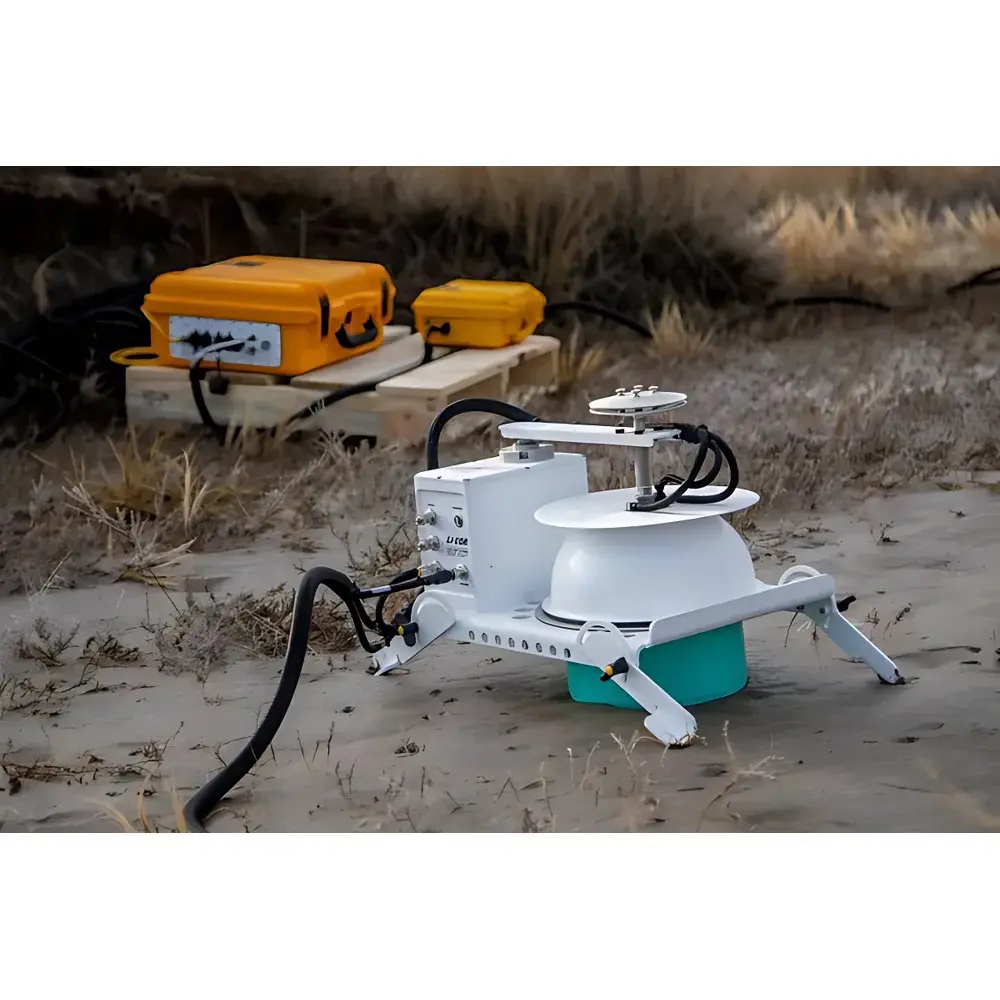
LI-COR LI-8250 Multi-Channel Automated Soil Greenhouse Gas Flux Measurement System
| Brand | LI-COR |
|---|---|
| Origin | USA |
| Model | LI-8250 Multi-Channel Automated Soil Greenhouse Gas Flux Measurement System |
| Dimensions | 38.5 cm L × 52 cm W × 18.5 cm H |
| Weight | 7.7 kg |
| Ingress Protection | IP55 |
| Operating Temperature | –20 to 45 °C |
| Relative Humidity | 0–95% RH (non-condensing) |
| Data Storage | 8 GB internal |
| GPS Accuracy | 2.5 m CEP |
| Maximum Chamber Radius from Unit | 15.0 m (one tube per chamber) |
| Maximum Chamber Diameter Coverage | 30.0 m |
| Pump Flow Rate (chamber-to-unit) | ~2–3 L/min (diaphragm type) |
| Barometric Pressure Sensor Range | 20–110 kPa |
| Accuracy | ±0.4 kPa (50–110 kPa) |
| Resolution | 0.006 kPa |
| Power Input | 10–30 VDC |
| Typical Power Consumption | 4.8 W (standby), 15.6 W (sampling/moving), 18.2 W (peak) |
| Communication | 3× sealed RJ-45 Ethernet, Wi-Fi (2.4 GHz, 802.11 a/b/g/n/ac), USB-A (1 sealed for LI-870, 2 standard), RS-422 output (24 VDC, 115.2 kbps, 1.8 A max/port) |
| Chamber Compatibility | SDI-12–enabled long-term chambers (e.g., 8200-104 / 8200-104C) |
| chamber volume | 3955 cm³ |
| soil measurement area | 317.8 cm² |
| Environmental Sensor Support | Air temperature (±0.3 °C), PAR/light (0–100 µA input, ±0.37% of reading + 8 nA), soil temperature & moisture (via SDI-12) |
Overview
The LI-COR LI-8250 Multi-Channel Automated Soil Greenhouse Gas Flux Measurement System is an engineered platform for high-temporal-resolution, unattended quantification of soil-atmosphere exchange fluxes of carbon dioxide (CO₂), methane (CH₄), and water vapor (H₂O). Built upon the principles of dynamic closed-chamber methodology and integrated gas concentration time-series analysis, the LI-8250 executes automated, sequential sampling across up to eight independently controlled soil chambers—enabling spatially distributed, long-term monitoring in field-based biogeochemical research. Its architecture supports both LI-7810 (CH₄/CO₂/H₂O) and LI-870 (CO₂/H₂O) analyzers, leveraging their high-precision tunable diode laser absorption spectroscopy (TDLAS) or non-dispersive infrared (NDIR) detection to resolve sub-ppb CH₄ and <1 ppm CO₂ changes over time. The system computes real-time fluxes using linear or quadratic regression of concentration vs. time within each chamber closure cycle, correcting for chamber geometry, temperature, pressure, and humidity—ensuring traceable, reproducible results aligned with IPCC Tier 2 reporting standards and ASTM D6348–22 guidance for chamber-based gas flux assessment.
Key Features
- Simultaneous control and data acquisition from up to eight SDI-12–compatible long-term soil chambers (e.g., model 8200-104 or 8200-104C), enabling spatial replication and heterogeneous site characterization.
- Integrated flux computation engine compliant with widely adopted chamber-based algorithms—including HMR (Hutchinson & Mosier), R²-weighted linear regression, and polynomial fitting—accessible via embedded firmware and exportable as CSV or NetCDF.
- Dual-mode connectivity: local operation via built-in 2.4 GHz Wi-Fi (IEEE 802.11 a/b/g/n/ac) with mobile web interface, or remote access through secure Ethernet (3× sealed RJ-45 ports) supporting TLS-encrypted HTTP(S) and Modbus TCP protocols.
- Robust environmental resilience: IP55-rated enclosure rated for continuous outdoor deployment across –20 to 45 °C and 0–95% RH (non-condensing); internal GPS module (2.5 m CEP) geotags all flux records for GIS-integrated analysis.
- Modular power architecture: accepts 10–30 VDC input with peak draw ≤18.2 W; compatible with solar-battery systems and LI-COR’s 8250-770 AC/DC converter (IP55, 100–240 VAC input).
- Expandable sensor integration: native SDI-12 support for up to 10 auxiliary sensors—including air temperature (±0.3 °C), photosynthetically active radiation (PAR), soil temperature, volumetric water content, and barometric pressure (±0.4 kPa)—all time-synchronized to flux events.
Sample Compatibility & Compliance
The LI-8250 is designed for direct interfacing with LI-COR’s trace-gas analyzers and third-party instruments meeting RS-422 or Ethernet communication specifications. It fully supports the SDI-12 protocol for long-term chambers equipped with integrated temperature, humidity, and light sensors—ensuring synchronized environmental metadata capture during each flux measurement cycle. The system complies with IEC 60529 (IP55) for dust and water ingress protection and meets electromagnetic compatibility requirements per FCC Part 15 Class B and CE EN 61326-1. Data integrity protocols align with GLP and GMP expectations: all measurements include timestamps (UTC-synced via NTP or GPS), instrument configuration logs, and raw concentration time series—facilitating audit-ready documentation per FDA 21 CFR Part 11 when deployed with validated software workflows.
Software & Data Management
Data are stored locally on an 8 GB industrial-grade flash memory partition, retaining >12 months of high-frequency flux records (e.g., 30-min intervals across 8 chambers) without external media. The embedded web server provides real-time status dashboards, chamber sequencing control, and firmware updates via HTTPS. Export formats include timestamped CSV (with column headers for gas species, flux rate, uncertainty, chamber ID, and ancillary parameters) and NetCDF4 for interoperability with Python (xarray), R (ncdf4), and MATLAB. Optional integration with EddyPro® or FluxSuite™ enables cross-platform validation against eddy covariance datasets. All data files include SHA-256 checksums and support configurable auto-upload to FTP/SFTP or cloud storage endpoints with TLS 1.2+ encryption.
Applications
- Long-term monitoring of soil carbon dynamics across agricultural, wetland, tundra, and forest ecosystems—supporting IPCC national greenhouse gas inventories and LULUCF reporting.
- Evaluation of climate-smart agriculture practices—including cover cropping, reduced tillage, and biochar amendment—via replicated, multi-season flux comparisons.
- Process-level studies of methanogenesis and methanotrophy under controlled moisture-temperature-oxygen gradients.
- Calibration and validation of airborne or satellite-based GHG inversion models using ground-truthed, spatially explicit flux maps.
- Atmospheric boundary layer profiling: when configured with vertical chamber arrays, the LI-8250 supports CO₂ and CH₄ gradient measurements for aerodynamic resistance estimation and footprint modeling.
- Controlled-environment experiments in growth chambers or mesocosms where automated, low-disturbance flux quantification is required under varying light, temperature, or CO₂ enrichment regimes.
FAQ
Can the LI-8250 operate without a connected LI-COR gas analyzer?
No—the LI-8250 is a controller and flux computation unit; it requires a compatible gas analyzer (e.g., LI-7810 or LI-870) to provide real-time concentration data for flux calculation.
What is the maximum recommended tubing length between the LI-8250 and a soil chamber?
For optimal response time and minimal diffusion bias, LI-COR specifies a maximum radial distance of 15.0 m (30.0 m total diameter), with one dedicated 6-mm OD PFA tube per chamber.
Does the system support automatic correction for ambient pressure and temperature during flux computation?
Yes—integrated barometric pressure (20–110 kPa, ±0.4 kPa) and chamber air temperature sensors feed real-time corrections into the HMR and polynomial flux algorithms.
Is SDI-12 sensor data time-aligned with gas concentration readings?
Yes—all SDI-12 sensor values are acquired synchronously with the start of each chamber closure cycle and embedded in the same data record as the corresponding gas concentration time series.
Can users customize the flux calculation algorithm or regression window?
Yes—through the web interface or API, users may select linear/quadratic fitting, define minimum R² thresholds, adjust time-window duration (e.g., 60–180 s), and enable or disable automatic outlier rejection based on residual analysis.





