
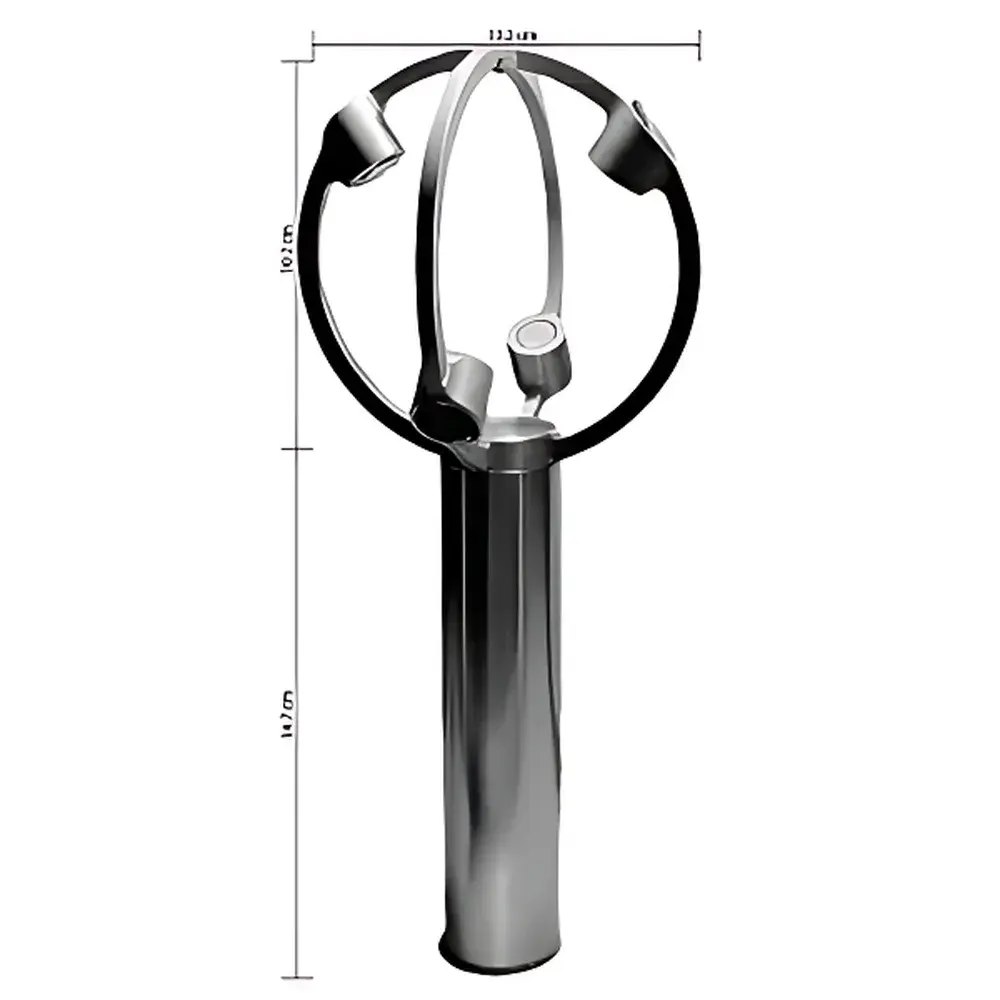
LI-COR LI-560 Spherical Three-Dimensional Ultrasonic Anemometer
| Brand | LI-COR |
|---|---|
| Origin | USA |
| Model | LI-560 Spherical 3D Ultrasonic Anemometer |
| Instrument Type | Ultrasonic Anemometer |
| Wind Speed Range | 0–50 m/s, Resolution: 0.01 m/s, Accuracy: ±0.1 m/s (0–10 m/s), ±1% of reading (11–30 m/s), ±2% of reading (31–50 m/s) |
| Wind Direction (u/v) | 0–359°, (w): ±60°, Resolution: 1°, Accuracy: ±1° |
| Temperature Range | −20 to +72 °C, Resolution: 0.01 °C, Accuracy: ±2.0 °C |
| 3D Accelerometer Range | ±2 g (u/v/w), Tilt (Pitch/Roll): ±90° |
| Measurement Path Length | 60 mm |
| Dimensions | 10.2 cm × 10.2 cm × 24.9 cm |
| Weight | 225 g |
| Power Supply | 5–32 VDC @ 500 mW |
| Output Interfaces | RS-232, RS-422, 3.3-V UART |
| Data Output Frequencies | 1, 2, 5, 10, 20, 25, 50, 100 Hz |
| Ultrasonic Transducer Frequency | 60 kHz |
| Housing Material | Aerospace-grade aluminum |
| IP Rating | NEMA-4X equivalent (sensor head) |
| DL422 data logger | IP67 |
Overview
The LI-COR LI-560 Spherical Three-Dimensional Ultrasonic Anemometer is a high-fidelity, open-path sensor engineered for precise eddy covariance and turbulent flux measurements in atmospheric science applications. It employs time-of-flight ultrasonic anemometry across three orthogonal acoustic paths—each 60 mm in length—to simultaneously resolve the u, v, and w components of wind velocity with minimal flow distortion. Its spherical geometry minimizes wake interference and shadowing effects that commonly degrade vertical wind (w-component) accuracy in conventional transducer arrangements. Designed specifically for integration into unmanned aerial systems (UAS), the LI-560 delivers synchronized, high-temporal-resolution wind vector data at up to 100 Hz, enabling robust characterization of boundary-layer turbulence, momentum transfer, and scalar fluxes under dynamic flight conditions.
Key Features
- Spherical open-path design reduces aerodynamic perturbation and eliminates need for empirical shadow correction—critical for accurate w-component quantification in eddy covariance workflows.
- Compact form factor (10.2 × 10.2 × 24.9 cm) and low mass (225 g) enable seamless integration onto UAS platforms including DJI M600, IE-V2, E900, and E1250 airframes.
- Aerospace-grade aluminum housing ensures mechanical rigidity, thermal stability, and corrosion resistance while maintaining low power consumption (500 mW at 12 VDC).
- Integrated 3-axis MEMS accelerometer (±2 g range) and tilt sensors (±90° pitch/roll) provide real-time motion compensation and attitude metadata essential for post-flight inertial correction.
- Dual-mode temperature measurement (ultrasonic-derived and onboard thermistor) supports cross-validated sonic temperature computation per ISO 7726 and ASTM D5468 standards.
- Configurable digital output via RS-232, RS-422, or 3.3-V UART enables direct interfacing with embedded controllers, telemetry modules, or dedicated data loggers such as the DL422 series.
Sample Compatibility & Compliance
The LI-560 is validated for continuous operation across ambient temperatures from −20 °C to +72 °C and relative humidity up to 100% non-condensing. Its mechanical and electrical architecture conforms to IEC 60529 (IP67-rated DL422 logger), MIL-STD-810G (vibration/shock), and FCC Part 15 Class B emission limits. When deployed within the WP-V3 Atmospheric Characterization Payload (ACP) developed jointly with BlueHalo, the system satisfies DoD STIG requirements for airborne environmental sensing and supports traceable calibration against NIST-traceable wind tunnel standards. The instrument’s measurement uncertainty budget aligns with the QA/QC protocols outlined in AmeriFlux and ICOS network guidelines, and its timestamped, dual-precision output format facilitates compliance with GLP and ISO/IEC 17025 documentation requirements.
Software & Data Management
Raw LI-560 data streams are structured in ASCII or binary frame formats with microsecond-precision timestamps synchronized to internal oscillator or external GPS PPS input. The DL422 data logger—available in E1, E2, and E4 configurations—provides on-board storage (MicroSD), programmable sampling schedules, and fail-safe power management compatible with UN38.3-certified Li-ion, solar, or wind-rechargeable sources. Firmware supports configurable burst-mode acquisition, real-time spectral analysis (FFT), and automatic gain control for signal integrity across variable acoustic impedance conditions. Data export is compatible with EddyPro®, TK3, and Python-based flux processing pipelines (e.g., PyFluxPro). All firmware and configuration tools adhere to FDA 21 CFR Part 11 principles, supporting electronic signatures, audit trails, and role-based access control when deployed in regulated research environments.
Applications
- Atmospheric boundary layer profiling and turbulence kinetic energy (TKE) quantification from fixed towers and UAS platforms.
- Wildfire plume dynamics and convective updraft mapping using multi-platform coordinated deployments.
- Urban canopy meteorology—including drag coefficient estimation and ventilation rate modeling for air quality forecasting.
- Validation of high-resolution numerical weather prediction (NWP) models such as WRF-LES and MPAS-Atmosphere.
- Educational field campaigns requiring rugged, low-maintenance instrumentation for student-led micrometeorological studies.
- Long-term eddy covariance networks where sensor drift, power autonomy, and environmental resilience are mission-critical.
FAQ
What is the recommended mounting orientation for optimal w-component accuracy?
Mount the LI-560 with its symmetry axis aligned vertically and ensure ≥1.5 m clearance from UAV propellers and fuselage surfaces to minimize rotor wash interference. Use the integrated accelerometer for post-processing pitch/roll correction.
Can the LI-560 operate independently without the DL422 logger?
Yes—the sensor outputs serial data directly and may be interfaced with third-party DAQ systems supporting RS-232/RS-422 protocols and 3.3-V UART logic levels.
Is factory calibration traceable to national standards?
Each unit ships with a certificate of calibration traceable to NIST through accredited wind tunnel testing at LI-COR’s Lincoln, NE facility; recalibration services are available annually.
How does the LI-560 handle precipitation or frost accumulation?
The spherical transducer geometry promotes natural shedding; optional hydrophobic coating (LI-COR Part #560-HC) is available for enhanced rain rejection and ice mitigation in sub-zero environments.
Does the LI-560 support time-synchronized multi-sensor arrays?
Yes—via external PPS input and configurable latency compensation, enabling phase-aligned deployment of up to four LI-560 units on a single DL422-E4 platform for spatially resolved turbulence analysis.







