
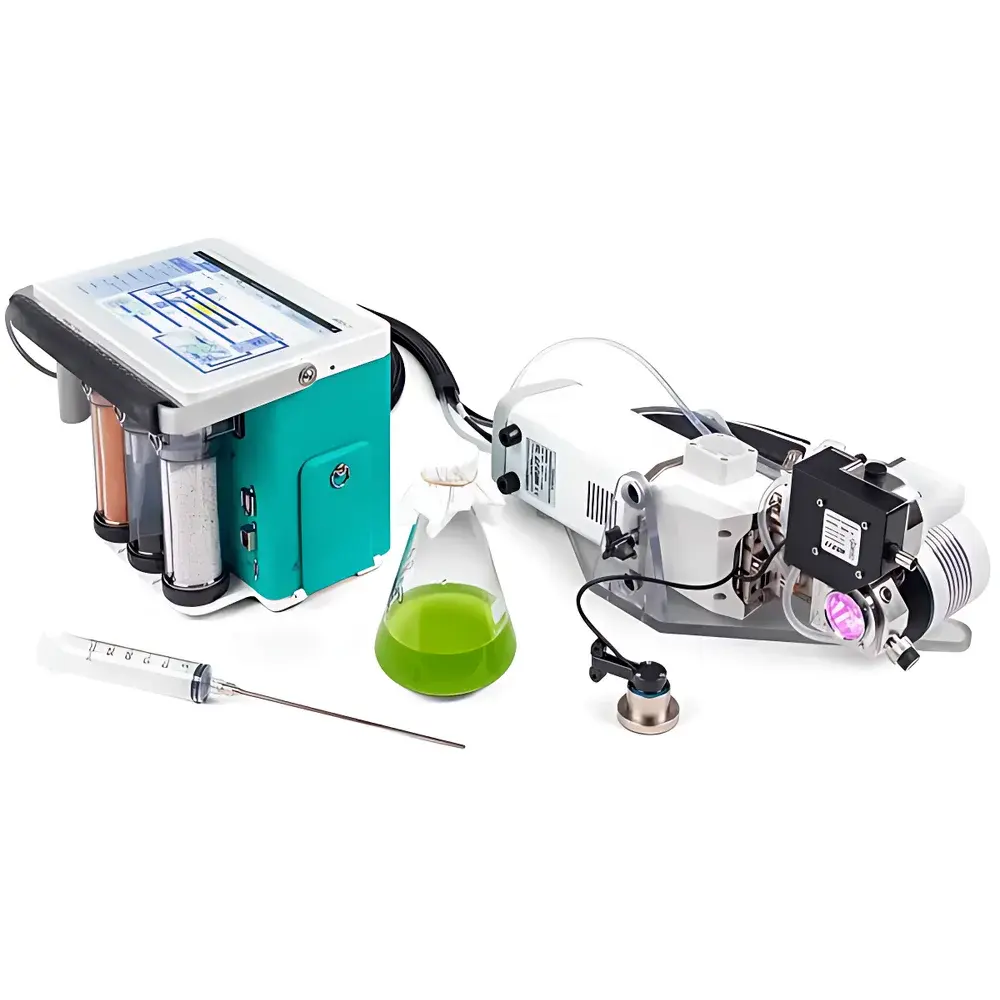
LI-COR LI-6800-18 Aquatic Photosynthesis Measurement Chamber for Suspended Algal Cultures
| Brand | LI-COR |
|---|---|
| Origin | USA |
| Model | 6800-18 Aquatic Measurement Chamber |
| Chamber Working Volume | 0–20 mL (recommended 15 mL) |
| CO₂ Analyzer | NDIR, Range 0–3100 µmol/mol, Precision ≤0.1 µmol/mol RMS @ 4 s avg at 400 µmol/mol |
| CO₂ Control Range | 0–2000 µmol/mol |
| Actinic Light Sources | Red (625 nm), Blue (475 nm), Far-Red (735 nm) |
| Fluorescence Detection | PAM-modulated chlorophyll fluorescence |
| Chamber Wetted Materials | 316 stainless steel, float glass, Viton®, PTFE, silicone, acetal |
| Operating Temperature | 0–50 °C (non-condensing, no direct solar exposure) |
| Liquid Sample Temp Range | freezing point to 50 °C |
| Salinity Compatibility | 0–35 ppt |
| pH Interface | BNC-compatible passive glass electrode (12 mm OD, O-ring sealed), -59 mV/pH slope (user-calibrated) |
| Data Output | ASCII text & Excel (.xlsx) with embedded calculation formulas |
Overview
The LI-COR LI-6800-18 Aquatic Photosynthesis Measurement Chamber is a purpose-engineered module for the LI-6800 Advanced Photosynthesis-Fluorescence System, extending its high-precision gas exchange and chlorophyll fluorescence capabilities to suspended aquatic samples—including microalgal cultures, cyanobacterial suspensions, coral symbiont isolates, and other small-scale aquatic photosynthetic organisms. Unlike traditional dissolved oxygen (DO)-based methods, the LI-6800 operates as an open-path, steady-state gas exchange system. It maintains precise, user-defined concentrations of CO₂ and H₂O in the inlet air stream while continuously measuring inlet and outlet CO₂ and H₂O mole fractions via dual non-dispersive infrared (NDIR) analyzers. Net carbon assimilation rate (A, µmol CO₂·cell⁻¹·s⁻¹, µmol CO₂·mg⁻¹·s⁻¹, or µmol CO₂·µg Chl⁻¹·s⁻¹) is calculated from the mass balance across the chamber, enabling quantitative physiological assessment under tightly controlled environmental conditions. Concurrently, the integrated pulse-amplitude modulated (PAM) fluorometer quantifies key photochemical parameters—including effective quantum yield of PSII (ΦPSII), non-photochemical quenching (NPQ), and the redox state of the PSII acceptor side (1−qL)—providing mechanistic insight into electron transport efficiency and photoprotective regulation.
Key Features
- Modular integration with the LI-6800 platform—fully synchronized control of gas composition, light spectra, temperature, and fluorescence excitation
- Stainless steel (316) and float-glass chamber body with chemically inert wetted materials (Viton®, PTFE, silicone, acetal) ensuring compatibility with saline, acidic, or alkaline suspensions (0–35 ppt salinity)
- Dual-wavelength actinic lighting (625 nm red, 475 nm blue) and far-red (735 nm) source for selective excitation and dark-interval relaxation protocols
- Saturation pulse capability up to 16,000 µmol·m⁻²·s⁻¹ for robust determination of maximum quantum yield (Fᵥ/Fₘ) and kinetic parameters
- BNC-compatible pH interface supporting standardized 12-mm-diameter glass electrodes with user-calibratable slope (−59 mV/pH)
- Configurable gas inlet port enabling delivery of custom gas mixtures (e.g., N₂/CO₂/O₂ blends) for hypoxic, hyperoxic, or low-CO₂ experimental regimes
- Real-time graphical display of A, ΦPSII, NPQ, and chamber humidity/temperature during measurement—no post-acquisition interpretation required
- Automated protocol execution via Python scripting or drag-and-drop graphical programming environment (LI-6800 Control Software v8.x+)
- Native export to ASCII-delimited text and Excel (.xlsx) formats, including embedded equations for recalculating derived variables (e.g., electron transport rate, ETR)
Sample Compatibility & Compliance
The 6800-18 chamber accommodates liquid-phase samples within a nominal working volume of 0–20 mL (15 mL recommended). Its design supports reproducible measurements of unicellular and colonial microalgae (e.g., Chlamydomonas, Dunaliella, Phaeodactylum), cyanobacteria (Synechocystis, Prochlorococcus), dinoflagellate symbionts (e.g., Symbiodinium), and homogenized benthic biofilms. Chamber geometry and flow dynamics are optimized to minimize boundary layer resistance and ensure uniform light penetration and gas exchange across the suspension column. All hardware and firmware comply with CE marking requirements for laboratory instrumentation. Data acquisition and storage support audit-trail functionality aligned with GLP principles; raw sensor outputs, metadata timestamps, and operator annotations are preserved in immutable log files—facilitating traceability in regulatory or peer-reviewed contexts (e.g., ISO 14040 LCA studies, USP analytical instrument qualification).
Software & Data Management
The LI-6800 Control Software (v8.4+) provides full bidirectional communication with the 6800-18 chamber. Experimental protocols—including multi-step light-response curves, CO₂ response assays, rapid light curves (RLCs), and induction kinetics—are defined, validated, and deployed without external scripting. The software enforces parameter interlocks (e.g., preventing simultaneous saturation pulses and high actinic irradiance) to safeguard sample integrity. All acquired data are timestamped to ±10 ms and stored with associated environmental metadata (Tair, Tliquid, [CO₂], RH, pH, flow rate). Exported Excel workbooks contain formula-driven columns for instantaneous A, ΦPSII, NPQ, ETR, and Cᵢ (intercellular CO₂ concentration), allowing reprocessing without raw file access. For laboratories operating under FDA 21 CFR Part 11 requirements, optional software modules provide electronic signatures, role-based access control, and versioned protocol archiving.
Applications
- Quantifying photosynthetic performance of algal strains under nutrient limitation, metal stress, or ocean acidification scenarios
- Characterizing photophysiological acclimation in coral holobionts exposed to thermal or light stress
- Evaluating biofuel-relevant microalgae for carbon fixation efficiency and light-use optimization
- Validating biogeochemical models of primary production using empirically derived A/Cᵢ and A/Q curves
- Assessing photoinhibitory dynamics in freshwater phytoplankton communities following UV-B exposure
- Screening mutant libraries for altered PSII repair kinetics or non-photochemical energy dissipation capacity
- Calibrating remote-sensing algorithms using ground-truthed ΦPSII and NPQ relationships
FAQ
Can the 6800-18 chamber be used with viscous or sedimenting suspensions?
Yes—chamber flow path geometry and inlet/outlet positioning minimize settling artifacts; however, continuous gentle agitation (e.g., magnetic stirring via external plate) is recommended for highly dense or flocculent cultures.
Is calibration of the CO₂ analyzer required before each aquatic measurement?
No—factory-calibrated NDIR sensors maintain stability over time; routine zero/span verification using certified gas standards (e.g., 0 ppm and 1000 ppm CO₂ in N₂) is advised weekly or per ISO/IEC 17025 internal quality procedures.
Does the system support simultaneous O₂ evolution measurement?
No—the LI-6800 measures net CO₂ assimilation only; complementary O₂ evolution must be assessed separately using Clark-type electrodes or membrane-inlet mass spectrometry.
How is temperature controlled for the liquid sample?
The chamber includes a #10-32 threaded port for connection to an external recirculating water bath; users supply temperature-stabilized fluid (±0.1 °C) to maintain precise liquid-phase thermal conditions.
Are there application notes or peer-reviewed protocols available for algae-specific use cases?
Yes—LI-COR provides validated SOPs for Chlorella vulgaris, Nannochloropsis oceanica, and reef-building corals on its technical resources portal, alongside citations in journals including Plant, Cell & Environment, Limnology and Oceanography: Methods, and Frontiers in Marine Science.






