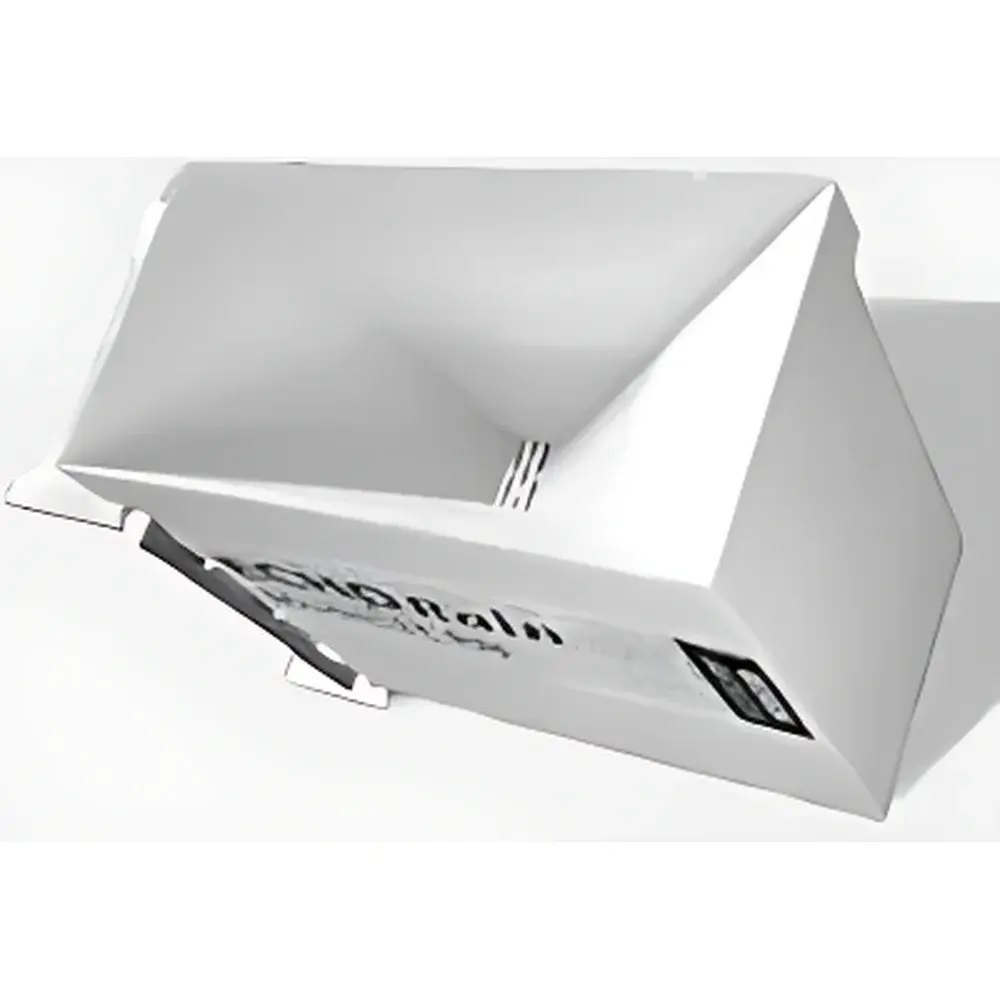
METER ECRN-50 Tipping Bucket Rain Gauge
| Brand | METER |
|---|---|
| Origin | USA |
| Manufacturer Type | Authorized Distributor |
| Import Status | Imported |
| Model | ECRN-50 |
| Pricing | Available Upon Request |
| Sensor Type | Single-Tip Tipping Bucket |
| Resolution | 1 mm |
| Output Units | gal/h or L/h (configurable) |
| Housing Material | UV-Stabilized, Waterproof, Frost-Resistant ABS Plastic |
| Operating Temperature | 0–60 °C |
| Cable Length | 5 m |
| Interface | 3.5 mm Stereo Jack (TTL Pulse Output) |
| Dimensions | 5 cm × 10 cm (Diameter × Height) |
| Data Logger Compatibility | METER ZL6, EM50/EM60 Series, ProCheck (sold separately) |
Overview
The METER ECRN-50 Tipping Bucket Rain Gauge is a field-deployable, precision precipitation measurement instrument engineered for long-term environmental monitoring in meteorological, agricultural, hydrological, and ecological research applications. Based on the well-established tipping bucket principle, the sensor mechanically translates accumulated rainfall into discrete digital pulses—each tip corresponding to a calibrated 1 mm increment of precipitation depth. This analog-to-digital transduction mechanism ensures high reproducibility under variable climatic conditions, including light drizzle, moderate showers, and intermittent convective events. Unlike optical or weighing-based alternatives, the ECRN-50 delivers robust performance without requiring real-time power or complex calibration routines, making it ideal for remote, battery-operated monitoring networks where maintenance access is limited.
Key Features
- Dual-unit configurable output: User-selectable reporting in liters per hour (L/h) or gallons per hour (gal/h), enabling seamless integration with regional data standards and legacy reporting frameworks.
- UV-stabilized ABS housing: Engineered for outdoor durability across diverse exposure environments—from arid desert stations to humid subtropical field sites—resisting degradation, water ingress, and frost-induced mechanical stress.
- High-resolution mechanical sensing: 1 mm resolution conforms to WMO Guide to Instruments and Observing Methods (CIMO Guide, Chapter 12) recommendations for standard rain gauge classification.
- Low-power TTL pulse interface: Delivers clean, noise-immune digital signals via a standardized 3.5 mm stereo jack—compatible with industry-standard dataloggers without signal conditioning.
- Compact form factor (5 cm × 10 cm): Minimizes wind-induced turbulence and splash error while supporting rapid deployment on towers, masts, or portable weather stations.
- Thermal stability across 0–60 °C: Ensures consistent tipping dynamics and minimal thermal hysteresis in both freezing-edge winter conditions and high-temperature summer deployments.
Sample Compatibility & Compliance
The ECRN-50 is designed for open-exposure mounting per ISO 20938:2017 (Hydrometry — Measurement of precipitation — Requirements for rain gauges) and ASTM D4222-18 (Standard Practice for Installation and Operation of Precipitation Gauges). Its single-bucket architecture complies with Class B specifications for non-recording and telemetered gauges used in operational hydrometric networks. While not intrinsically certified for hazardous locations, its passive mechanical design eliminates spark risk and supports installation in Class I, Division 2 environments when paired with appropriately rated datalogger enclosures. The sensor requires no routine recalibration; however, annual visual inspection and cleaning per NOAA Technical Memorandum NWS HYDRO-4 are recommended to maintain traceability to NIST-traceable reference standards.
Software & Data Management
The ECRN-50 operates as a pulse-counting peripheral and does not embed firmware or onboard storage. Data acquisition is managed externally through compatible METER platforms—including the ZL6 Environmental Monitoring System, EM50/EM60 Wireless Sensor Nodes, and ProCheck Handheld Logger—each supporting time-stamped event logging, burst-mode sampling, and automated upload to METER’s cloud-based ZENTRA Cloud platform. All supported loggers record pulse timestamps with microsecond resolution, enabling derived metrics such as instantaneous rainfall intensity, cumulative storm totals, and inter-tip interval analysis. For regulated environments (e.g., USDA ARS watershed studies or EPA NPDES compliance monitoring), ZL6 firmware supports audit-trail-enabled logging compliant with 21 CFR Part 11 requirements when deployed with appropriate user access controls and electronic signature protocols.
Applications
- Real-time watershed-scale precipitation monitoring for flood forecasting and reservoir inflow modeling.
- Soil moisture–rainfall correlation studies in eddy covariance flux towers and lysimeter networks.
- Irrigation scheduling support in precision agriculture systems integrating with soil water potential sensors (e.g., TEROS 21).
- Long-term climate trend analysis in NEON, AmeriFlux, and ILTER observational networks.
- Calibration validation for radar-derived quantitative precipitation estimates (QPE) and satellite precipitation products (e.g., GPM IMERG).
- Educational field instrumentation for university hydrology and atmospheric science laboratories.
FAQ
What is the minimum detectable rainfall rate for the ECRN-50?
The sensor resolves 1 mm of accumulated depth per tip; at typical bucket geometry and orifice size, this corresponds to a theoretical lower detection limit of ~0.2 mm/h under steady-state conditions. However, detection sensitivity depends on datalogger sampling interval and anti-chatter filtering settings.
Can the ECRN-50 be used in freezing conditions?
Yes—the housing and tipping mechanism are rated for operation down to 0 °C. For sustained sub-zero deployment, supplemental heating or wind shielding is recommended to prevent rim icing and undercatch; METER offers optional radiation shields (e.g., NR01) to mitigate thermal advection errors.
Is the 3.5 mm interface compatible with Campbell Scientific or Onset HOBO loggers?
Yes—when configured for open-collector TTL pulse output, the ECRN-50 interfaces directly with Campbell CR1000X/CR6 and HOBO U30-NRC dataloggers using standard pulse-counting channels and appropriate pull-up resistors.
Does the ECRN-50 require periodic recalibration?
No—its mechanical calibration is factory-set and stable over time. Field verification using a NIST-traceable graduated cylinder and controlled water pour test is recommended annually per WMO guidelines.
How does the ECRN-50 compare to weighing-type rain gauges in terms of accuracy?
Tipping bucket gauges like the ECRN-50 exhibit higher dynamic response to rapid intensity changes but may undercatch during low-intensity, high-wind, or frozen-precipitation events. Weighing gauges offer superior accuracy for total accumulation but require temperature-compensated load cells and more frequent maintenance.