
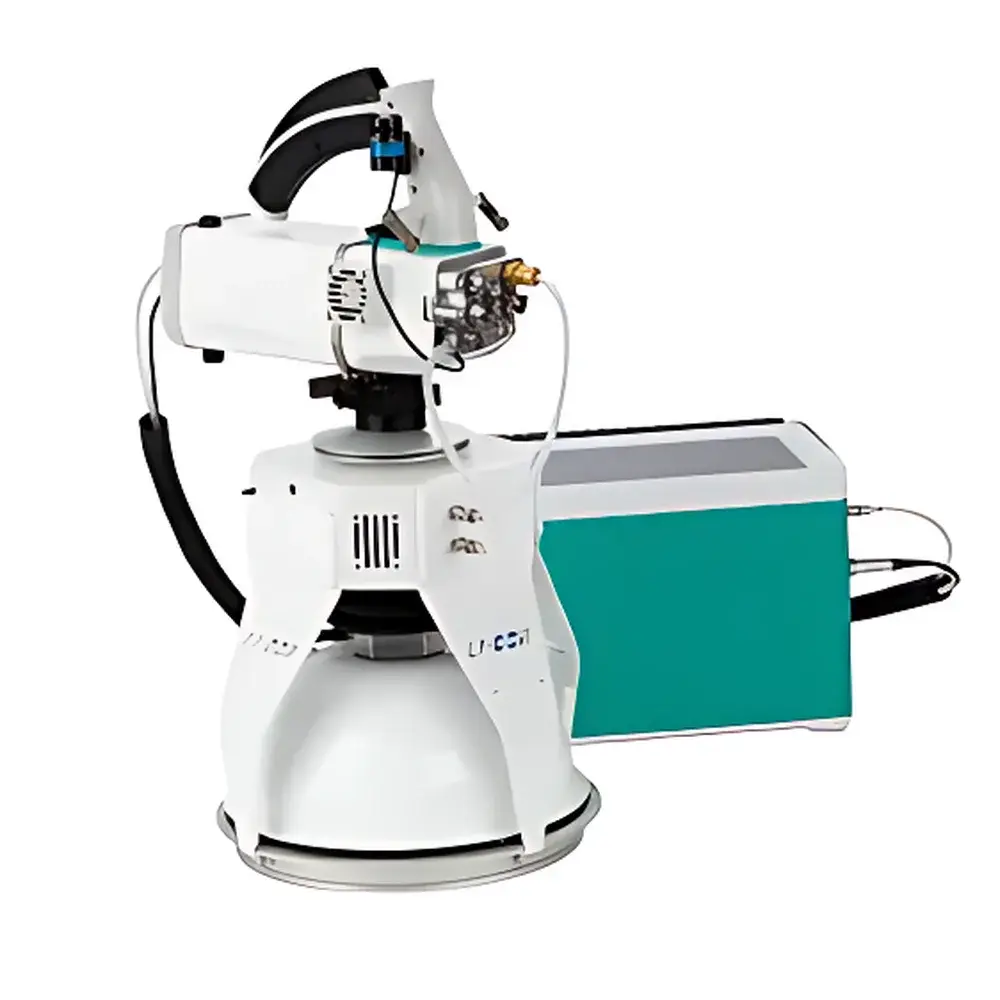
LI-COR 6800-09 Soil Carbon and Water Flux Chamber
| Brand | LI-COR |
|---|---|
| Origin | USA |
| Model | 6800-09 |
| Internal Chamber Volume | 4244.1 cm³ |
| IRGA Cell Volume | 57 cm³ |
| Sampling Area | 317.8 cm² (49.3 in²) |
| Air Temperature Sensor (Thermistor) | Range: −20 to 45 °C, Accuracy: ±0.5 °C (0–70 °C) |
| Weight | 4.06 kg |
Overview
The LI-COR 6800-09 Soil Carbon and Water Flux Chamber is a precision-engineered, portable chamber module designed for high-temporal-resolution measurement of surface-level CO₂ and H₂O fluxes from soil and low-canopy ecosystems. It operates as an integral component of the LI-6800 Portable Photosynthesis System, interfacing directly with the system’s integrated infrared gas analyzer (IRGA), flow control unit, and environmental sensors. The chamber employs a closed-path, non-steady-state (dynamic) accumulation method—based on first-order mass balance principles—to quantify net ecosystem exchange (NEE) of carbon dioxide and evapotranspiration (ET)-linked water vapor fluxes. Its 20 cm internal diameter and optimized chamber geometry minimize boundary layer disturbance while ensuring rapid equilibration and high signal-to-noise ratio under field conditions. As a globally adopted standard in soil biogeochemistry and eddy-covariance validation studies, the 6800-09 enables reproducible, traceable flux measurements compliant with established protocols including AmeriFlux, ICOS, and FLUXNET guidelines.
Key Features
- Optimized chamber design with 20 cm inner diameter and 4244.1 cm³ total internal volume ensures minimal pressure perturbation and robust integration with LI-6800’s real-time feedback-controlled air handling system.
- Dedicated thermistor-based air temperature sensor (−20 to 45 °C; ±0.5 °C accuracy within 0–70 °C range) mounted at chamber inlet provides precise thermal reference for flux calculation and density corrections.
- Integrated soil moisture and temperature probe (sold separately or as part of optional sensor suite) enables concurrent monitoring of key drivers of microbial respiration and diffusion-limited gas transport.
- Low-volume (57 cm³) IRGA cell interface minimizes lag time and enhances temporal resolution—supporting sub-minute flux estimation suitable for spatial heterogeneity mapping and diel cycle analysis.
- Lightweight aluminum alloy construction (4.06 kg) and modular mounting interface allow rapid deployment across diverse terrain types, including grasslands, agricultural plots, tundra, and restored wetlands.
Sample Compatibility & Compliance
The 6800-09 chamber is compatible with mineral and organic soils, litter layers, moss mats, and shallow-rooted vegetation up to ~15 cm height. Its 317.8 cm² sampling area (49.3 in²) balances spatial representativeness with portability and signal stability. All materials contacting sample surfaces are inert (anodized aluminum, fluoropolymer gaskets), preventing catalytic interference or adsorption artifacts. The chamber meets ASTM D6196-21 requirements for soil gas emission testing methodology and supports GLP-compliant workflows when used with LI-6800’s audit-trail-enabled firmware and timestamp-synchronized data logging. Data acquisition adheres to ISO 14064-3 verification criteria for greenhouse gas inventory reporting where chamber-based flux estimates serve as ground-truth inputs.
Software & Data Management
Raw concentration-time series from the 6800-09 are streamed in real time to the LI-6800 console and exported in standardized .csv and .xls formats. Integration with SoilFlux Pro™ software enables automated flux calculation using multiple regression models—including linear, quadratic, and exponential fitting—as well as manual review, outlier flagging, and batch reprocessing. SoilFlux Pro™ supports metadata tagging (e.g., soil texture class, antecedent precipitation, collar insertion depth), georeferenced mapping via GPS-linked coordinates, and export to R, Python (via pandas), or MATLAB for advanced statistical modeling. All processing steps generate immutable audit logs compliant with FDA 21 CFR Part 11 requirements when configured with user authentication and electronic signatures.
Applications
- Quantification of soil respiration (Rs) and autotrophic/heterotrophic partitioning in response to land-use change, fertilization, or drought stress.
- Validation and downscaling of eddy covariance tower measurements through spatially distributed chamber networks.
- Assessment of carbon sequestration potential in regenerative agriculture and afforestation projects.
- Soil-atmosphere exchange studies of stable isotopes (δ¹³C-CO₂, δ¹⁸O-H₂O) when coupled with isotope-ratio IRGAs.
- Method development for standardized GHG flux protocols under IPCC Tier 2 and Tier 3 reporting frameworks.
FAQ
Is the 6800-09 chamber compatible with instruments other than the LI-6800?
No—it is engineered exclusively for seamless hardware and firmware integration with the LI-6800 Portable Photosynthesis System and requires its proprietary gas handling, pressure regulation, and data synchronization architecture.
Can the chamber be used for CH₄ or N₂O flux measurements?
Not natively—the 6800-09 relies on the LI-6800’s dual-wavelength IRGA optimized for CO₂ and H₂O. For trace gas analysis, users must integrate compatible tunable diode laser (TDL) or cavity ring-down spectrometers external to the chamber system.
What collar depth is recommended for optimal sealing and minimal root disturbance?
A 5–8 cm insertion depth into mineral soil is standard; deeper placement (>10 cm) may compress macropores and bias diffusion-driven flux estimates downward.
Does the chamber include built-in soil moisture sensing?
The base 6800-09 unit does not include soil sensors—these are available as optional add-ons (e.g., LI-192SA soil moisture/temperature probe) and require separate calibration and connection to the LI-6800 analog input ports.
How frequently should the chamber seal and gasket be inspected in field use?
Inspect before each deployment cycle; replace fluoropolymer gaskets annually or after 200 field insertions to maintain leak-tight integrity below 0.1 µmol mol⁻¹ s⁻¹ CO₂ drift.
Related Products







