
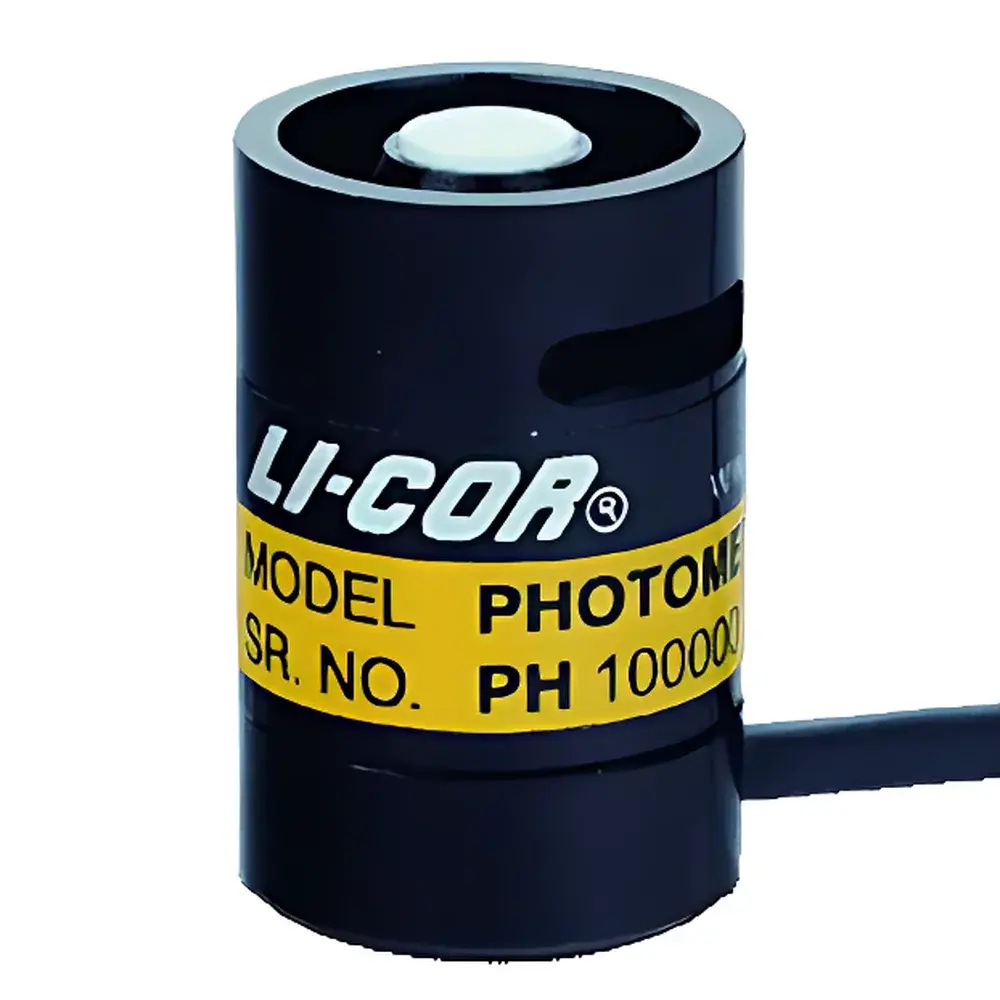
LI-COR LI-210R Visible Light Quantum Sensor
| Brand | LI-COR |
|---|---|
| Origin | USA |
| Model | LI-210R |
| Spectral Range | 450–650 nm |
| Output Unit | lux / klux |
| Calibration Uncertainty | ±5% (absolute) |
| Sensitivity | 30 µA per 100 klux (typical) |
| Linearity | ≤1% (up to 100 klux) |
| Response Time | <1 µs |
| Temperature Dependence | ±0.15%/°C |
| Cosine Correction Accuracy | ±1% up to 82° incidence angle |
| Azimuthal Error | <±1% over 360° at 45° elevation |
| Tilt Independence | No orientation-dependent bias |
| Operating Environment | −40 to +65°C, 0–100% RH (non-condensing) |
| Detector | Blue-enhanced silicon photovoltaic cell |
| Housing | Anodized aluminum with acrylic diffuser and stainless steel mounting hardware |
| Dimensions | 2.36 cm Ø × 3.63 cm H |
| Head Mass | 24 g |
| Cable Options | 2 m, 5 m, 15 m, or 50 m |
| Compatible Loggers | LI-1500, LI-250A, 2420 Amplifier, mV Adapter 2003S, Leveling Base 2001S/2003S, Protective Hood |
Overview
The LI-COR LI-210R Visible Light Quantum Sensor is a precision-calibrated photometric instrument engineered for accurate measurement of illuminance in the human-visible spectral band (450–650 nm). Unlike broadband radiometric sensors, the LI-210R incorporates a spectrally selective optical filter matched to the CIE 1931 photopic luminosity function—ensuring photometric response closely aligned with standardized human visual sensitivity. It operates on the principle of photocurrent generation in a blue-enhanced silicon photovoltaic detector, delivering stable, zero-bias output proportional to incident visible light flux. Designed for both indoor and semi-outdoor applications—including workplace lighting assessment, architectural daylighting analysis, display illumination validation, and glazing transmittance characterization—the LI-210R provides traceable, repeatable lux-level quantification under variable angular and thermal conditions.
Key Features
- CIE-matched spectral response: Optimized filter transmission profile replicates the V(λ) curve within ±3% across 450–650 nm, enabling metrologically sound illuminance reporting per ISO/CIE standards.
- High-fidelity cosine correction: Precision-machined acrylic diffuser and head geometry ensure angular response deviation remains ≤±1% up to 82° incidence angle—critical for measurements under non-perpendicular illumination geometries.
- Thermal stability: Compensated detector design limits temperature-induced drift to ±0.15%/°C, supporting reliable operation across industrial and environmental chambers (-40 to +65°C).
- Rapid temporal response: <1 µs rise/fall time enables capture of transient lighting events, including pulsed LED sources and flicker analysis when paired with high-speed data loggers.
- Modular mechanical architecture: Removable sensor head facilitates field recalibration and contamination-free maintenance without disassembly of cabling or mounting hardware.
- Robust environmental sealing: Anodized aluminum housing with O-ring base seal and IP67-rated construction ensures integrity in humid, dusty, or intermittently wet locations.
Sample Compatibility & Compliance
The LI-210R is validated for use with standard photometric data acquisition systems compliant with IEC 61262, ISO 8995-1 (lighting of work places), and EN 12464-1. Its absolute calibration traceability extends to NIST via LI-COR’s ISO/IEC 17025-accredited calibration laboratory. The sensor meets GLP documentation requirements for audit-ready illumination validation in pharmaceutical cleanrooms, clinical lighting audits, and LEED daylight credit verification. It is compatible with continuous monitoring setups operating under FDA 21 CFR Part 11-compliant software environments when integrated with LI-1500 or third-party DAQ platforms supporting electronic signature and audit trail functionality.
Software & Data Management
Raw analog output (current mode, 0–30 µA full scale) is compatible with LI-COR’s LI-1500 Smart Sensor Logger and LI-250A Light Meter, both offering onboard lux scaling, auto-ranging, and timestamped CSV export. When interfaced with the 2420 Signal Amplifier and millivolt adapter 2003S, the LI-210R supports integration into SCADA, LabVIEW, or Python-based acquisition frameworks via standard 0–5 V or 4–20 mA analog inputs. Firmware-upgradable loggers provide configurable averaging intervals (100 ms to 1 h), alarm thresholds, and memory buffering—enabling long-term illuminance trend analysis aligned with ISO 8995-1 uniformity metrics (e.g., U1 = Emin/Eavg, U2 = Emin/Emax). All calibration coefficients are stored in EEPROM and auto-applied upon connection.
Applications
- Quantitative evaluation of task lighting compliance in office, healthcare, and educational facilities per EN 12464-1 minimum illuminance requirements.
- Daylight harvesting system commissioning—measuring sky component contribution and glare potential through vertical and horizontal plane illuminance mapping.
- LED product development: Characterizing spatial uniformity, chromaticity-independent illuminance output, and thermal derating behavior across drive currents.
- Architectural glazing performance testing—comparing transmitted vs. incident lux ratios to determine visible light transmittance (VLT) in double-skin façades.
- Photobiological safety screening: Supporting IEC/TR 62778 assessments by providing spectrally filtered irradiance data relevant to photopic hazard weighting.
- Calibration transfer between reference-grade illuminance meters and production-line test benches in lighting manufacturing QA/QC labs.
FAQ
Is the LI-210R suitable for outdoor solar irradiance measurements?
No. The LI-210R is strictly limited to the 450–650 nm photopic band and lacks UV/NIR rejection required for solar pyranometry. For total solar irradiance, use the LI-200SZ or LI-210S.
Can the LI-210R be used with third-party data loggers?
Yes—provided the logger accepts 0–30 µA current input or is paired with the 2420 amplifier and 2003S mV adapter for voltage output scaling.
What is the recommended recalibration interval?
LI-COR recommends annual recalibration for applications requiring ISO/IEC 17025 traceability; biennial verification is acceptable for routine facility monitoring where drift tolerance exceeds ±3%.
Does the sensor require external power?
No. The LI-210R is a passive photovoltaic device generating self-powered current output; no excitation voltage or bias supply is needed.
How does the LI-210R differ from the LI-200R?
The LI-210R replaces the LI-200R’s broader 400–700 nm quantum response with a narrower, CIE-weighted 450–650 nm band optimized specifically for photometric (lux) rather than photosynthetic (PPFD) applications.
Related Products






