
METER SKS20 Soil Pore Water Sampler System with VS-Pro Vacuum Controller
| Brand | METER |
|---|---|
| Origin | USA |
| Manufacturer Type | Authorized Distributor |
| Origin Category | Imported |
| Model | SKS20 Pore Water Sampler System |
| Vacuum Controllers | VS-Pro, VacuPorter, VPS-2 |
| Sampling Principle | Suction-based ceramic cup extraction under controlled negative pressure |
| Ceramic Cup Material | Sintered aluminum oxide |
| Cup Dimensions | Ø2 cm × 6 cm |
| Dead Volume | Minimal |
| pH Range | 4–9 |
| Bubble Point | –100 kPa |
| Sampling Rate (Free Water, –50 kPa) | ~5 mL / 10 min |
| Sampling Rate (Sandy Loam, –50 kPa) | ~5 mL / h |
| Vacuum Range (VS-Pro) | 0 to –85 kPa |
| Vacuum Accuracy (VS-Pro) | ±0.05 kPa |
| Power Supply (VS-Pro) | 10.5–15 VDC |
| Current Draw (VS-Pro, Operating) | ~15–16 mA |
| Memory Capacity (VS-Pro) | 5,000 readings |
| Enclosure Rating (VS-Pro) | IP66 |
| Operating Temperature (VS-Pro) | –10 °C to 45 °C |
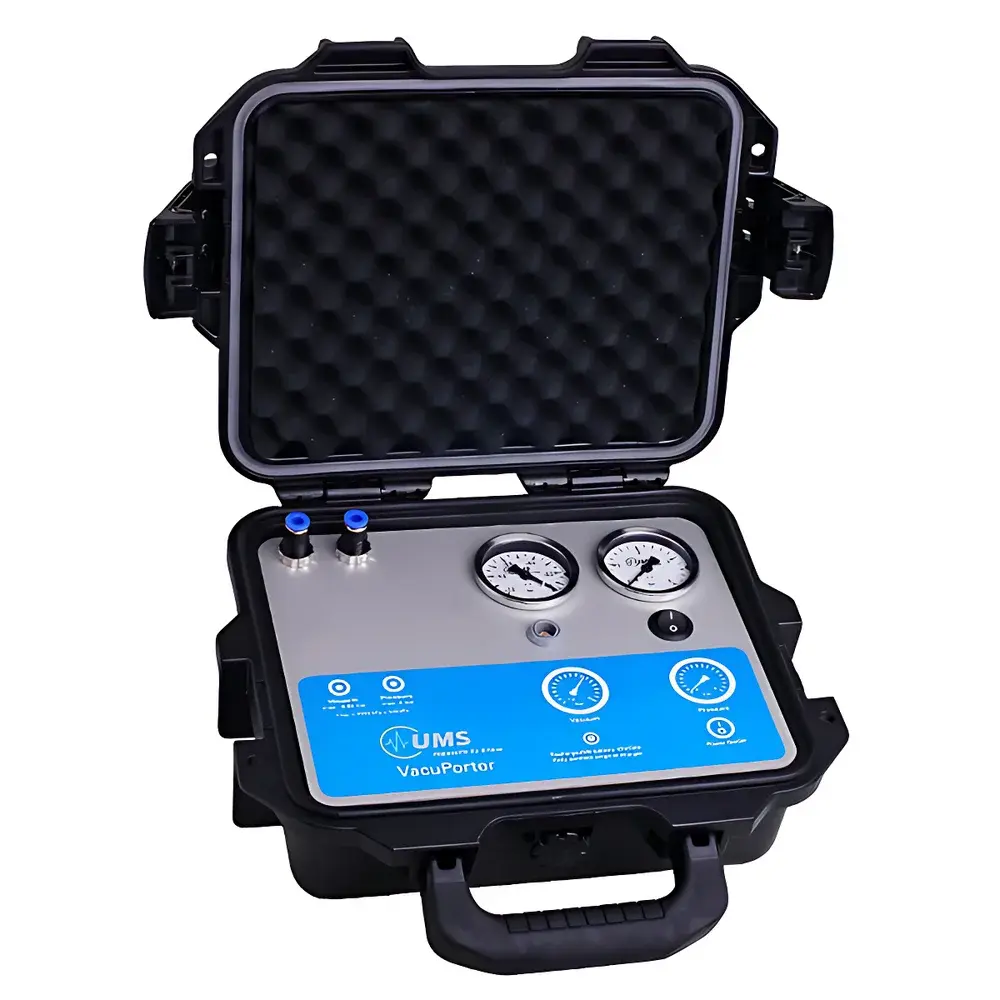
| VacuPorter Max Vacuum | –85 kPa @ 1 bar |
| VacuPorter Flow Rate | 10 L/min |
| VacuPorter Battery Life | 7 h |
| VPS-2 Max Vacuum | –85 kPa @ 1 bar |
| VPS-2 Displacement | 0.41 L/stroke |
Overview
The METER SKS20 Soil Pore Water Sampler System is an engineered field-deployable solution for the in situ extraction and collection of soil solution—the aqueous phase residing within soil pore spaces. It operates on the principle of suction-controlled equilibrium sampling, wherein a sintered aluminum oxide ceramic cup serves as a semi-permeable interface between the soil matrix and the extraction manifold. When subjected to calibrated negative pressure via an integrated vacuum controller (e.g., VS-Pro), the system induces water flow across the ceramic membrane only when the applied tension exceeds the soil water matric potential—ensuring representative, minimally disturbed sampling of mobile solutes. This method is grounded in Richards’ equation and adheres to established pedological sampling theory, enabling quantitative retrieval of dissolved ions and low-molecular-weight organics without mechanical disturbance or preferential flow artifacts. The SKS20 is not a passive lysimeter; rather, it is a tension-controlled, active extraction platform designed for both discrete event sampling and long-term monitoring deployments in heterogeneous vadose zone environments.
Key Features
- Sintered aluminum oxide ceramic cup (Ø2 cm × 6 cm) with bubble point of –100 kPa, optimized for high hydraulic conductivity and chemical inertness toward nitrate, chloride, sulfate, Ca²⁺, Na⁺, NH₄⁺, and phosphate.
- Minimal dead volume design ensures rapid equilibration and reduces sample carryover between extractions—critical for sequential time-series analysis.
- Modular construction: replaceable ceramic cup and central shaft allow for field maintenance and material-specific customization (e.g., alternate cup chemistries for trace metal applications).
- Three vacuum control options: VS-Pro (programmable, data-logging, tensiometer-integrated), VacuPorter (portable, battery-powered, single-bottle evacuation), and VPS-2 (robust manual pump for high-throughput field campaigns).
- VS-Pro controller features RS485 and tensioLINK interfaces, dual analog outputs (0–1 V, 0–5 V), and onboard memory storing up to 5,000 timestamped vacuum and tension readings—enabling GLP-compliant audit trails.
- IP66-rated aluminum enclosure and operating range of –10 °C to 45 °C ensure reliability across temperate, arid, and humid field conditions.
Sample Compatibility & Compliance
The SKS20 system is validated for extraction of soil solutions from mineral soils ranging from sandy loam to silty clay, provided matric potentials fall within the operational tension window (typically –1 to –85 kPa). It is widely cited in ASTM D4448 (Standard Guide for Sampling Groundwater Monitoring Wells) and ISO 5667-11 (Water quality — Sampling — Part 11: Guidance on groundwater sampling) for unsaturated zone solution sampling. While suitable for anions, cations, and polar organics, the aluminum oxide cup is not recommended for dissolved heavy metals (e.g., Pb²⁺, Cd²⁺, Cu²⁺) due to surface complexation and adsorption—users requiring trace metal integrity should implement post-extraction acidification or consider alternative cup materials per USP /. All controllers comply with IEC 61326-1 for electromagnetic compatibility in laboratory and field use.
Software & Data Management
The VS-Pro controller integrates seamlessly with METER’s proprietary software suite (including Em50/Em60 configuration tools and cloud-based ZENTRA Cloud). Raw vacuum setpoints, measured soil water tension (when paired with a tensiometer), and system status logs are exportable in CSV format with UTC timestamps. Data streams support automated QA/QC flagging (e.g., out-of-range tension alerts, battery voltage decay trends) and can be mapped to LIMS via API endpoints. For regulated environments, the VS-Pro supports 21 CFR Part 11–compliant user access controls, electronic signatures, and immutable audit logs when deployed with appropriate IT infrastructure and validation protocols.
Applications
- Long-term biogeochemical monitoring of nitrate leaching in agricultural watersheds.
- Validation of reactive transport models in unsaturated zone hydrology studies.
- Contaminant plume delineation (e.g., chloride breakthrough, pesticide metabolites) at landfill and brownfield sites.
- Soil solution chemistry characterization for plant nutrient availability assessments (e.g., K⁺, NO₃⁻, H₂PO₄⁻ speciation).
- Calibration and verification of in situ soil moisture and solute sensors (e.g., TEROS 21, GS3).
- Supporting ISO 10381-3 (soil sampling — Part 3: Guidance on sampling of soil solution) compliant site investigations.
FAQ
What is the minimum soil water tension required for effective sampling with the SKS20?
Effective extraction begins when soil matric potential is more negative than the applied vacuum tension—for example, at –50 kPa vacuum, sampling initiates only where soil tension is < –50 kPa. In coarse-textured soils, this may require drier conditions; fine-textured soils permit sampling at higher water contents.
Can the SKS20 be used for trace metal analysis?
Not without modification: the aluminum oxide cup exhibits affinity for many transition metals. For trace metal work, users must either apply rigorous cup pre-treatment (e.g., HNO₃ soaking), employ post-sampling chelation, or select alternative cup materials—consult application notes for EPA Method 1311 TCLP-compliant adaptations.
How often should the ceramic cup be cleaned or replaced?
Cups should be rinsed with deionized water after each use and soaked in 10% HNO₃ for 24 h quarterly. Replace cups if bubble point shifts >10% from baseline or if physical cracking or discoloration is observed.
Is the VS-Pro controller compatible with third-party data loggers?
Yes—via RS485 Modbus RTU or analog voltage output (0–1 V or 0–5 V), the VS-Pro can feed vacuum and tension data into Campbell Scientific CR series, Onset HOBO, or other Modbus-compatible loggers.
Does the system meet FDA or EU regulatory requirements for environmental monitoring?
While the hardware itself is not “certified,” its measurement traceability, data integrity features (audit trail, electronic signatures), and adherence to ISO/ASTM standards enable compliance with GMP/GLP environmental monitoring programs when implemented within a validated SOP framework.






