
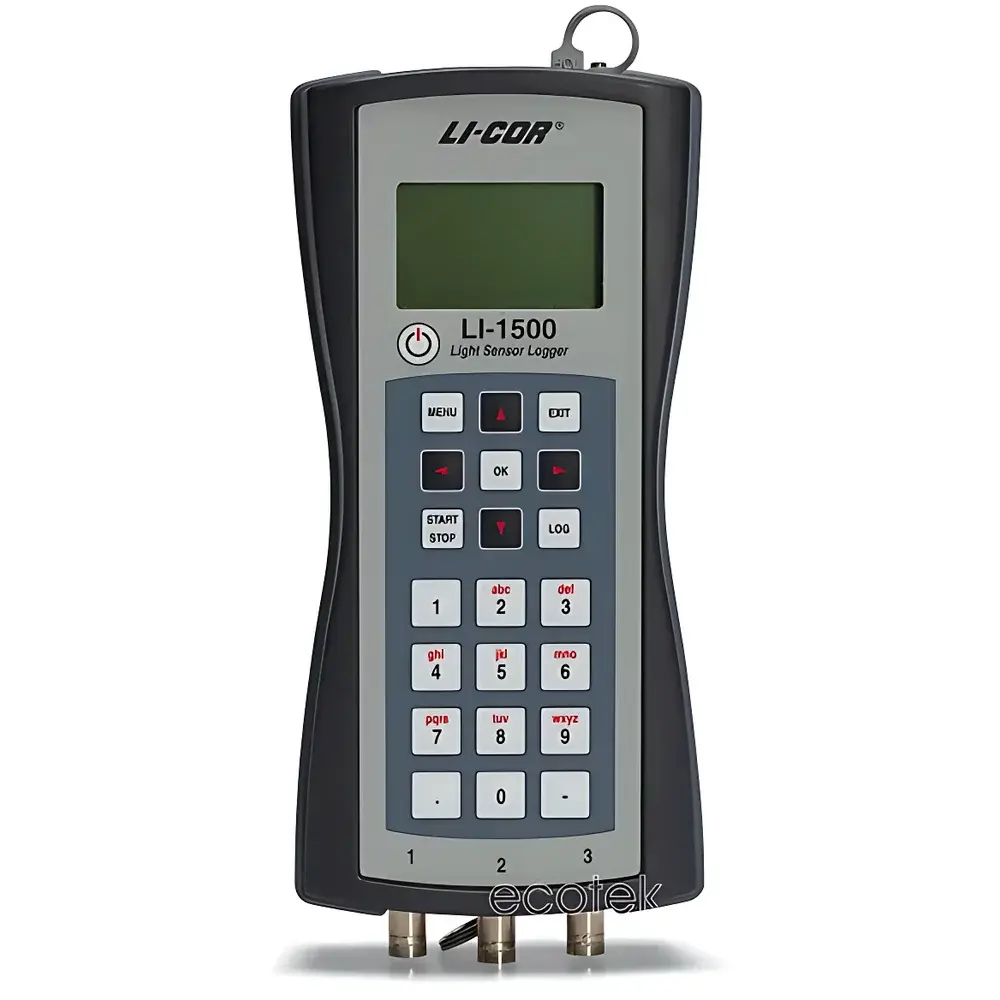
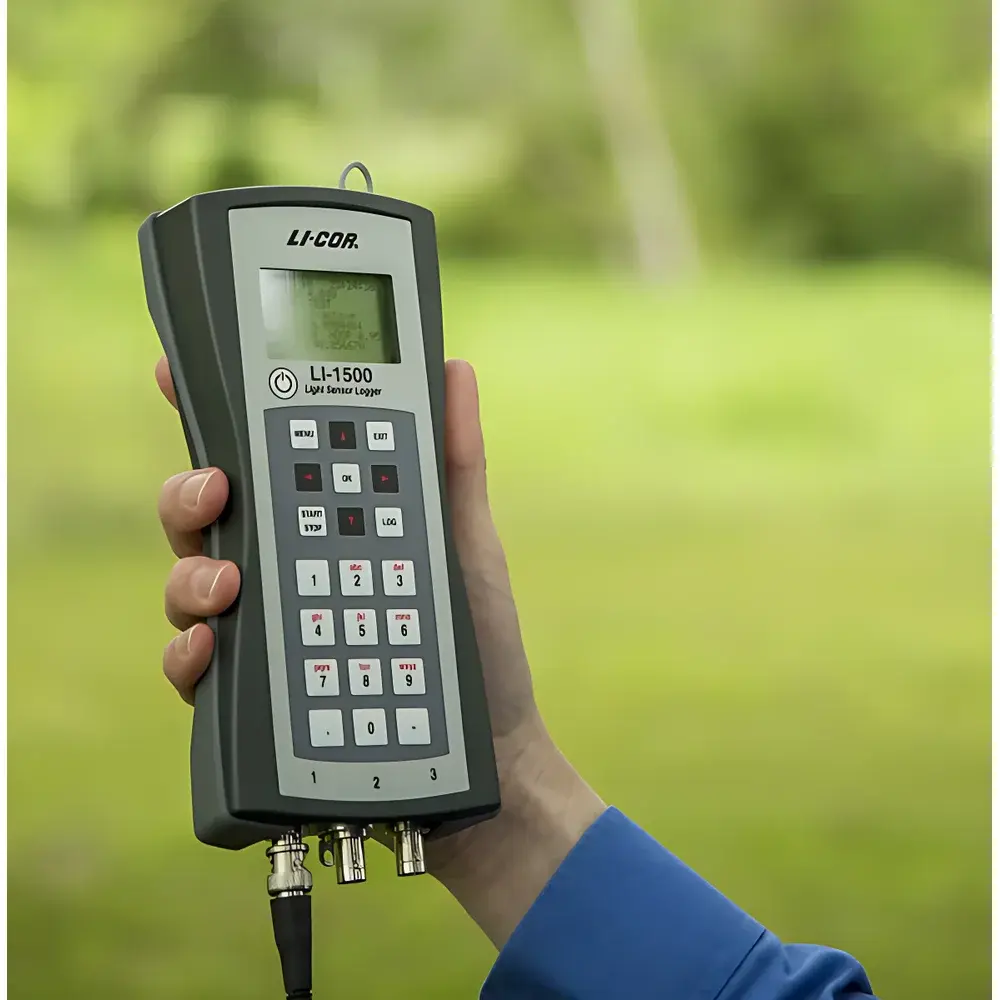
LI-COR LI-1500 Light and Radiation Data Logger
| Brand | LI-COR |
|---|---|
| Origin | USA |
| Model | LI-1500 |
| Input Channels | 3 BNC (current-output sensors) |
| Sampling Rate | up to 500 Hz (raw mode), 0.01–20 Hz (standard mode) |
| Storage Capacity | 1 GB FAT16 |
| GPS Option | Radiosonde Nova® RF Antenna Module (CEP ≤ 2.5 m, 1 Hz update rate) |
| Operating Temperature | –20 to +50 °C |
| Battery Life | up to 80 h (GPS off), 40 h (GPS on) |
| Weight | 0.454 kg (with batteries) |
| Compliance | Designed for ASTM E2917, ISO 9060:2018 Class C spectral response alignment (when used with LI-COR PAR, solar, or visible light sensors) |
Overview
The LI-COR LI-1500 Light and Radiation Data Logger is a field-deployable, high-fidelity data acquisition system engineered specifically for precision radiometric measurements in agricultural, ecological, and environmental research. Unlike general-purpose loggers, the LI-1500 integrates native hardware-level support for LI-COR’s family of calibrated analog current-output sensors—including quantum sensors (e.g., LI-190R, LI-192SA), pyranometers (LI-200R), and underwater PAR sensors (LI-193SA)—enabling traceable, low-noise signal conditioning optimized for photosynthetically active radiation (PAR, 400–700 nm) and broadband solar irradiance. Its core architecture implements dual-mode sampling: standard mode for long-term ecological monitoring (with configurable averaging and time-stamped logging), and raw mode for transient optical analysis—including LED flicker characterization, pulsed-light response studies, and rapid photobiological event capture at up to 500 Hz per channel. All measurements are synchronized with an internal real-time clock (±3 min/month drift) and—when equipped with the optional GPS module—georeferenced to sub-3-meter horizontal accuracy under open-sky conditions, supporting repeatable spatial surveys and diurnal transect analysis.
Key Features
- Triple-channel BNC input interface with programmable gain and auto-ranging (four selectable current ranges: 0.25–250 µA), delivering ±0.3% full-scale accuracy at 25 °C and >70 dB line-frequency noise rejection at 50/60 Hz.
- Dual sampling architecture: standard mode (0.01–20 Hz) with built-in mathematical operations (addition, subtraction, multiplication, division, natural logarithm, integration, daily integral, exponential decay modeling); raw mode (1–500 Hz integer-step) for unaveraged time-series capture.
- Integrated 128 × 64 graphical display with intuitive menu-driven navigation—no PC required for field setup, calibration coefficient loading, or manual data acquisition.
- 1 GB internal FAT16 storage supports >100 preloaded sensor calibration coefficients and accommodates multi-year deployments at 1 Hz logging across all channels.
- Optional GPS module (Radiosonde Nova® RF Antenna) provides autonomous geotagging with 1 Hz position updates, cold-start TTFF <37 s, and CEP ≤2.5 m—fully compatible with post-processing in GIS and time-series alignment tools.
- Ruggedized handheld enclosure rated for continuous operation from –20 to +50 °C and 0–95% RH (non-condensing); IP67-rated when sealed; powered by four AA alkaline cells (40–80 h life) or USB bus power (including external battery packs).
Sample Compatibility & Compliance
The LI-1500 is validated for use with LI-COR’s ecosystem of NIST-traceably calibrated optical sensors, including terrestrial and submersible quantum sensors (LI-190R, LI-192SA, LI-193SA), silicon-cell pyranometers (LI-200R), and visible-light sensors (LI-189). When paired with these devices, the system complies with measurement practices referenced in ASTM E2917 (Standard Practice for Determining Photosynthetic Photon Flux Density), ISO 9060:2018 (Solar energy — Specification and classification of instruments for measuring hemispherical solar and direct solar radiation), and USDA ARS field protocol guidelines for canopy light interception studies. The logger itself does not require regulatory certification but is designed to support GLP-compliant data integrity workflows—metadata (timestamp, GPS, battery voltage, sensor ID, range selection) is embedded in every recorded file, and firmware enforces write-once file structure to prevent post-acquisition modification.
Software & Data Management
Data export occurs via USB mass-storage mode: no proprietary drivers required. Binary files (.dat) are structured in ASCII-delimited format with header metadata, directly importable into MATLAB, Python (pandas), R, or Excel. LI-COR’s FV7x00 software (Windows/macOS) provides visualization, spectral weighting application, PAR attenuation profiling (e.g., depth-resolved underwater PAR decay modeling using Beer–Lambert calculations), and batch calibration coefficient management. All timestamps adhere to UTC, and GPS-tagged records include latitude, longitude, altitude, PDOP, and fix status. Audit trails are maintained through immutable file creation timestamps and internal RTC logs; while the LI-1500 does not implement FDA 21 CFR Part 11 electronic signature controls, its deterministic file generation and metadata-rich output meet baseline requirements for scientific reproducibility and peer-review data submission.
Applications
- Agricultural canopy light interception mapping—quantifying PAR distribution across crop rows, orchards, or greenhouse zones using synchronized upward/downward-facing sensor arrays.
- Aquatic ecology: profiling underwater PAR extinction coefficients (Kd) with LI-193SA sensors deployed at discrete depths; calculating euphotic zone depth and primary productivity proxies.
- LED lighting validation: characterizing temporal modulation (flicker index, percent flicker) of horticultural lighting systems at frequencies up to 500 Hz—critical for photomorphogenic response studies.
- Long-term phenology monitoring: deploying stationary units with GPS georeferencing to track seasonal changes in incident solar radiation, diffuse-to-global ratios, and cloud cover indices.
- Microclimate network integration: serving as edge-node data concentrator in wireless sensor networks (via USB-connected gateways), aggregating multi-sensor PAR, temperature, and humidity streams.
FAQ
Can the LI-1500 log data from non-LI-COR sensors?
The LI-1500 is optimized for LI-COR’s 0–250 µA current-output sensors. While it may accept other 4–20 mA or 0–5 V sources with external signal conditioning, factory calibration, accuracy specifications, and software compatibility are only guaranteed for LI-COR-branded transducers.
Does the GPS module store location data independently of light measurements?
Yes—the GPS engine operates autonomously and can record position fixes at 1 Hz even when no sensors are connected or actively sampled. Geotags are merged with radiometric data only upon user-defined synchronization during configuration.
How is sensor calibration maintained across field deployments?
The LI-1500 stores up to 100 full calibration coefficients (slope, offset, nonlinearity terms) internally. Each sensor is assigned a unique ID; upon connection, the logger auto-selects the matching calibration set, eliminating manual coefficient entry in the field.
Is the 1 GB memory expandable?
No—the internal flash memory is fixed and non-upgradable. However, FAT16 formatting ensures broad cross-platform compatibility, and files can be offloaded in the field using any USB-capable device (e.g., tablet, laptop, portable SSD).
What happens if the battery dies mid-recording?
The LI-1500 writes data in atomic blocks and maintains a persistent journal of the last successful write address. Upon restart, logging resumes seamlessly without data corruption or timestamp gaps—verified across >10,000 power-cycle tests in accelerated aging trials.





