
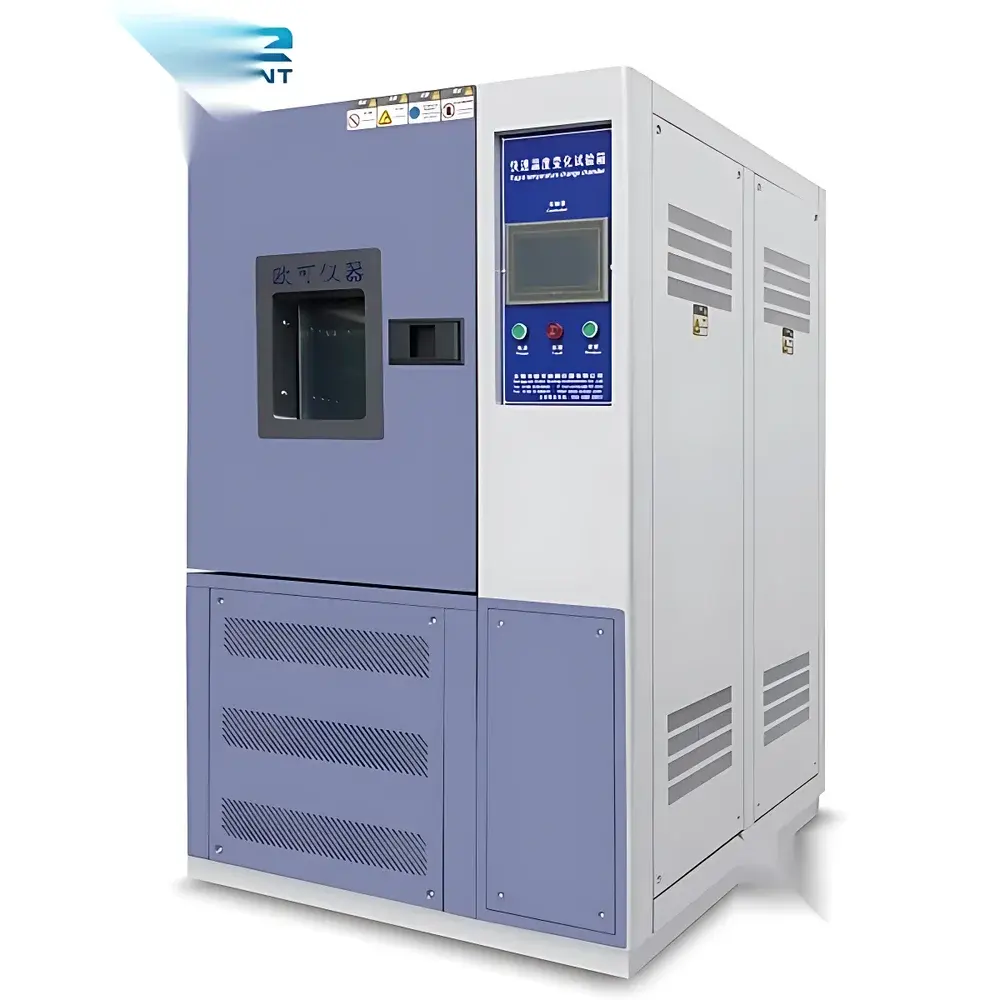
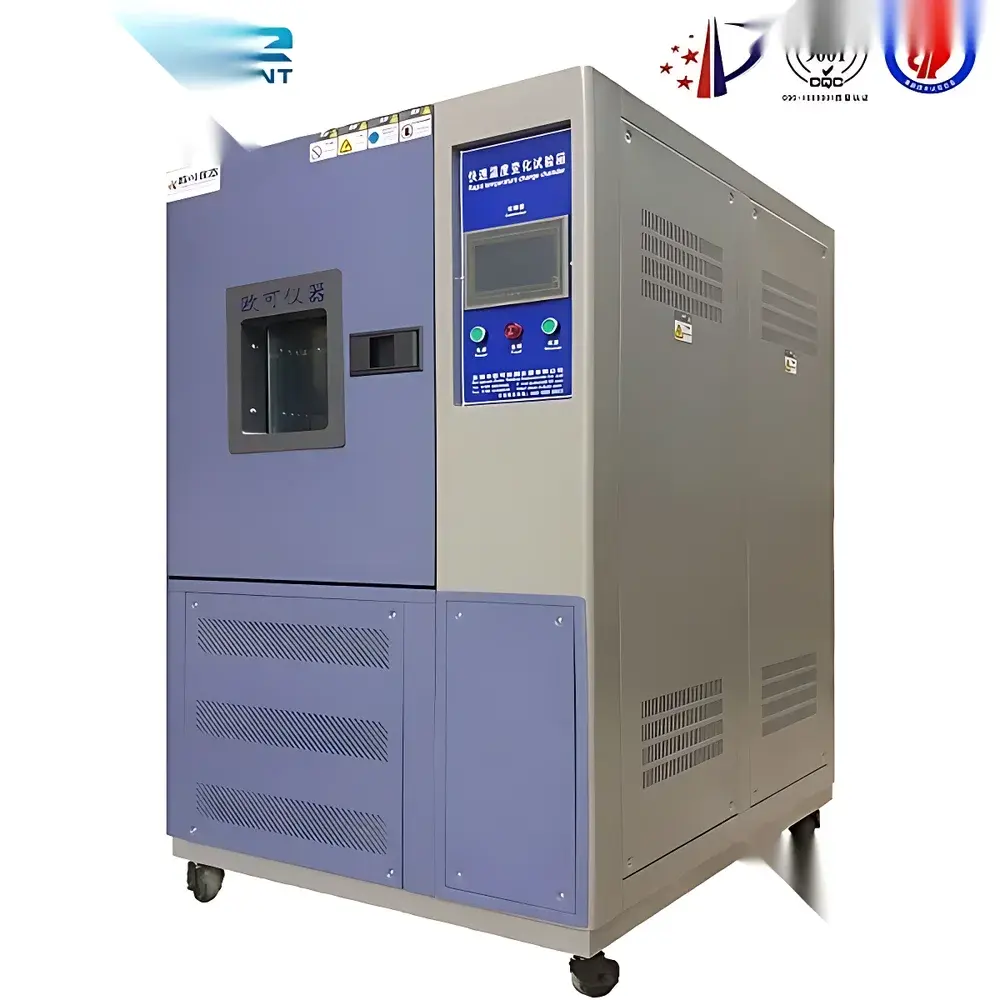
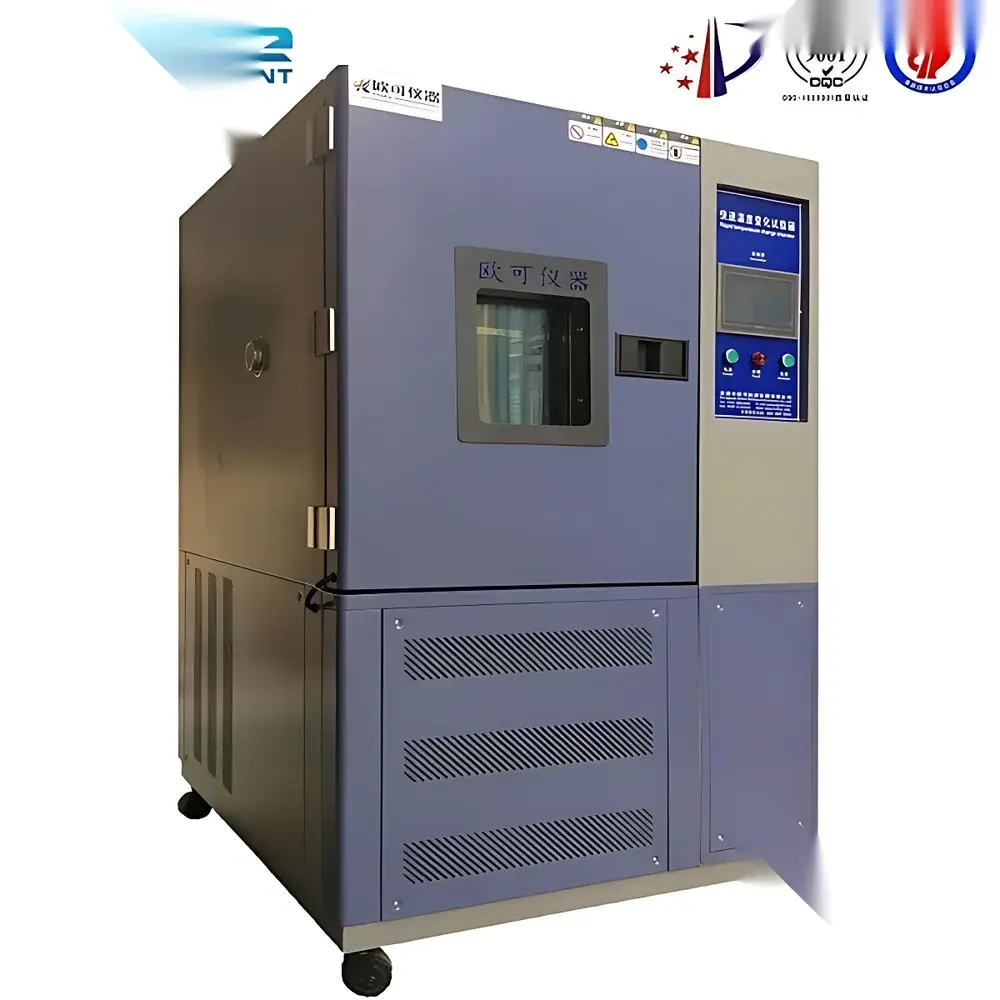
OKE KS-TH Series Rapid Temperature Change Environmental Test Chamber
| Brand | OKE |
|---|---|
| Origin | Imported |
| Manufacturer Type | Authorized Distributor |
| Temperature Range | -70°C to +150°C |
| Humidity Range (optional) | 20–98% RH |
| Rapid Temperature Transition Range | -45°C to +85°C |
| Transition Rate Options | 5–30°C/min (linear or non-linear, selectable) |
| Temperature Control Accuracy | ±0.5°C |
| Humidity Control Accuracy (optional) | ±2.5% RH |
| Temperature Uniformity | ±2.0°C |
| Humidity Uniformity (optional) | ±3.0% RH |
| Temperature Resolution | 0.1°C |
| Humidity Resolution (optional) | 0.1% RH |
| Internal Dimensions (W×H×D, mm) | 500×600×500 to 1000×1000×1000 |
| External Dimensions (W×H×D, mm) | 1750×2250×2350 to 2350×2800×3000 |
| Weight | 950–2300 kg |
| Power Supply | AC 380 V, 3-phase 5-wire, 50/60 Hz |
| Refrigeration System | Air-cooled, hermetic compressors (Tecumseh or Bitzer) |
| Controller | Siemens PLC with 7-inch full-color TFT touchscreen interface |
| Communication Interface | 10/100 Mbps Ethernet |
| Compliance | Designed for ISO 17025-compliant test environments, supports GLP/GMP audit trails via optional software logging |
Overview
The OKE KS-TH Series Rapid Temperature Change Environmental Test Chamber is an engineered solution for accelerated thermal stress evaluation of materials, components, and electronic assemblies under dynamically controlled temperature transitions. Based on the principle of forced-air convection combined with high-efficiency refrigeration and precision resistive heating, the chamber delivers repeatable, traceable thermal profiles across a wide operational envelope—from cryogenic lows of -70°C to high-temperature extremes of +150°C. Its core capability lies in programmable linear or non-linear ramp rates ranging from 5°C/min to 30°C/min, enabling simulation of real-world thermal shock conditions encountered during aerospace component qualification, automotive electronics validation, and semiconductor packaging reliability testing. The system adheres to fundamental thermal test standards including IEC 60068-2-14 (change of temperature), MIL-STD-810H Method 503.6, and JESD22-A104, providing laboratories with a platform capable of generating data suitable for formal compliance reporting.
Key Features
- High-fidelity Siemens PLC-based control architecture with 7-inch color TFT touchscreen interface supporting both English and Chinese language modes
- Integrated Ethernet (10/100 Mbps) connectivity for remote monitoring, firmware updates, and integration into centralized lab management systems
- Dual-stage or single-stage air-cooled refrigeration system utilizing certified hermetic compressors (Tecumseh or Bitzer), optimized for energy efficiency through cold-end output modulation rather than conventional hot-cold balancing
- Internal chamber constructed from mirror-finished SUS 304 stainless steel; external housing available in either stainless steel or SECC cold-rolled steel with electrostatic epoxy-powder coating for corrosion resistance and laboratory-grade aesthetics
- High-density polyurethane insulation (chlorinated ethyl carbamate-based) with thermal conductivity ≤0.022 W/m·K, minimizing heat leakage and stabilizing chamber dynamics during rapid transitions
- Redundant safety architecture including high/low refrigerant pressure switches, overtemperature and overhumidity cutouts, compressor overload protection, and integrated fault diagnostics with audible/visual alerts
Sample Compatibility & Compliance
The KS-TH chamber accommodates test specimens up to 1000 mm × 1000 mm × 1000 mm (internal volume: 1 m³), with standardized mounting provisions and optional access ports (e.g., glove-compatible observation windows, cable feedthroughs). Humidity functionality is available as a configurable option, extending applicability to combined temperature-humidity stress tests per ISO 6270-2 and ASTM D4332. All models are designed to operate within accredited calibration frameworks—temperature sensors employ PT100Ω platinum resistance elements traceable to NIST standards, while humidity sensors utilize capacitive polymer elements calibrated against saturated salt solutions. The control system architecture supports audit-ready data integrity when paired with validated software modules compliant with FDA 21 CFR Part 11 requirements for electronic records and signatures.
Software & Data Management
OKE provides standard Windows-based operation software compatible with Windows 10/11, enabling full profile programming (ramp-soak-cycle sequences), real-time parameter visualization, and automated report generation in PDF or CSV formats. Optional advanced modules include trend analysis tools, deviation alerting with email/SNMP notification, and time-synchronized multi-channel logging (up to 32 virtual channels). Raw data files are stored in encrypted binary format with SHA-256 checksum verification, ensuring immutability for regulatory submissions. The embedded controller logs all setpoint changes, alarm events, and system status transitions with timestamps accurate to ±100 ms, satisfying GLP and GMP documentation requirements for test method validation.
Applications
This chamber serves critical roles in product development and quality assurance workflows across multiple regulated industries. In electronics manufacturing, it validates solder joint integrity and interconnect reliability under thermal cycling per IPC-9701 and JEDEC JESD22-A104. Automotive Tier-1 suppliers use it for ECUs, ADAS sensors, and battery management systems per ISO 16750-4. Aerospace component vendors apply it to qualify avionics enclosures per RTCA DO-160 Section 4. Research institutions deploy it for polymer aging studies, coating adhesion assessment, and composite material delamination analysis under cyclic thermal loads. Its rapid transition capability also supports failure mode acceleration studies where Arrhenius-based lifetime extrapolation is required.
FAQ
What is the maximum allowable test load mass for thermal stability during rapid transitions?
Thermal performance specifications (uniformity, rate accuracy) are guaranteed under no-load conditions per IEC 60068-3-5. For loaded configurations, OKE recommends limiting total thermal mass to ≤30% of internal chamber volume and conducting a site-specific thermal mapping study prior to qualification testing.
Can the chamber be integrated into a facility-wide Building Management System (BMS)?
Yes—the standard Ethernet interface supports Modbus TCP/IP and OPC UA protocols. Custom API integration is available upon request for enterprise-level LIMS or MES synchronization.
Is humidity control available on all models and rate variants?
Humidity functionality is an optional add-on across all KS-TH models and rate classes (A–F), but requires additional chamber sealing, steam generator integration, and dedicated dehumidification circuitry. It is not retrofittable post-delivery.
What calibration documentation is provided at shipment?
Each unit ships with a factory calibration certificate covering temperature uniformity, control accuracy, and ramp rate verification at three representative setpoints (-40°C, 25°C, +85°C), traceable to national metrology institutes via ISO/IEC 17025-accredited subcontractors.
Does the system support automated test sequencing across multiple chambers?
When deployed with OKE’s centralized TestOrchestrator software suite, up to 16 KS-TH units can be synchronized for parallel or cascaded thermal profiles, enabling complex multi-axis environmental stress screening (ESS) protocols.



