
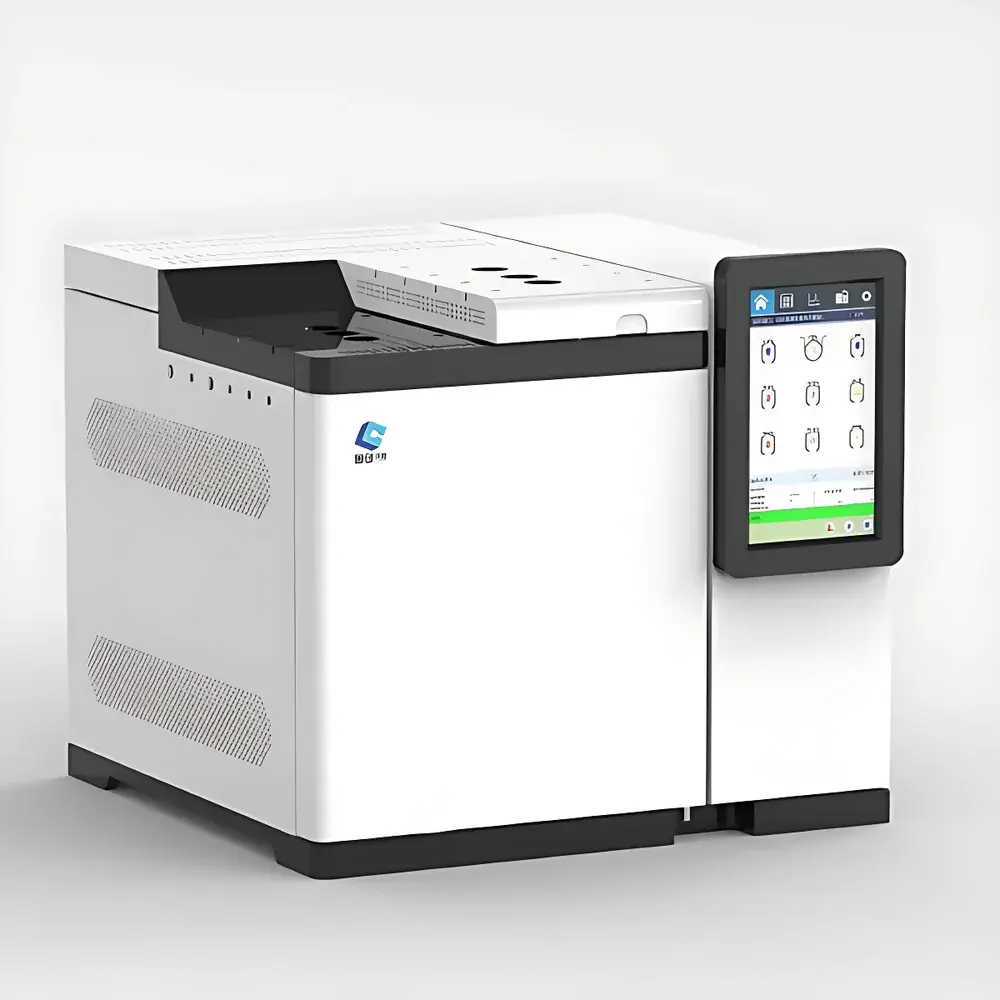
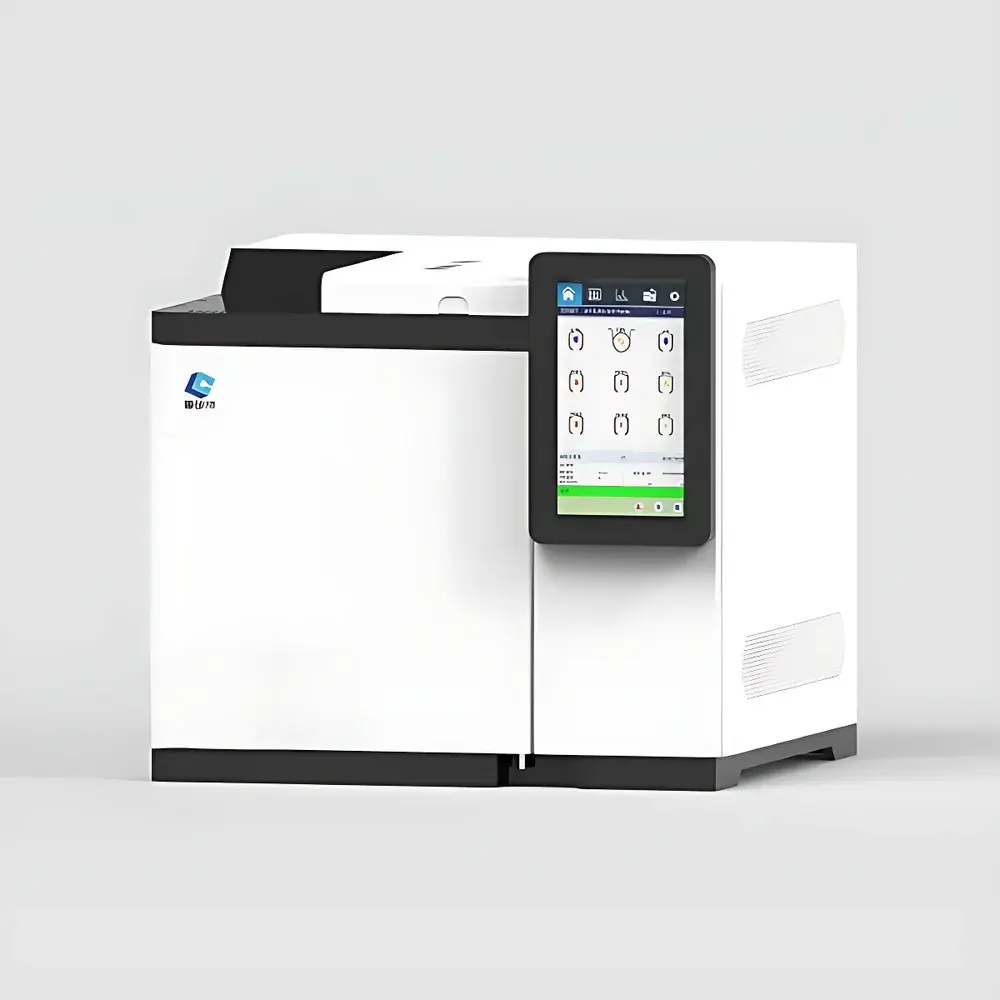
Shandong Luchuang GC-9870 F Advanced Laboratory Gas Chromatograph
| Brand | Shandong Luchuang |
|---|---|
| Origin | Shandong, China |
| Manufacturer Type | OEM Manufacturer |
| Instrument Type | Benchtop Laboratory Gas Chromatograph |
| Model | GC-9870 F |
| Price Range | USD 2,800–4,200 (FOB) |
| Operating Temperature Range | Ambient + 5°C to 400°C |
| Oven Ramp Rate | 0.1–50°C/min |
| Oven Cool-down | ~6 min (300°C to 50°C) |
| Carrier Gas Flow Control Range | 0–600 mL/min |
| Carrier Gas Pressure Control Range | 0–0.4 MPa |
| Injector Maximum Temperature | 400°C |
| Injector Pressure Setting Range | 0–0.4 MPa |
| Injector Total Flow Setting Range | 0–600 mL/min |
| Column Installation Span | 152.4 mm (6-inch standard) |
| Dimensions (L×H×W) | 520 × 480 × 500 mm |
| Net Weight | 50 kg |
| Max Power Consumption | 2500 W |
| Voltage | 220 V ±10% |
Overview
The Shandong Luchuang GC-9870 F is a high-performance, microprocessor-controlled laboratory gas chromatograph engineered for precision separation and quantitative analysis of volatile and semi-volatile organic compounds. Based on robust capillary and packed column chromatography principles, it employs temperature-programmed elution with dual independent oven control architecture—featuring an intelligent dual rear-door design enabling near-ambient temperature operation (down to ambient +5°C). Its modular detector configuration supports simultaneous operation of up to four detectors—including dual FID, dual TCD, dual ECD, or hybrid combinations—enabling parallel method development and multi-analyte screening without hardware reconfiguration. The system complies with fundamental chromatographic performance criteria defined in ASTM D3606, ISO 10101, and USP , and its hardware architecture supports GLP-compliant data integrity workflows when integrated with validated chromatography data systems (CDS).
Key Features
- 8-stage linear programmable temperature ramping with ±0.1°C oven temperature accuracy across 100–350°C range
- Dual independent rear-door cooling system enabling rapid thermal equilibration (300°C → 50°C in ~6 minutes)
- Integrated carrier gas control: digital mass flow controllers (MFCs) for precise, pressure-compensated flow regulation (0–600 mL/min) and pressure regulation (0–0.4 MPa)
- High-stability FID with auto-ignition, detection limit ≤2×10⁻¹² g/s (n-hexadecane), linear dynamic range ≥10⁶
- Enhanced TCD with dual-column compensation gas channels; sensitivity ≥10,000 mV·mL/mg (n-hexadecane, selectable gain: 1×/2×/4×/8×)
- ECD equipped with ⁶³Ni radioactive source; detection limit ≤1×10⁻¹⁴ g/mL (γ-HCH)
- Modular inlet system supporting split/splitless, on-column, and PTV injection; maximum injector temperature: 400°C
- 10-inch full-color LCD touchscreen with 20 customizable display interfaces; embedded Flash memory ensures non-volatile method and result storage (≥20 methods)
- Comprehensive self-diagnostic suite with real-time fault localization and Chinese/English bilingual prompts
- Hardware-level断气 protection (carrier gas failure detection) to prevent column degradation and detector damage
Sample Compatibility & Compliance
The GC-9870 F accommodates standard 1/4″ and 1/8″ packed columns (3–5 mm OD), as well as fused-silica capillary columns (up to 0.53 mm ID) via universal 6-inch column mounting span. It supports direct coupling to auxiliary sample introduction devices—including headspace autosamplers, thermal desorbers, pyrolyzers, and catalytic methanizers—enabling automated analysis of complex matrices in environmental, pharmaceutical, petrochemical, and food safety applications. All electronic modules meet IEC 61000-4 electromagnetic compatibility standards. While not pre-certified for FDA 21 CFR Part 11, the instrument’s event-driven acquisition engine, audit-trail-ready firmware architecture, and deterministic data export protocols (CSV, TXT) facilitate validation under GxP environments when deployed with compliant CDS software.
Software & Data Management
The onboard firmware implements a real-time, event-triggered acquisition framework with timestamped method parameters, detector signals, and hardware status logs. Data files are stored in non-volatile Flash memory—eliminating battery-dependent SRAM retention—and exported via USB 2.0 interface in ASCII-compatible formats for third-party integration. Optional PC-based ChromaLink CDS (v3.2+) provides full 21 CFR Part 11 compliance support, including electronic signatures, role-based access control, and immutable audit trails. Raw signal files include metadata headers specifying column type, carrier gas identity, flow/pressure setpoints, oven program steps, and detector gain settings—ensuring traceability per ISO/IEC 17025 clause 7.7.
Applications
This system is routinely deployed in regulatory and research laboratories for: residual solvent analysis per ICH Q3C; hydrocarbon profiling in gasoline per ASTM D3606; pesticide residue screening in agricultural commodities (AOAC 2007.01); volatile organic compound (VOC) quantification in indoor air (EPA TO-17); fatty acid methyl ester (FAME) composition in biodiesel (EN 14103); and impurity profiling in active pharmaceutical ingredients (APIs) per USP . Its dual-detector capability allows concurrent FID/TCD analysis of permanent gases and hydrocarbons in refinery streams, while ECD/FPD configurations support organochlorine and sulfur compound detection at sub-ppt levels in wastewater effluents.
FAQ
What column types are supported?
Standard 1/4″ and 1/8″ packed columns (3–5 mm OD), and fused-silica capillary columns up to 0.53 mm ID with universal 6-inch mounting span.
Does the instrument support GLP-compliant data handling?
Yes—the embedded firmware records all acquisition events with timestamps and method parameters; full GLP compliance requires integration with validated CDS software supporting audit trails and electronic signatures.
Can multiple detectors operate simultaneously?
Yes—up to four detectors may be installed and operated concurrently, including dual FID, dual TCD, or mixed configurations (e.g., FID + ECD), with independent power and signal conditioning circuits.
Is remote monitoring or network connectivity available?
The base model features USB 2.0 host interface only; Ethernet or Wi-Fi connectivity requires optional ChromaLink CDS server deployment with local area network configuration.
What safety protections are built into the system?
Hardware-level carrier gas failure detection (with automatic shutdown), overtemperature cutoff (±0.1°C deviation threshold), platinum RTD open/short circuit alarms, and flame-out detection for FID ignition control.
Related Products





