
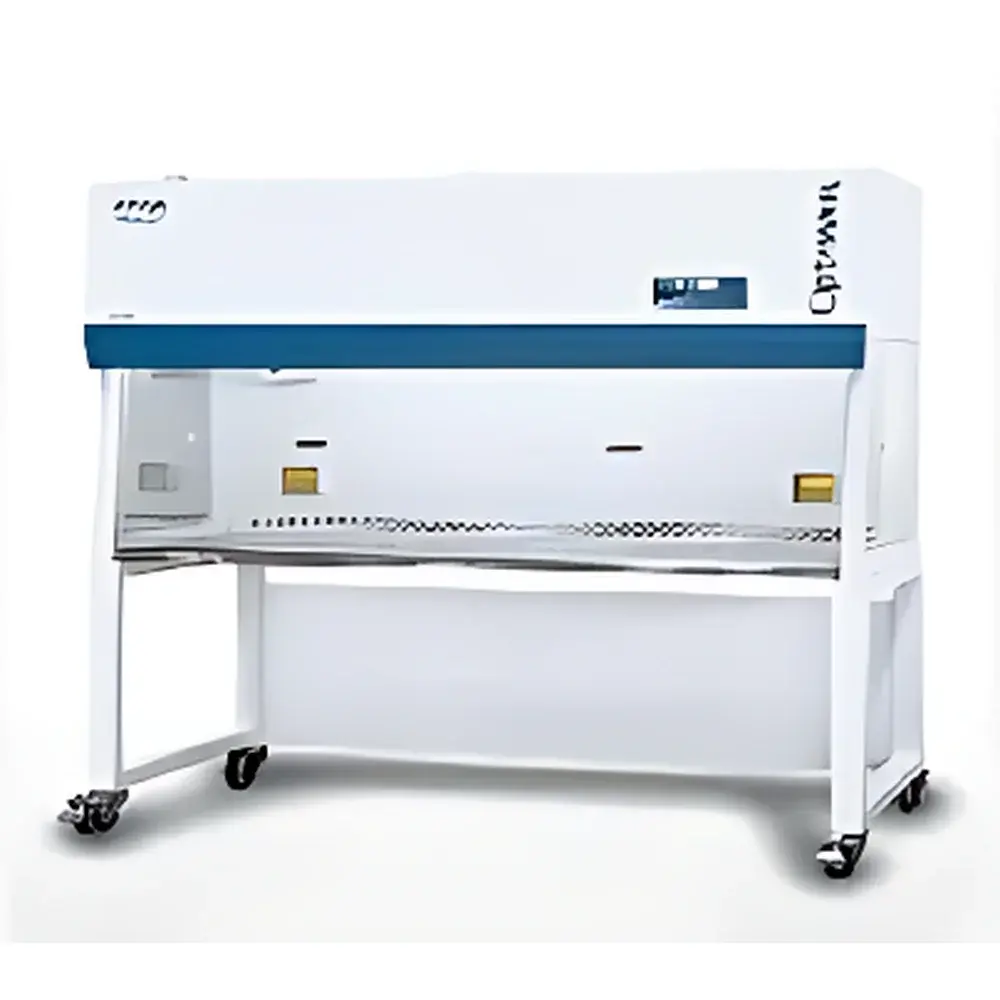
ESCO ACB-4A1 Vertical Laminar Flow Clean Bench
| Brand | ESCO |
|---|---|
| Origin | Singapore |
| Manufacturer Type | Authorized Distributor |
| Origin Category | Imported |
| Model | ACB-4A1 |
| Pricing | Upon Request |
Overview
The ESCO ACB-4A1 Vertical Laminar Flow Clean Bench is an ISO Class 5 (equivalent to Federal Standard 209E Class 100) certified laminar flow workstation engineered for non-hazardous sample handling in microbiology, cell culture, pharmaceutical quality control, and precision electronics assembly. It operates on the principle of unidirectional, downward laminar airflow—generated by a high-efficiency centrifugal blower and conditioned through a certified HEPA filter—to create a particle-free work environment. Air enters the plenum above the work surface, passes vertically through the HEPA filter (tested per EN 1822-1 to achieve ≥99.99% efficiency against 0.3 µm particles), and exits as uniform, low-turbulence airflow across the entire work area at a precisely controlled velocity of 0.30 m/s (adjustable). This positive-pressure, recirculating airflow architecture prevents ambient contamination ingress and eliminates cross-contamination between samples—critical for aseptic technique compliance and GLP/GMP-aligned workflows.
Key Features
- OptiMair® vertical laminar flow design with real-time air velocity monitoring via Sentinel™ touchscreen microprocessor controller
- Certified HEPA filter (EN 1822 H14 grade) delivering ≥99.99% particle capture efficiency for particles ≥0.3 µm
- Ergonomic 15° forward-tilted sash window with smooth-sliding mechanism for operator comfort and optimal reach depth
- Integrated UV-C germicidal lamp (254 nm, 30 W) with programmable timer and interlocked activation—UV only energizes when sash is fully closed to ensure operator safety per IEC 61000-4-2 and AS/NZS 2210.3
- Isoceide™ antimicrobial coating applied to all external cabinet surfaces, inhibiting bacterial and fungal colonization per ISO 22196
- One-piece, seamless stainless steel work surface with raised front lip (15 mm height) to contain spills and prevent liquid migration toward the operator
- Low-noise EBM-Papst centrifugal blower system (<61 dBA at 1 m, measured per EN 12469)
- Rear-mounted exhaust grille design optimizing laminar stability and minimizing air recirculation eddies
- Energy-efficient architecture meeting EU Ecodesign Directive 2019/2021 requirements for laboratory ventilation equipment
Sample Compatibility & Compliance
The ACB-4A1 is validated for use with non-toxic, non-volatile, non-aerosol-generating biological and chemical materials—including microbial cultures, tissue explants, sterile media preparation, and semiconductor wafer inspection. It complies with international standards including AS 1386.5:2021 (Australian Standard for laminar flow cabinets), ISO 14644-1:2015 Class 5 (≤3,520 particles/m³ ≥0.5 µm), EN 12469:2000 (performance requirements for clean benches), and IEC 61010-1:2012 for electrical safety. While not suitable for biohazardous or volatile organic compound (VOC) applications—those require Class II biosafety cabinets—the unit supports routine environmental monitoring, media pour plates, and sterile instrument staging under cGMP Annex 1 and USP guidance for compounding sterile preparations.
Software & Data Management
The Sentinel™ microprocessor controller provides continuous digital readout of average face velocity (m/s), operational hours, UV lamp runtime, and filter service life estimation. All parameters are logged with timestamps in non-volatile memory and exportable via USB port for audit trail generation. The system supports configurable alarm thresholds (e.g., airflow deviation >±10%), automatic shutdown on sash breach, and password-protected parameter modification—enabling alignment with FDA 21 CFR Part 11 requirements for electronic records when integrated into validated laboratory information management systems (LIMS). No cloud connectivity or proprietary software installation is required; interface remains local and deterministic.
Applications
- Aseptic transfer of bacterial/fungal cultures and mammalian cell lines
- Preparation of agar plates, broth dilutions, and sterile reagent aliquots
- Assembly of sterile medical devices and diagnostic kits
- Quality control testing of raw materials and finished pharmaceutical products
- Microelectronics handling where electrostatic discharge (ESD)-safe variants can be specified
- Environmental sampling kit preparation for ISO 14644-2 certification audits
FAQ
Is the ACB-4A1 suitable for handling pathogenic organisms?
No. This is a clean bench—not a biosafety cabinet—and provides no personnel or environmental protection against aerosols or splashes. It must not be used for BSL-2 or higher agents.
What maintenance intervals are recommended for the HEPA filter?
Filter replacement is determined by real-time pressure drop monitoring and annual integrity testing per EN 1822. Typical service life is 3–5 years under continuous operation with proper pre-filtering.
Can the unit be integrated into a facility’s building management system (BMS)?
Yes—via optional 4–20 mA analog output module (part number: IO-ANALOG-ACB) for remote airflow and status signal transmission.
Does the Isoceide™ coating require special cleaning agents?
No. Standard 70% ethanol or hospital-grade quaternary ammonium disinfectants may be used without degrading the coating’s efficacy.
What electrical specifications does the ACB-4A1 support?
Standard configuration: 230 V AC ±10%, 50/60 Hz, 16 A dedicated circuit. Custom voltage options (e.g., 115 V) available upon request.



