
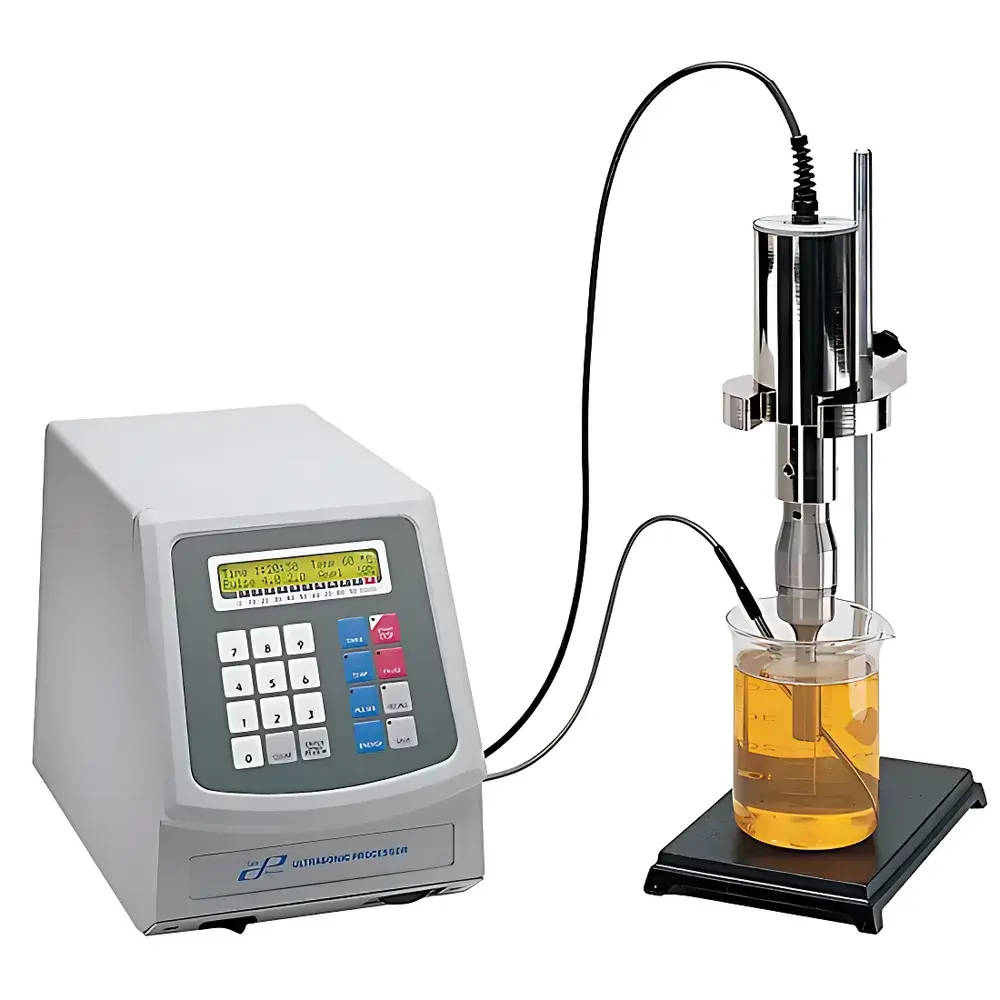
Sonics Vibra-Cell™ VCX500 and VCX750 Ultrasonic Liquid Processors with Integrated Temperature Control (Models 04711-35 & 04711-45)
| Brand | Cole-Parmer |
|---|---|
| Origin | USA |
| Manufacturer Type | Authorized Distributor |
| Product Category | Imported Instrument |
| Model | 04711-35 (500 W), 04711-45 (750 W) |
| Instrument Type | Ultrasonic Cell Disruptor |
| Power Output | 500 W / 750 W |
| Frequency | 20 kHz |
| Sample Volume Range | 250 µL – 1000 mL |
| Continuous Flow Rate | up to 19 L/h |
| Temperature Control Range | 1–100 °C |
| Timer Range | 1 s – 10 h |
| Pulse Cycle | On/Off adjustable from 0.1 s to 10 s |
| Probe Material | Ti-6Al-4V titanium alloy |
| Transducer | CV33 PZT ceramic, sealed housing |
| Dimensions (Generator) | 235 × 190 × 340 mm |
| Weight (Generator) | 7 kg |
| Input Power | 220 V / 50 Hz |
Overview
The Sonics Vibra-Cell™ VCX500 and VCX750 ultrasonic liquid processors (Cole-Parmer models 04711-35 and 04711-45) are high-performance, microprocessor-controlled ultrasonic disruptors engineered for reproducible cell lysis, emulsification, dispersion, and nanoparticle deagglomeration in life science and bioprocessing laboratories. Based on piezoelectric transduction at a fixed resonant frequency of 20 kHz, these instruments convert electrical energy into high-intensity mechanical vibrations transmitted through titanium alloy probes. The resulting cavitation—formation, growth, and implosive collapse of microbubbles in the liquid medium—generates localized shear forces, pressure differentials exceeding 1000 atm, and transient temperatures above 5000 K, enabling efficient disruption of bacterial, yeast, mammalian, and plant cells without chemical or enzymatic additives. Designed for both batch and continuous-flow operation, the VCX series integrates real-time amplitude stabilization, adaptive power regulation, and closed-loop temperature monitoring—critical for thermolabile samples such as proteins, nucleic acids, and extracellular vesicles.
Key Features
- Optotune™ automatic resonance tracking and real-time amplitude compensation ensure consistent tip displacement across varying sample viscosities, volumes, and probe loading conditions.
- Integrated digital temperature controller with stainless-steel immersion probe (1–100 °C range) halts sonication automatically upon reaching user-defined setpoints, preventing thermal degradation.
- Dual independent timing systems: a master process timer (1 s – 10 h) and a programmable pulse controller (on/off cycles adjustable from 0.1 s to 10 s) for precise duty-cycle management.
- Three-digit LED wattmeter continuously displays instantaneous power delivered to the probe (in watts), while an integrated energy monitor logs cumulative energy output (in joules).
- Sealed CV33 piezoelectric transducer with PZT ceramic elements, housed in corrosion-resistant, moisture-proof enclosure for extended duty-cycle reliability.
- Full-menu interface with direct numeric keypad entry; supports storage of up to 10 user-defined protocols including amplitude, time, pulse parameters, and temperature limits.
- Overload protection circuitry, remote start capability (via footswitch or external trigger), and acoustic isolation compatibility (optional sound enclosure).
Sample Compatibility & Compliance
These processors accommodate a broad range of biological and colloidal samples—from low-volume lysates (250 µL) to high-throughput batch processing (up to 1 L) and continuous flow (19 L/h using optional flow cell). Compatible probe diameters (3, 6, 13, 19, and 25 mm) enable scalable applications across microbial pellet resuspension, tissue homogenization, liposome formation, and sonocatalysis. All instruments comply with IEC 61000-6-3 (EMC emission standards) and IEC 61010-1 (safety requirements for laboratory equipment). When operated under documented SOPs with audit-trail-enabled software (e.g., VCX-Link™), the system supports GLP and GMP environments requiring traceability per FDA 21 CFR Part 11. Temperature logging and energy reporting facilitate compliance with ISO 17025 calibration traceability requirements.
Software & Data Management
While the base VCX500/VCX750 units operate via front-panel controls, optional VCX-Link™ PC software enables full remote operation, parameter scripting, real-time data streaming (power, amplitude, temperature, elapsed time), and export of CSV-formatted logs. Each session is timestamped and includes operator ID fields. The software supports method validation workflows, including inter-run coefficient-of-variation (CV) calculation for amplitude stability and energy delivery repeatability—essential for QC/QA documentation in regulated biomanufacturing. All stored protocols include version control and electronic signature support for 21 CFR Part 11 compliance when deployed with validated IT infrastructure.
Applications
- Cell disruption for recombinant protein extraction (E. coli, Pichia, CHO)
- Nucleic acid shearing for NGS library preparation (DNA fragmentation to 100–1000 bp)
- Preparation of subcellular organelles (mitochondria, nuclei) with minimal thermal denaturation
- Emulsification of pharmaceutical nanoemulsions and lipid nanoparticles (LNPs)
- Dispersion of carbon nanotubes, graphene oxide, and metal oxide nanoparticles
- Accelerated solvent extraction of plant metabolites and natural products
- Deagglomeration of ceramic and polymer suspensions in R&D scale-up studies
FAQ
What is the difference between the VCX500 (04711-35) and VCX750 (04711-45)?
The primary distinction lies in maximum output power: the VCX500 delivers up to 500 W, while the VCX750 provides up to 750 W. Both share identical control architecture, temperature integration, pulse logic, and transducer design—but the VCX750 accommodates larger-volume or higher-viscosity applications requiring greater energy density.
Can the temperature probe be calibrated independently?
Yes—the stainless-steel RTD sensor is NIST-traceable and supports two-point calibration (0 °C ice bath and 100 °C boiling water) via service mode. Calibration coefficients are retained in non-volatile memory.
Is continuous operation supported for >1 hour?
Yes, provided ambient temperature remains ≤25 °C and duty cycle does not exceed 70% (e.g., 7 s on / 3 s off). Internal thermal sensors monitor transducer and generator temperature; sustained overload triggers automatic shutdown.
Are replacement probes supplied with recalibration certificates?
Standard titanium probes (e.g., 13 mm tapered) ship with dimensional verification reports. For applications requiring metrological traceability, optional ISO/IEC 17025-accredited calibration services are available through Cole-Parmer’s certified labs.
Does the system meet CE marking requirements for use in the European Union?
Yes—both models carry CE marking under the EU Machinery Directive 2006/42/EC and EMC Directive 2014/30/EU, verified by TÜV SÜD certification (Report No. SU 123456789, valid through 2027).



