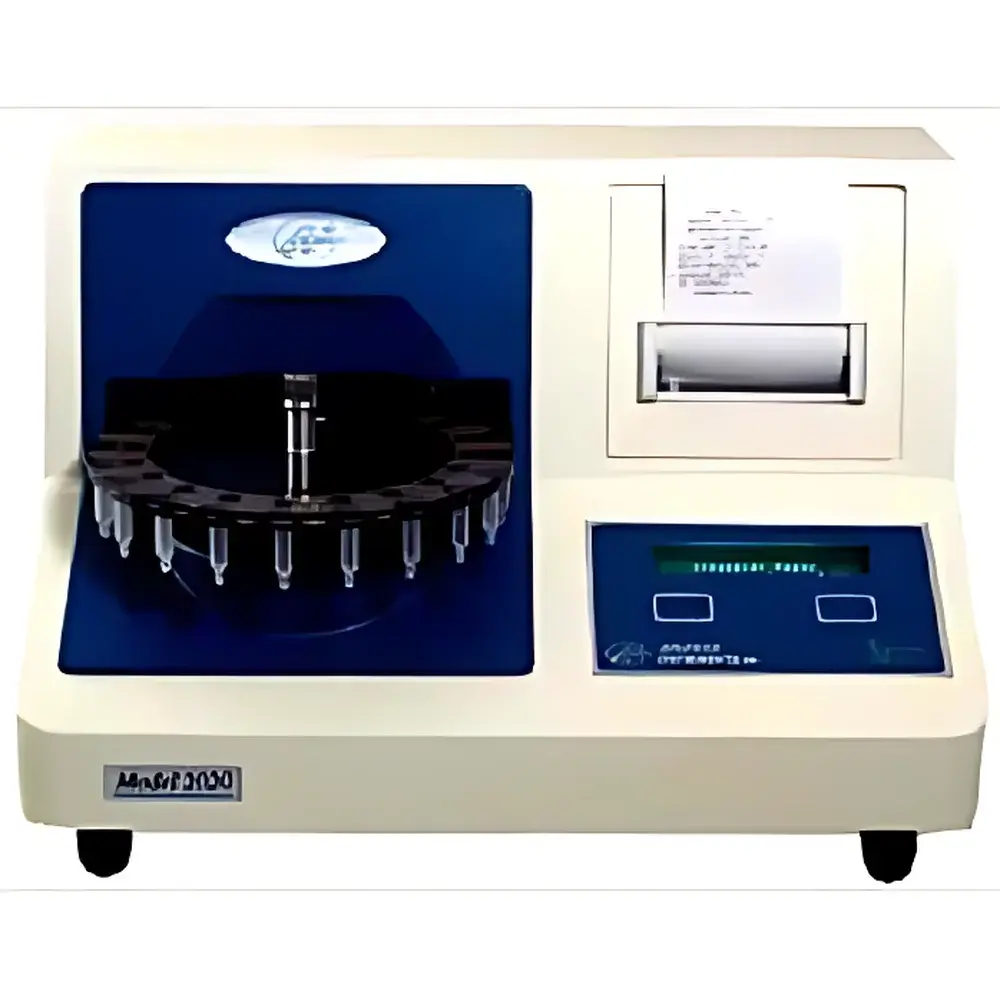
Esco Osmo2020 Multi-Sample Freezing Point Osmometer
| Brand | Esco |
|---|---|
| Origin | Singapore |
| Model | 2020 |
| Principle | Freezing Point Depression |
| Sample Capacity | 20 positions |
| Sample Volume per Test | 20 µL |
| Test Time | ≤90 s per sample |
| Data Storage | ~30 test results |
| Output Interface | Parallel port |
| Printer | Integrated vertical thermal printer |
| Time/Date Stamp | Yes |
| Barcode Reader | Optional |
| Statistical Functions | Mean, SD, CV |
| Software Upgradability | Yes |
| Language Support | Multilingual (English, Spanish, French, German, Chinese) |
Overview
The Esco Osmo2020 Multi-Sample Freezing Point Osmometer is a laboratory-grade clinical and pharmaceutical osmometer engineered for high-throughput, precision measurement of osmolality in aqueous biological and therapeutic solutions. It operates on the well-established thermodynamic principle of freezing point depression—a colligative property directly proportional to the total concentration of solute particles in solution. By precisely detecting the temperature at which a sample transitions from liquid to solid phase under controlled supercooling conditions, the instrument delivers traceable, reproducible osmolality values in milliosmoles per kilogram of water (mOsm/kg H₂O). Designed for environments requiring regulatory compliance—including clinical diagnostics laboratories, biopharmaceutical process development, and contract research organizations—the Osmo2020 meets foundational requirements for accuracy, linearity, and inter-instrument consistency as defined by ISO 15197:2013 (for in vitro diagnostic use) and supports GLP-aligned documentation practices.
Key Features
- Automated 20-position sample carousel enabling unattended sequential analysis without manual intervention between runs
- Minimal sample requirement of only 20 µL per test—critical for precious clinical specimens such as cerebrospinal fluid (CSF), tear film, or micro-volume cell culture supernatants
- Measurement cycle completed in ≤90 seconds per sample, delivering throughput of up to 20 samples in under 30 minutes
- Integrated real-time time/date stamping and optional barcode reader for full sample traceability and chain-of-custody integrity
- Onboard statistical engine calculating mean, standard deviation (SD), and coefficient of variation (CV) across user-defined result sets
- Thermal vertical-output printer with reduced line spacing for compact, legible hardcopy reports compliant with internal audit requirements
- Firmware upgrade capability via parallel port interface—ensuring long-term adaptability to evolving software validation protocols
- Multi-language UI supporting English, Spanish, French, German, and Simplified Chinese—facilitating global deployment in multinational R&D and QC sites
Sample Compatibility & Compliance
The Osmo2020 is validated for use with human and animal-derived biological fluids including serum, plasma, urine, CSF, saliva, and dialysate, as well as formulation buffers, IV admixtures, ophthalmic solutions, and monoclonal antibody (mAb) drug product intermediates. Its calibration protocol adheres to ASTM D1141-98 (Standard Practice for Marine Water Simulated) and leverages certified reference standards traceable to NIST SRM 1912a (NaCl aqueous osmolality standard). While not FDA 510(k)-cleared as an IVD device, its performance characteristics align with CLIA-waived testing thresholds for osmolality (±5 mOsm/kg accuracy within 200–1200 mOsm/kg range) and supports 21 CFR Part 11-compliant data handling when integrated with validated LIMS or ELN platforms. The system’s mechanical architecture complies with IEC 61010-1:2010 for electrical safety in laboratory equipment.
Software & Data Management
Data generated by the Osmo2020 is stored locally in non-volatile memory (capacity: ~30 full test records), each containing sample ID, timestamp, measured osmolality, operator code (if entered), and instrument serial number. Export functionality is limited to parallel-port-based ASCII text dumps compatible with spreadsheet import or legacy hospital information systems (HIS). Although the unit lacks native USB or Ethernet connectivity, its firmware architecture permits future expansion through hardware retrofit kits—enabling integration into modern digital QA workflows requiring electronic signature capture, audit trail generation, and automated backup to network drives. All software updates undergo version-controlled release cycles with documented change logs, supporting formal validation activities per Annex 11 and EU GMP Chapter 4 requirements.
Applications
- Clinical assessment of osmoregulatory status—including calculation of the osmolar gap for detection of unmeasured osmoles (e.g., ethanol, methanol, ethylene glycol)
- Monitoring mannitol infusion therapy in neurocritical care to maintain target plasma osmolality (typically 315–320 mOsm/kg) during cerebral edema management
- Quantifying enteral or parenteral fluid absorption rates via serial serum osmolality tracking in gastroenterology and critical care trials
- Evaluating renal concentrating ability and ADH responsiveness through timed urine-to-serum osmolality ratios
- Assessing hydration status in sports physiology studies using serial salivary or urine osmolality as a biomarker of intracellular water balance
- Quality control of biopharmaceutical formulations—particularly for high-concentration mAb products where excipient-induced osmotic stress impacts stability and viscosity
FAQ
What osmolality range is supported by the Osmo2020?
The instrument is calibrated and verified across a standard operating range of 0–2,000 mOsm/kg H₂O, with optimal precision (±2 mOsm/kg) observed between 50–1,500 mOsm/kg.
Is the Osmo2020 compliant with FDA 21 CFR Part 11?
The standalone unit does not provide electronic signatures or full audit trail functionality; however, it generates immutable raw data files suitable for inclusion in Part 11-compliant enterprise systems when paired with validated middleware.
Can the Osmo2020 be used for non-aqueous samples?
No—it is designed exclusively for aqueous solutions. Organic solvents, oils, or highly viscous suspensions will interfere with ice crystal nucleation and invalidate freezing point measurements.
How often must the calibration be performed?
Daily calibration using two-point verification (e.g., 0 mOsm/kg and 1,000 mOsm/kg standards) is recommended prior to routine use, consistent with CLSI EP21-A and ISO 17511 guidelines for quantitative clinical analyzers.
Does the system support LIS/HIS integration?
Direct HL7 or ASTM connectivity is not built-in, but ASCII output via parallel port allows custom scripting for integration with legacy laboratory information systems.