
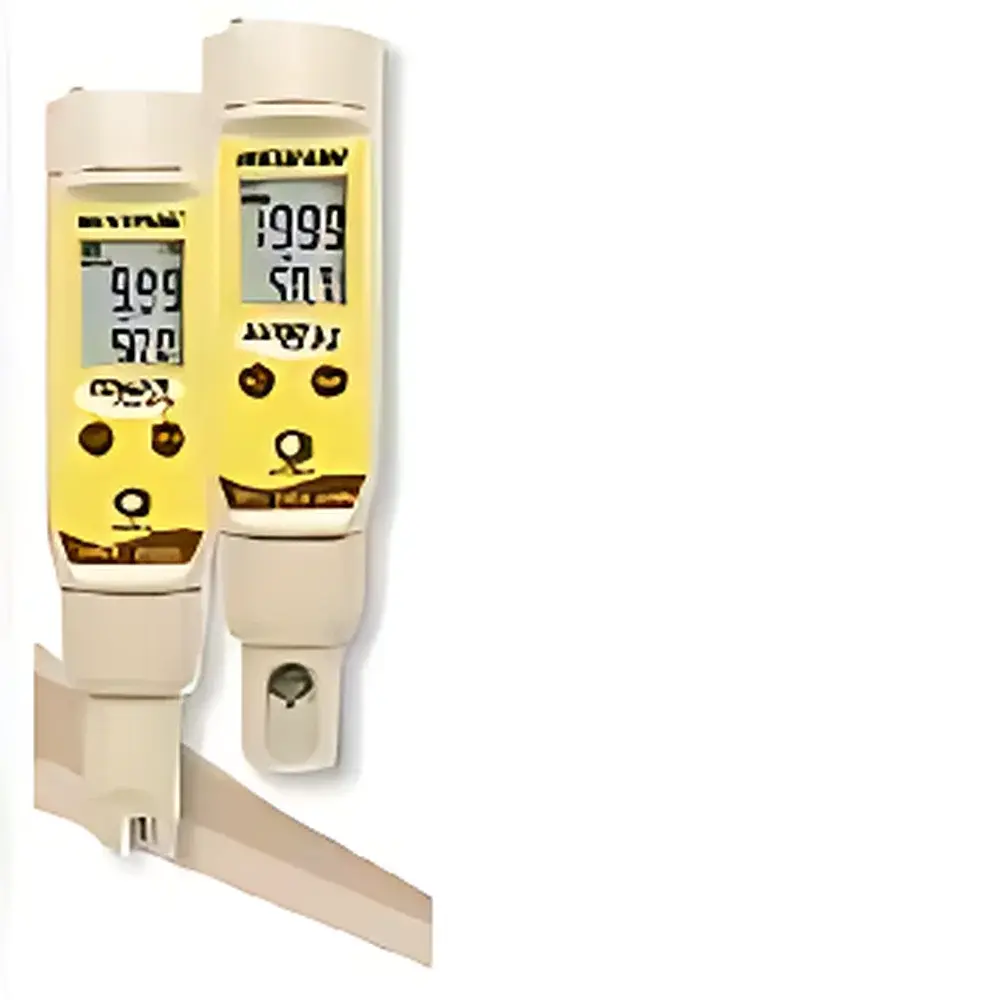
Thermo Fisher ECtestr 11+ Conductivity and TDS Pen Tester
| Brand | Thermo Fisher |
|---|---|
| Origin | USA |
| Model | ECtestr 11+ |
| Conductivity Range | 0–200.0 µS/cm, 0–2000 µS/cm, 0–20.00 mS/cm |
| Resolution | 0.1 µS/cm, 1 µS/cm, 0.01 mS/cm |
| Accuracy | ±1% of full scale |
| Calibration Points | 3-point (auto/manual) |
| Temperature Range | 0–50.0 °C |
| Temperature Resolution | 0.1 °C |
| Temperature Accuracy | ±0.5 °C |
| TDS Conversion Factor | Adjustable (0.40–1.00) |
| Sensor Material | SS316 stainless steel with Valox protective housing |
| Ingress Protection | IP67 |
| Power | Replaceable batteries |
| Battery Status Retention | Calibration settings retained after battery replacement |
Overview
The Thermo Fisher ECtestr 11+ Conductivity and TDS Pen Tester is a handheld, field-deployable electrochemical instrument engineered for rapid, reliable measurement of electrical conductivity and total dissolved solids (TDS) in aqueous solutions. It operates on the principle of two-electrode conductometric measurement, where an alternating current is applied across a pair of SS316 stainless steel electrodes immersed in the sample; the resulting conductance is converted to conductivity (µS/cm or mS/cm) using cell constant compensation and temperature correction algorithms. TDS is derived from conductivity via user-selectable linear conversion factors (0.40–1.00), accommodating varying ionic composition profiles typical of drinking water, wastewater, hydroponic nutrient solutions, boiler feedwater, and laboratory buffer verification. Designed for routine QC checks, environmental monitoring, and educational applications, the ECtestr 11+ delivers consistent performance under variable ambient conditions without requiring benchtop infrastructure.
Key Features
- Triple-range conductivity measurement (0–200.0 µS/cm, 0–2000 µS/cm, 0–20.00 mS/cm) with automatic or manual range selection for optimal resolution across low- and high-conductivity matrices
- 3-point calibration capability—supports both automatic recognition of standard solutions (e.g., 84 µS/cm, 1413 µS/cm, 12.88 mS/cm) and manual entry of custom calibration values—ensuring traceable accuracy per ASTM D1125 and ISO 7888 guidelines
- Integrated temperature sensor (0–50.0 °C, ±0.5 °C accuracy) with automatic temperature compensation (ATC) using default 2%/°C coefficient or user-defined β-value input
- Chemically robust sensor assembly featuring industrial-grade SS316 electrodes housed within a molded Valox thermoplastic shroud—resistant to chloride-induced pitting, acidic/alkaline exposure, and mechanical abrasion
- IP67-rated enclosure enables submersion up to 1 m for 30 minutes; unit floats on water surface for convenient field use in open channels, ponds, or reservoirs
- Replaceable sensor module design extends instrument service life—only the electrode assembly requires periodic replacement, while the main housing and electronics remain reusable
- Non-volatile memory retains calibration coefficients, TDS factor, and unit preferences even after battery replacement or power loss
Sample Compatibility & Compliance
The ECtestr 11+ is validated for use with potable water, surface water, groundwater, wastewater effluent, reverse osmosis permeate, nutrient solutions, and process rinse waters. Its SS316 sensor exhibits minimal polarization error and stable response in samples with turbidity < 100 NTU and suspended solids < 50 mg/L. The device complies with IEC 60529 (IP67), RoHS Directive 2011/65/EU, and FCC Part 15 Class B emission limits. While not certified for GLP/GMP-regulated production environments, its calibration traceability supports data integrity requirements for ISO/IEC 17025-accredited laboratories when used in conjunction with documented SOPs and reference standard certificates (e.g., NIST-traceable KCl standards).
Software & Data Management
As a standalone pen tester, the ECtestr 11+ does not interface with proprietary software or cloud platforms. All measurements are displayed in real time on a dual-line LCD with simultaneous conductivity/TDS and temperature readouts. No firmware updates or PC connectivity are required. However, users may document readings manually or integrate results into LIMS or Excel-based QA logs using standardized templates aligned with FDA 21 CFR Part 11 principles—particularly when paired with controlled calibration records, operator identification, and timestamped entries.
Applications
- Verification of deionized water purity in pharmaceutical cleanrooms (USP compliant conductivity screening)
- Routine monitoring of irrigation water salinity in agricultural extension services
- Field assessment of membrane fouling potential in RO system pre-treatment stages
- Classroom experiments demonstrating ionic strength effects on solution conductivity
- Quick-check validation of buffer preparation accuracy prior to pH or ion chromatography analysis
- Environmental sampling for EPA Method 120.1 (conductivity) and supporting TDS estimation per APHA Standard Methods 2540C
FAQ
Does the ECtestr 11+ support automatic temperature compensation (ATC)?
Yes—built-in ATC applies either the default 2%/°C linear coefficient or a user-defined β-value for non-standard electrolytes.
Can calibration data be retained after battery replacement?
Yes—non-volatile memory preserves all calibration points, TDS factor, and display units without external backup.
Is the sensor replaceable as a field-serviceable component?
Yes—the SS316/Valox sensor module is designed for tool-free replacement, minimizing long-term ownership cost.
What is the recommended calibration frequency for routine use?
Daily calibration is advised for critical applications; weekly calibration suffices for general monitoring when using stable reference standards.
Does this instrument meet ISO 7888 or ASTM D1125 specifications?
Its measurement methodology and accuracy (±1% FS) align with the performance criteria defined in these standards, though formal certification requires third-party verification under controlled lab conditions.





