
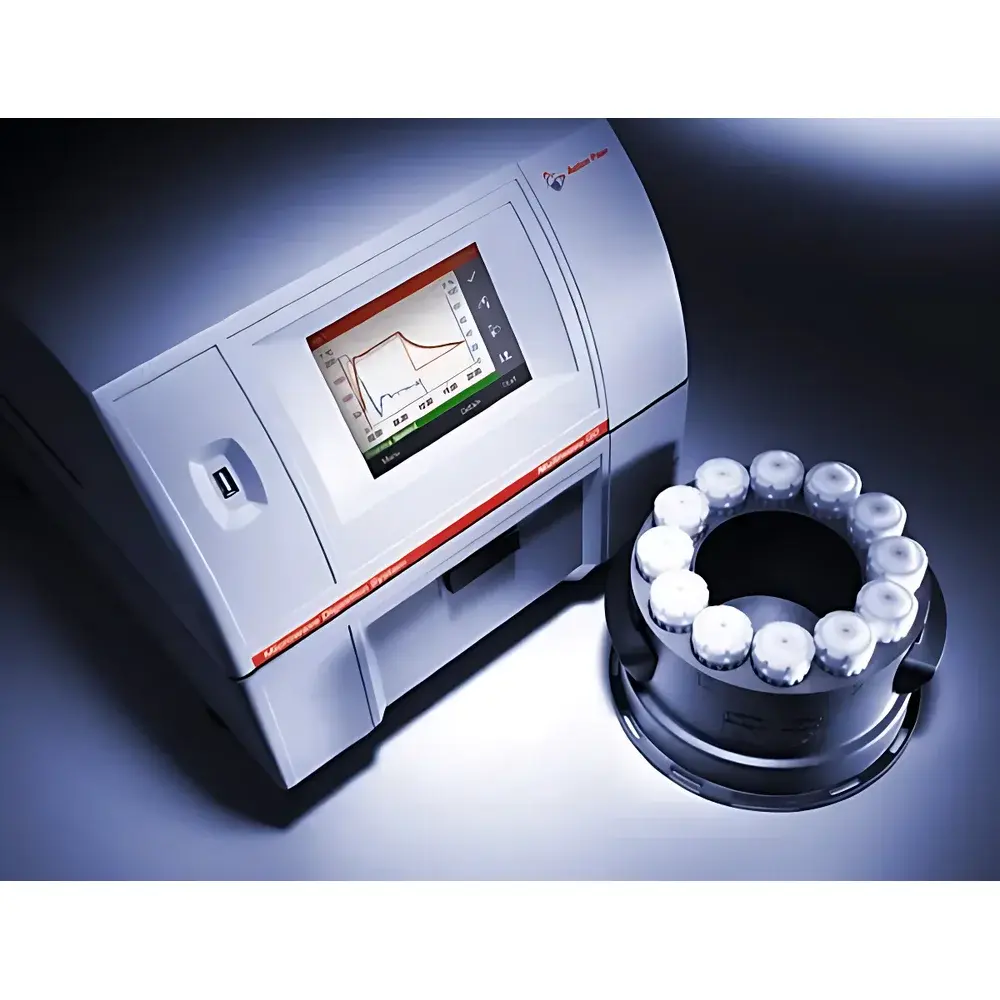
Anton Paar Multiwave GO Microwave Digestion System
| Brand | Anton Paar |
|---|---|
| Origin | Austria |
| Model | Multiwave GO |
| Cavity Class | Industrial-Grade |
| Batch Capacity | 12 samples |
| Microwave Source | Industrial Magnetron |
| Max Temperature | 260 °C / 300 °C (operational / safety limit) |
| Max Pressure | 2200 psi |
| Dimensions | ≤36 × 53 cm |
| Max Microwave Power | ≤900 W |
| Cooling Time to RT | ≤8 min (in situ) |
| Vessel Volume | 50 mL |
| Vessel Material | PTFE-TFM composite with integrated metal spring seal |
| Temperature Measurement Range | 20–400 °C |
| Accuracy | ±1 °C |
| Safety Certifications | ETL, GS, CE, ISO 9001 |
Overview
The Anton Paar Multiwave GO Microwave Digestion System is an industrial-grade, compact benchtop instrument engineered for rapid, reproducible, and fully traceable sample preparation in regulated and research laboratories. It operates on the principle of controlled microwave energy absorption by polar solvents and ionic matrices—enabling efficient thermal decomposition of organic matter while preserving analyte integrity for subsequent elemental analysis. Designed for compatibility with AAS, ICP-OES, ICP-MS, and HG-AFS instrumentation, the system delivers validated digestion protocols aligned with EPA Methods 3051A, 3052, and ASTM D5511/D5512. Its DMC (Directed Multimode Cavity) technology ensures uniform field distribution and precise energy coupling to each vessel, eliminating hot spots and enhancing inter-vessel temperature homogeneity. The integrated TURBO heating and cooling modules allow full digestion cycles—including ramp, hold, and cooldown—to be completed in under 20 minutes per batch, significantly reducing turnaround time without compromising method robustness.
Key Features
- Industrial magnetron source delivering up to 900 W of controllable microwave power, optimized via real-time power modulation based on vessel count and sample volume.
- DMC-directed multimode cavity architecture with dynamic field focusing—ensuring consistent energy delivery across all 12 positions, independent of loading pattern.
- TURBO active cooling system enabling in-situ cooling of all vessels to ambient temperature within 8 minutes post-digestion—eliminating manual transfer and thermal shock risks.
- Top-loading rotor design with mechanical safety interlock; pressure-release mechanism employs magnetic resealing for immediate re-closure after overpressure event.
- Full-vessel infrared temperature monitoring from the base of each TFM-lined vessel, providing individual real-time temperature readouts (20–400 °C, ±1 °C accuracy) and trend curves.
- Intelligent pressure control across the full temperature range, validated for safe digestion of up to 3 g of heterogeneous solid samples (e.g., soils, polymers, biological tissues).
- Integrated touchscreen interface with embedded processor supporting method editing, EPA/ASTM protocol libraries, and live parameter visualization—including simultaneous temperature, pressure, and power graphs.
Sample Compatibility & Compliance
The Multiwave GO accommodates a broad spectrum of sample matrices including foodstuffs, agricultural products, environmental solids (soils, sediments), water filters, cosmetics, pharmaceutical excipients, plastics, and animal feed. Each 50 mL TFM/PTFE vessel features ≥10 vertical cooling channels on its outer wall to promote radial heat dissipation and minimize thermal gradients during cooldown. Rotor construction utilizes high-strength corrosion-resistant alloy with protective upper shield—designed for long-term stability under repeated thermal cycling and aggressive acid conditions (HNO₃/HF/HCl mixtures). The system complies with international safety and quality standards: ETL-listed (North America), GS-marked (Germany), CE-certified (EU Machinery and EMC Directives), and manufactured under ISO 9001-certified quality management systems. All safety-critical components—including pressure sensors, thermal cutoffs, and door interlocks—are independently verified and documented per IEC 61010-1.
Software & Data Management
The Multiwave GO runs on Anton Paar’s proprietary firmware with embedded method storage, audit-trail logging, and wireless data transmission—no physical connectors required between rotor and cavity. Every digestion run records timestamped temperature, pressure, power, and ramp/hold profiles for all 12 vessels individually. Data export is supported via USB or network interface in CSV and PDF formats, compatible with LIMS integration. Temperature calibration is user-performable using the supplied NIST-traceable reference tool, with automatic offset correction applied across the full 20–400 °C range. The system supports 21 CFR Part 11-compliant operation when paired with Anton Paar’s optional LabX software—enabling electronic signatures, role-based access control, and immutable audit trails for GLP/GMP environments.
Applications
This system is routinely deployed in environmental testing labs for EPA-compliant digestion of soil and sludge prior to heavy metal quantification; in food safety labs for lead, cadmium, and arsenic analysis in spices and infant formula; in polymer R&D for halogen screening in flame-retardant additives; and in clinical research for trace element profiling in tissue biopsies. Its ability to handle high-boiling-point acids (e.g., HF for silicate dissolution) and maintain sub-1 °C inter-vessel temperature variance makes it suitable for multi-element validation studies requiring strict comparability across replicates. Method development workflows benefit from the ability to modify ramp rates, hold times, and power profiles on-the-fly—even during active digestion.
FAQ
What safety certifications does the Multiwave GO hold?
The system carries ETL, GS, and CE marks, and is manufactured under ISO 9001 quality management certification—all documentation is available upon request.
Can the system digest samples containing hydrofluoric acid (HF)?
Yes—vessels are constructed from TFM-modified PTFE with integrated metal spring seals, rated for continuous use with HF at temperatures up to 260 °C.
Is remote monitoring or LIMS integration supported?
Data can be exported via USB or Ethernet; full LIMS interoperability and 21 CFR Part 11 compliance are enabled through optional LabX software deployment.
How is temperature accuracy maintained across repeated use?
The system includes a factory-calibrated IR sensor array and a user-accessible NIST-traceable temperature calibration kit, allowing field verification and correction at any time.
Does the rotor require maintenance or periodic replacement?
The high-strength alloy rotor is designed for >10,000 digestion cycles; routine inspection of O-rings and torque calibration of vessel caps is recommended per Anton Paar’s Maintenance Schedule No. MW-GO-MNT-02.



