
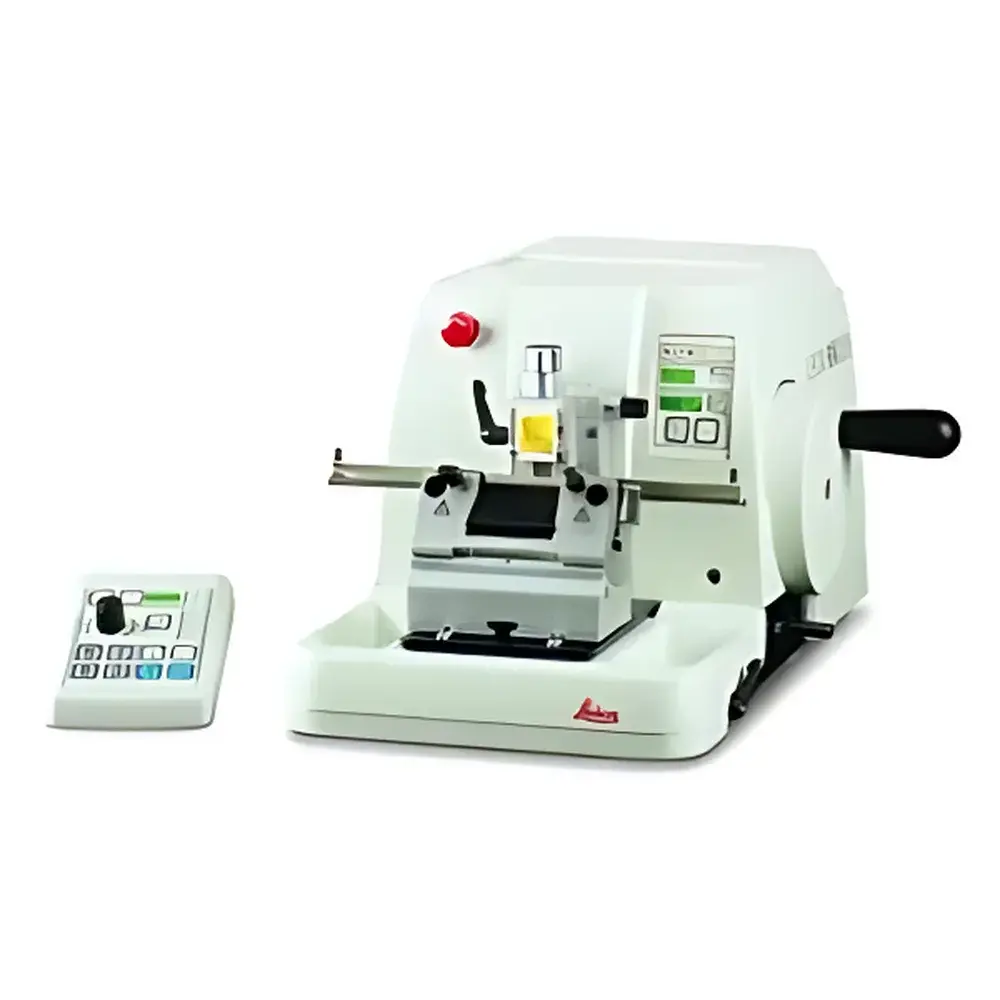
Leica RM2265 Automated Rotary Microtome
| Brand | Leica |
|---|---|
| Origin | Germany |
| Model | RM2265 |
| Cutting Stroke | 70 mm |
| Compatible Blades | Glass (triangular or Ralph) and Diamond knives |
| Optional Cryo Integration | Compatible with Leica LN22 Liquid Nitrogen Cryo-Attachment for ultra-low temperature sectioning down to −150 °C |
| Compliance | Designed and manufactured in accordance with ISO 13485 and CE medical device directives (Class I) |
| Software Control | Integrated programmable microprocessor with memory for user-defined protocols |
Overview
The Leica RM2265 is a high-precision, fully automated rotary microtome engineered for reproducible, high-fidelity sectioning of biological, pathological, and industrial specimens across a broad hardness spectrum—from paraffin-embedded soft tissues to semi-rigid polymers, ceramics, and composite materials. Its operational principle relies on a precision-machined rotary mechanism combined with closed-loop motorized feed control, enabling consistent advancement of the specimen block at sub-micron increments per cycle. The instrument’s architecture integrates thermal stability design, vibration-dampened base construction, and rigid knife holder kinematics to minimize mechanical drift and ensure long-term dimensional fidelity during extended cutting sessions. Designed for integration into regulated laboratory environments, the RM2265 supports traceable operation through timestamped protocol logging and adheres to foundational requirements for GLP-compliant histology workflows.
Key Features
- Constant-Speed Motorized Sectioning: A brushless DC drive system maintains uniform cutting velocity and feed force across the full sectioning range (0.5–100 µm), reducing operator-induced variability and mitigating ergonomic strain associated with manual microtomy.
- 70 mm Vertical Stroke Capacity: Enables handling of oversized embedding cassettes (e.g., 50 × 30 mm blocks) while increasing clearance between specimen surface and knife edge—enhancing safety during blade changes and block repositioning.
- Programmable X/Y Precision Positioning System (Optional): An 8° dual-axis stage with calibrated micrometer adjustment allows precise relocation of previously sectioned areas for serial re-cutting or targeted region analysis; returns automatically to factory-referenced zero position marked by dual red alignment indicators.
- Universal Blade Compatibility: Accommodates standard glass knives (including triangular and Ralph geometries) as well as industrial-grade diamond knives—supporting both routine histological sectioning and demanding applications such as hard-material microanalysis and electron microscopy sample preparation.
- Cryo-Ready Architecture: Engineered for seamless coupling with the Leica LN22 liquid nitrogen cryo-attachment, facilitating stable ultra-low temperature sectioning from −20 °C to −150 °C without structural compromise or thermal distortion.
Sample Compatibility & Compliance
The RM2265 accommodates specimens embedded in paraffin, resin (e.g., LR White, Epon), methacrylate, and low-viscosity polymers. It is routinely deployed in academic pathology labs, biopharmaceutical QC units, and materials science facilities conducting failure analysis on coated substrates, battery electrode cross-sections, and fiber-reinforced composites. The system conforms to ISO 13485:2016 for medical device manufacturing quality management and bears CE marking under Directive 93/42/EEC (as amended). While not a diagnostic device per se, its mechanical repeatability and protocol documentation capabilities align with pre-analytical requirements outlined in ISO/IEC 17025 and CLSI H36-A2 for laboratory accreditation.
Software & Data Management
The RM2265 operates via an embedded microcontroller interface with non-volatile memory storage for up to 20 user-defined cutting protocols—including thickness, speed, trim settings, and pause intervals. All parameter changes are logged with date/time stamps and operator ID fields (when integrated with networked lab information systems). Though it does not feature native FDA 21 CFR Part 11-compliant electronic signatures, its audit trail functionality supports internal validation efforts under GMP Annex 11 and GLP Principle 5 (record integrity). Exportable log files (CSV format) facilitate retrospective review during internal audits or regulatory inspections.
Applications
- Routine histopathology: High-throughput sectioning of FFPE tissue blocks for H&E and IHC staining.
- Neuroscience research: Serial sectioning of vibratome-prefixed brain tissue for 3D reconstruction and synaptic mapping.
- Materials characterization: Cross-sectional analysis of multilayer coatings, solder joints, and additive-manufactured metal parts.
- Cryo-ultramicrotomy: Preparation of frozen-hydrated biological samples for cryo-SEM and correlative light-electron microscopy (CLEM).
- Quality assurance in medical device manufacturing: Sectioning of silicone implants, polymer-based catheters, and drug-eluting stent coatings for defect detection and layer thickness verification.
FAQ
Does the RM2265 support automatic knife advance or auto-knife positioning?
No—the RM2265 does not include motorized knife translation or automatic knife height adjustment. Knife alignment and fine-tuning remain manual procedures performed via calibrated micrometers.
Is remote monitoring or Ethernet connectivity available?
The RM2265 lacks built-in Ethernet, Wi-Fi, or USB host interfaces. Protocol data export requires physical connection via USB flash drive; real-time remote control is not supported.
Can the RM2265 be validated for use in GMP-regulated environments?
Yes—its mechanical consistency, protocol memory, and audit-ready logging enable qualification under IQ/OQ protocols. Full PQ must be performed in situ using site-specific acceptance criteria aligned with ASTM E2917 or ISO 17025 clause 7.7.
What maintenance intervals are recommended for optimal performance?
Leica recommends lubrication of the rotary mechanism every 6 months, annual calibration of the thickness dial and feed mechanism, and quarterly inspection of knife holder clamping torque per service manual SM-RM2265-EN.



