
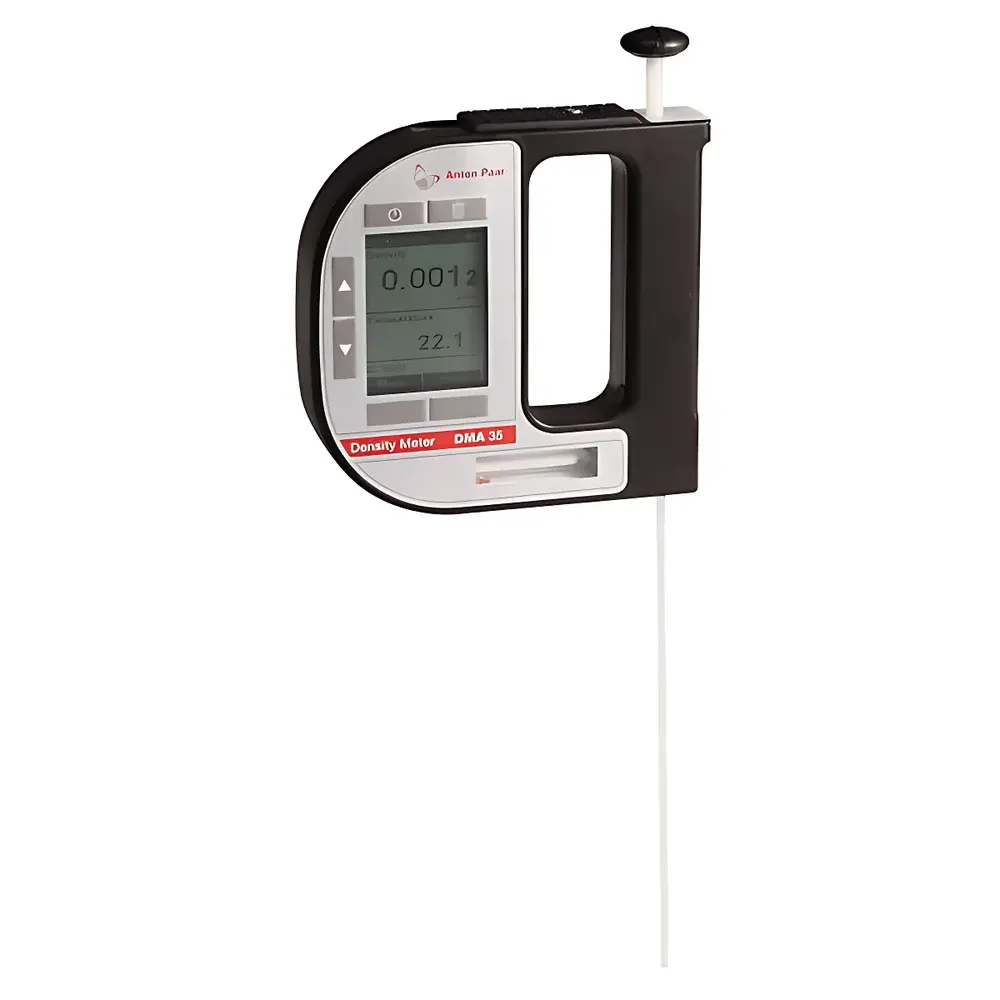
Cole-Parmer Digital Density/Specific Gravity Meter 25750-60
| Brand | Cole-Parmer |
|---|---|
| Origin | USA |
| Model | 25750-60 |
| Density Range | 0–3 g/cm³ (or SGU) |
| Density Resolution | 0.01 g/cm³ (or SGU) |
| Temperature Range | 0–40 °C |
| Temperature Resolution | 0.1 °C |
| Sample Volume | 2 mL |
| Dimensions | 14.0 × 13.6 × 2.5 cm |
| Power | 1.5 V AA battery |
| Interface | Infrared output |
| Data Storage | 1024 readings |
| Display | Large LCD showing density, specific gravity, % concentration, and sample temperature |
Overview
The Cole-Parmer Digital Density/Specific Gravity Meter 25750-60 is a portable, field-deployable instrument engineered for rapid, high-reproducibility density and specific gravity measurements of liquid petroleum products, refinery intermediates, and process fluids. It operates on the principle of hydrostatic weighing combined with integrated temperature compensation—leveraging precise buoyancy-based detection to determine mass per unit volume in real time. Unlike traditional pycnometers or oscillating U-tube densitometers, this device employs a compact, syringe-style aspiration mechanism that draws a fixed 2 mL sample into a sealed measurement chamber, eliminating operator-dependent handling errors and minimizing exposure to volatile or hazardous samples. Its design prioritizes robustness in industrial environments: the 2.5 cm profile enables operation in confined spaces such as pipeline manifolds, tank sumps, or mobile lab vans, while the wide-grip handle and tactile control lever ensure reliable actuation even with insulated or oil-resistant work gloves—critical for compliance with OSHA 1910.138 and API RP 500 zone requirements.
Key Features
- Single-hand operable ergonomic design with oversized control lever and non-slip textured grip surface
- Integrated micro-pump aspiration system—no fragile rubber bulbs, bellows, or glass bulbs susceptible to rupture or solvent degradation
- Large backlit LCD display simultaneously showing density (g/cm³), specific gravity (SGU), temperature (°C), and up to six selectable concentration units (°Bé, °API, Plato, % alcohol by volume, % Brix, % H₂SO₄)
- Onboard memory stores 1024 timestamped measurements with automatic temperature tagging; reference temperature and custom calibration offsets (e.g., 15.6 °C for ASTM D1298 or 20 °C for ISO 3675) are permanently retained
- Rugged polycarbonate housing rated IP54 for dust and splash resistance; compatible with optional infrared thermal printer (sold separately) for GLP-compliant hardcopy output
- Battery-powered operation using standard 1.5 V AA cells—no external power supply required for field use; typical runtime exceeds 2000 measurements per set
Sample Compatibility & Compliance
The 25750-60 is validated for use with hydrocarbon liquids including crude oil fractions, diesel fuel, lubricating oils, naphthas, and light distillates. It accommodates samples with viscosities up to 100 cSt at 20 °C and is chemically resistant to common petroleum solvents (e.g., toluene, xylene, mineral spirits). The measurement chamber is constructed from borosilicate glass and PTFE-sealed stainless steel components to prevent corrosion or swelling during repeated exposure to acidic or sulfur-containing streams. Instrument performance conforms to the procedural intent of ASTM D1298 (Standard Test Method for Density, Relative Density, and API Gravity of Crude Petroleum and Liquid Petroleum Products), ASTM D4052 (Density and Relative Density of Liquids by Digital Density Meter), and ISO 12185 (Crude Petroleum and Petroleum Products — Determination of Density — Digital Density Meters). While not certified for hazardous area installation, its intrinsically safe mechanical design supports deployment in Zone 2 classified locations when used with appropriate personal protective equipment.
Software & Data Management
Data export is facilitated via unidirectional infrared interface compliant with IrDA 1.1 standards, enabling direct transfer to Windows-based PCs or ruggedized field tablets equipped with IR receivers. No proprietary drivers are required—data files are delivered in plain-text CSV format with columns for date/time stamp, density, temperature, user-defined ID tag, and selected concentration unit. Internal firmware supports audit-trail logging for all configuration changes (e.g., reference temperature update, unit selection), satisfying basic GLP documentation requirements. Stored readings persist through battery replacement and retain integrity across firmware updates. Optional companion software (sold separately) provides trend analysis, statistical reporting (mean, SD, RSD), and automated report generation aligned with internal QA templates or regulatory submission formats (e.g., EPA 40 CFR Part 136).
Applications
- Field verification of crude oil API gravity prior to custody transfer at lease tanks or pipeline receipt points
- In-process density monitoring during fractionation, blending, or desalting operations in refineries
- Quality control of finished fuels (gasoline, jet fuel, marine diesel) against specification limits per ASTM D975 or DEF STAN 91-87
- Concentration verification of acid treatments (e.g., spent sulfuric acid alkylation catalysts) and glycol dehydration solutions
- Calibration support for online density transmitters (e.g., Coriolis or nuclear gauges) via spot-check traceability
- Educational use in petroleum engineering labs for teaching fundamental fluid property relationships
FAQ
Is the 25750-60 suitable for measuring highly viscous bitumen or heavy fuel oil?
No—its 2 mL aspiration mechanism is optimized for low-to-medium viscosity liquids (<100 cSt). For bitumen or residual fuels, heated rotational viscometry or vacuum distillation methods per ASTM D7042 are recommended.
Can the instrument be recalibrated in the field without sending it to a service center?
Yes—users may perform two-point density calibration using certified NIST-traceable water (0.9982 g/cm³ at 20 °C) and a secondary standard (e.g., 10% NaCl solution), with full procedure documented in the operator manual.
Does the infrared interface support real-time streaming or only batch export?
It supports only batch transmission of stored readings; continuous live data streaming is not implemented due to power and protocol constraints.
What is the temperature compensation algorithm used?
A polynomial-based correction model derived from the IUPAC reference data for pure water and hydrocarbon mixtures, applied dynamically per measurement to normalize density to user-selected reference temperature.
Is the device compliant with FDA 21 CFR Part 11 for electronic records?
No—it lacks electronic signature capability, audit trail encryption, or role-based access control; however, exported CSV logs may be incorporated into Part 11-compliant LIMS environments with supplemental validation.






