
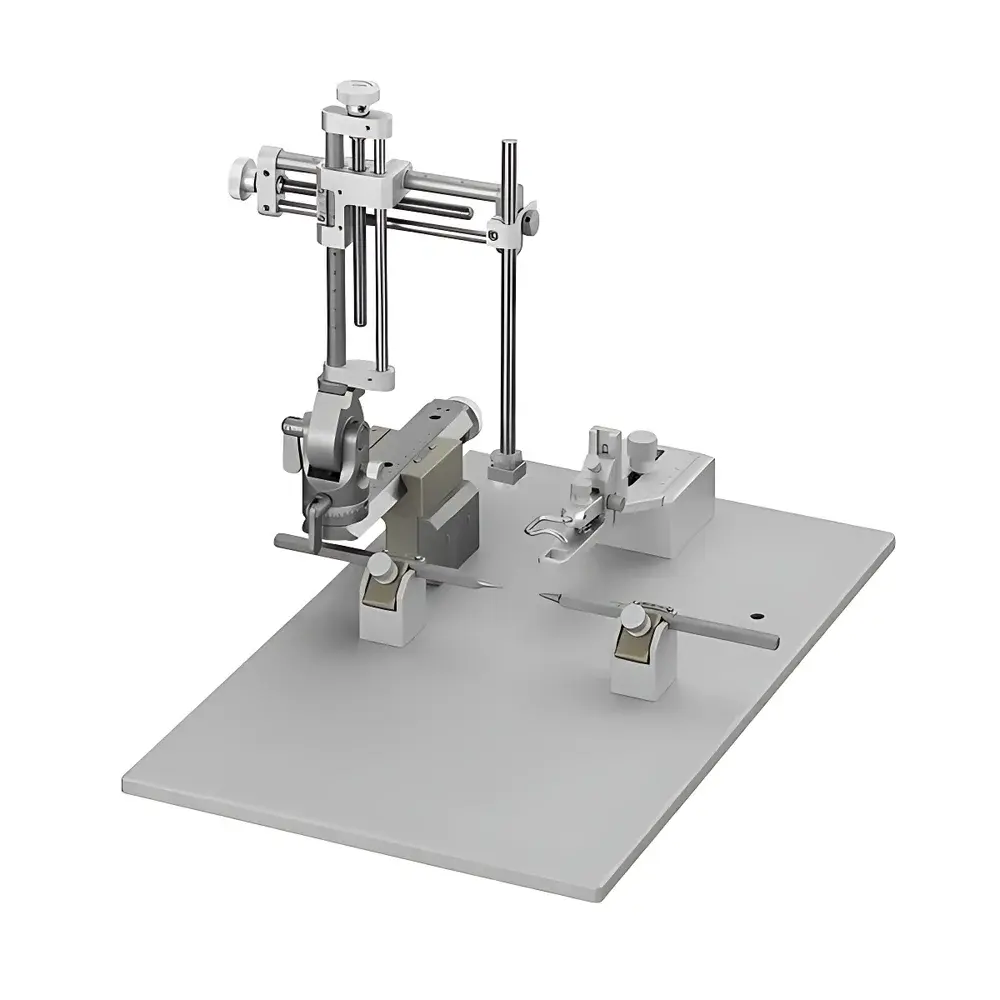
RWD 68505/68506/68507 Lightweight & Rail-Mounted Stereotaxic Instrument for Rodents and Mice
| Key | Brand: RWD |
|---|---|
| Origin | Shenzhen, China |
| Manufacturer Type | Direct Manufacturer |
| Model Series | Lightweight Block-Mounted & Linear Rail-Mounted Configurations |
| Compatible Species | Rat (Rattus norvegicus) and Mouse (Mus musculus) |
| Base Plate Dimensions (Lightweight Rat) | 400 mm × 255 mm |
| Base Plate Dimensions (Lightweight Mouse) | 255 mm × 255 mm |
| Ear Bar Height Above Base (Rat, Lightweight) | 35.5 mm |
| Ear Bar Height Above Base (Rat, Rail-Mounted) | 55.5 mm |
| Ear Bar Vertical Adjustment Range | 20 mm (Mouse), 30 mm (+10 mm to –20 mm, Rat) |
| Ear Bar Scale Resolution | 1 mm |
| Ear Bar Slot Vernier Scale | 0.1 mm |
| Adapter Anterior–Posterior Travel | 43.5 mm |
| Adapter Dorsal–Ventral Travel | 30 mm (+10 mm to –20 mm) with 0.1 mm micrometer resolution |
| Rail Length (Rail-Mounted) | 255 mm |
| Rail Symmetric Scale Range | ±100 mm from zero line aligned with ear bar centerline |
| Optional Accessories | Dual-Arm Assembly, Digital Readout (DRO) Module, AP Microdrive (Model 68102AP, 25 mm stroke, 10 µm step resolution) |
Overview
The RWD Lightweight and Rail-Mounted Stereotaxic Instruments (Models 68505–68516) are precision-engineered neurosurgical platforms designed for reproducible intracranial targeting in rodent models under stereotaxic coordinates. Unlike conventional U-frame architectures, these systems employ modular mounting blocks (lightweight configuration) or linear anodized aluminum rails (rail-mounted configuration), eliminating structural obstructions above the animal’s head and enabling unimpeded access for multi-electrode insertion, fiber optic cannulation, microinjection, or concurrent optogenetic/chemogenetic hardware integration. The instruments operate on classical stereotaxic principles—relying on standardized bregma–lambda reference points and orthogonal Cartesian coordinate translation (anterior–posterior, medial–lateral, dorsal–ventral)—to position manipulators with sub-millimeter spatial fidelity. All configurations comply with widely adopted rodent brain atlases (e.g., Paxinos & Watson, Franklin & Paxinos) and support both acute and chronic surgical workflows under isoflurane or ketamine/xylazine anesthesia protocols.
Key Features
- Modular mechanical architecture: Lightweight models replace rigid U-frames with low-profile adapter blocks; rail-mounted variants utilize precision-ground linear rails with symmetric ±100 mm lateral travel and zero-reference alignment to ear bar centerline.
- Enhanced ergonomics and workflow efficiency: Expanded base plates (up to 400 mm × 255 mm) accommodate large-diameter stereotaxic frames, auxiliary imaging stages, or multi-port infusion manifolds without compromising stability.
- Micrometer-driven positional control: All vertical (dorsal–ventral) and anterior–posterior adjustments incorporate 0.1 mm resolution micrometers; ear bar slots integrate vernier scales calibrated to 0.1 mm for precise interaural leveling.
- Biocompatible and non-traumatic fixation: Mouse-specific ear bars are fabricated from polyoxymethylene (POM), offering high stiffness-to-weight ratio and chemical resistance; dual-tip ear bar inserts (18° blunted conical + circular serrated hollow tips) minimize skull deformation and reduce peri-auricular tissue compression.
- Scalable modularity: Systems support optional dual-arm assemblies for simultaneous bilateral electrode placement or independent pipette/microdrive positioning; digital readout (DRO) modules provide real-time coordinate feedback with RS-232 interface compatibility.
- Microdrive integration: Model 68102AP AP-axis microdrive (25 mm stroke, 10 µm step resolution) mounts directly to rail-mounted frames, extending fine Y-axis control for deep-brain targeting applications such as substantia nigra pars compacta or ventral tegmental area injections.
Sample Compatibility & Compliance
These instruments are validated for use with adult Sprague-Dawley and Wistar rats (250–500 g) and C57BL/6, BALB/c, and CD-1 mice (20–35 g). Ear bar geometry, bite bar height range (0–20 mm for mice; fixed at 35.5 mm or 55.5 mm for rat configurations), and base plate footprint align with IACUC-approved surgical restraint standards. All metallic components undergo anodization per MIL-A-8625 Type II specifications for corrosion resistance and electrical insulation. The mechanical design conforms to ISO 13485-aligned manufacturing controls; documentation packages include calibration certificates traceable to NIST standards for micrometer and scale components. While not FDA-cleared medical devices, the platforms meet GLP-relevant engineering requirements for preclinical neuroscience studies intended for regulatory submission (e.g., IND-enabling toxicology or behavioral pharmacology studies).
Software & Data Management
The RWD Stereotaxic Platform does not require proprietary software for core operation, ensuring full compatibility with third-party electrophysiology suites (e.g., Spike2, OpenEphys), microinjection controllers (e.g., UMP3, Nanoject), or custom LabVIEW-based automation. Digital readout (DRO) modules output ASCII-formatted coordinate strings via TTL-level serial interface (9600 baud, 8N1), enabling direct ingestion into Python-, MATLAB-, or C#-based acquisition pipelines. Audit trails—including operator ID, timestamp, coordinate setpoints, and manual override logs—can be generated when integrated with LIMS or ELN systems compliant with 21 CFR Part 11 requirements (with appropriate electronic signature implementation). Firmware updates for DRO units are delivered via USB-C and validated against SHA-256 checksums.
Applications
- Chronic implantation of intracranial electrodes for in vivo electrophysiology (LFP, single-unit, tetrode arrays)
- Stereotactic delivery of viral vectors (AAV, lentivirus), CRISPR/Cas9 constructs, or siRNA into discrete nuclei (e.g., hippocampal CA1, basolateral amygdala, prefrontal cortex)
- Implantation of guide cannulae for repeated microinjection or dialysis probe insertion
- Targeted ablation using thermocoagulation or laser fiber coupling
- Combined optogenetic stimulation and calcium imaging (via GRIN lens or cortical window)
- Behavioral circuit mapping using chemogenetic (DREADD) or optogenetic actuators paired with operant conditioning rigs
FAQ
What species and weight ranges are supported by the lightweight vs. rail-mounted configurations?
The lightweight series (68505, 68507, 68508, 68510, 68511, 68513, 68514, 68516) supports rats (250–500 g) and mice (20–35 g); rail-mounted models (68506, 68509, 68512, 68515) are optimized for rats only due to increased mechanical rigidity and lateral travel envelope.
Is the 68102AP microdrive compatible with all rail-mounted systems?
Yes—Model 68102AP mounts exclusively to rail-mounted frames (68506, 68509, 68512, 68515) via standardized T-slot interfaces and provides motorized or manual 10 µm-step AP-axis advancement synchronized with rail zero-reference positioning.
Can digital readout (DRO) modules be retrofitted to existing non-DRO instruments?
Yes—DRO kits (68511, 68512, 68513, etc.) include adapter brackets, encoder-integrated micrometers, and plug-and-play cabling; field retrofit requires no disassembly beyond micrometer replacement and takes <15 minutes per axis.
Are ear bar inserts sterilizable?
All ear bar inserts (blunt conical and serrated hollow types) are autoclavable at 121°C for 20 minutes; POM ear bars themselves are rated for repeated steam sterilization but must be cooled to ambient temperature before reinstallation to avoid dimensional drift.
Does RWD provide atlas coordinate templates or alignment guides?
Yes—each instrument ships with a laminated bregma–lambda alignment chart, cross-referenced to Paxinos & Watson (7th ed.) and Franklin & Paxinos (4th ed.), including fiducial landmark diagrams and recommended skull flattening procedures for consistent DV zeroing.




