
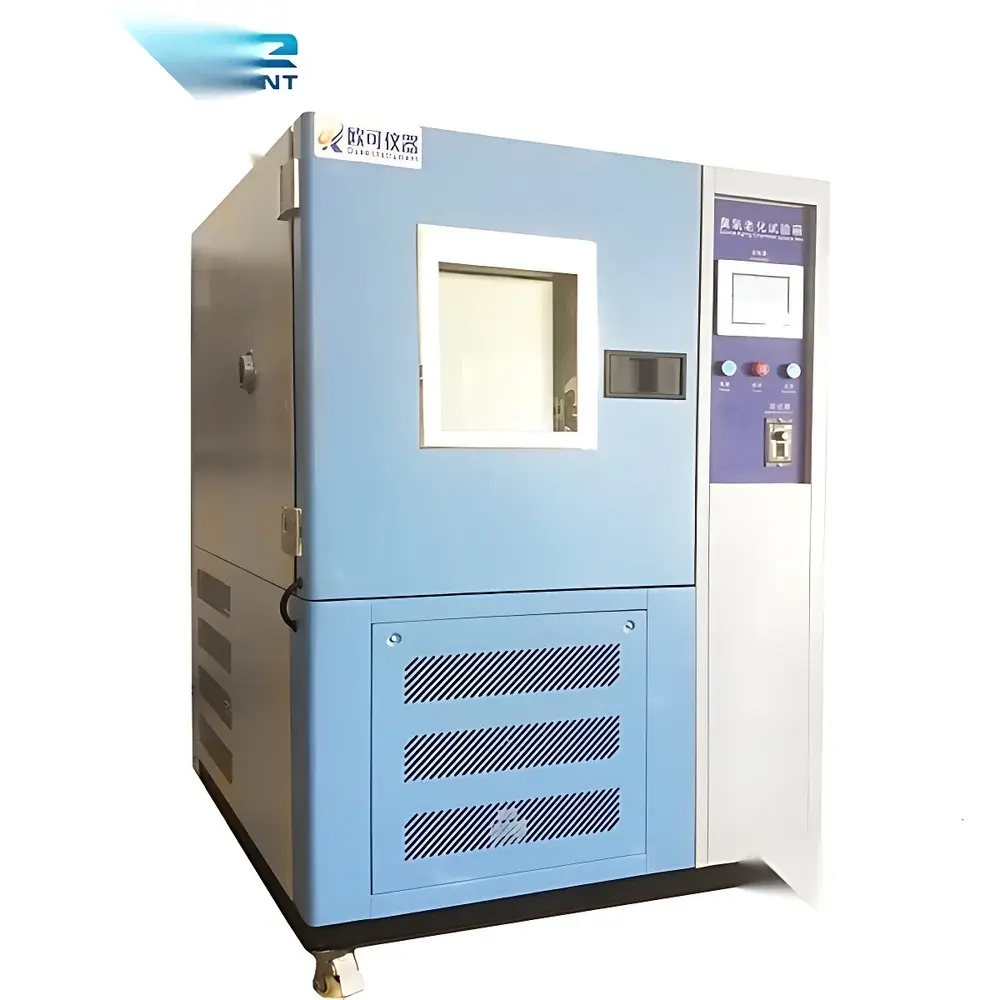
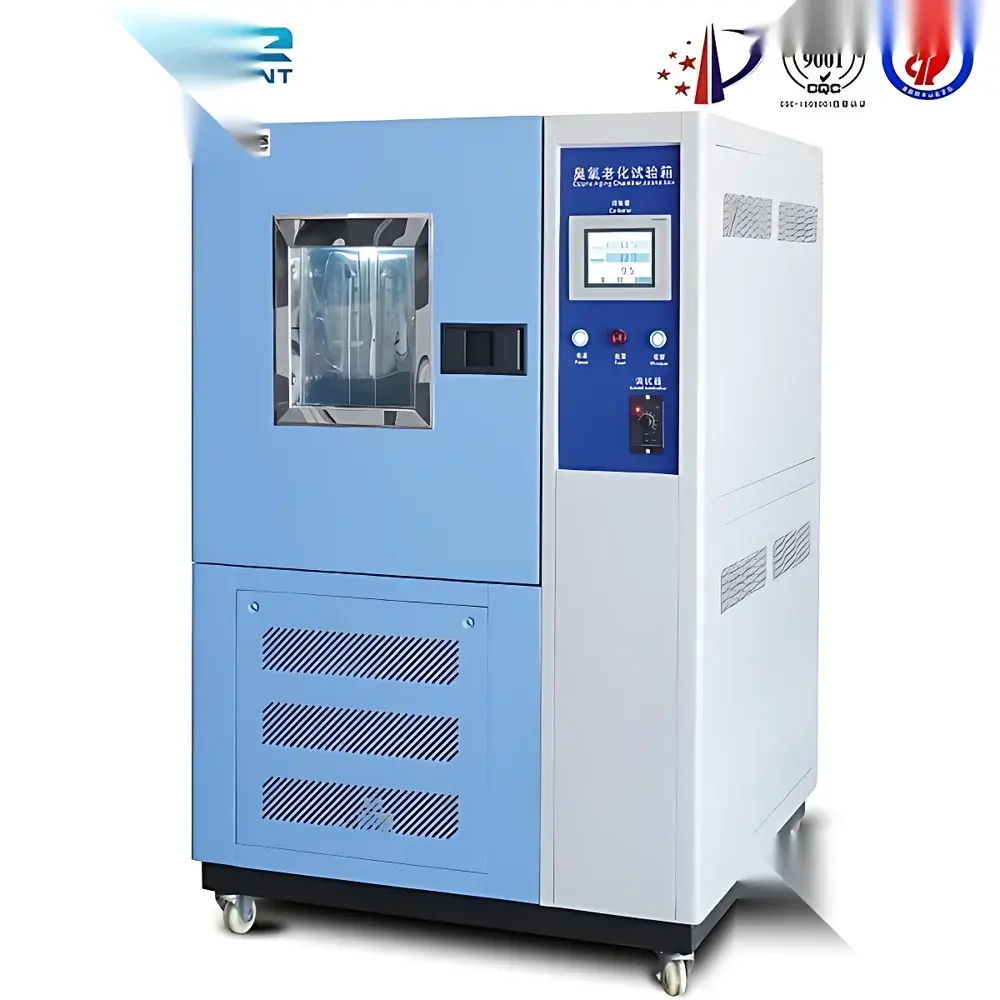
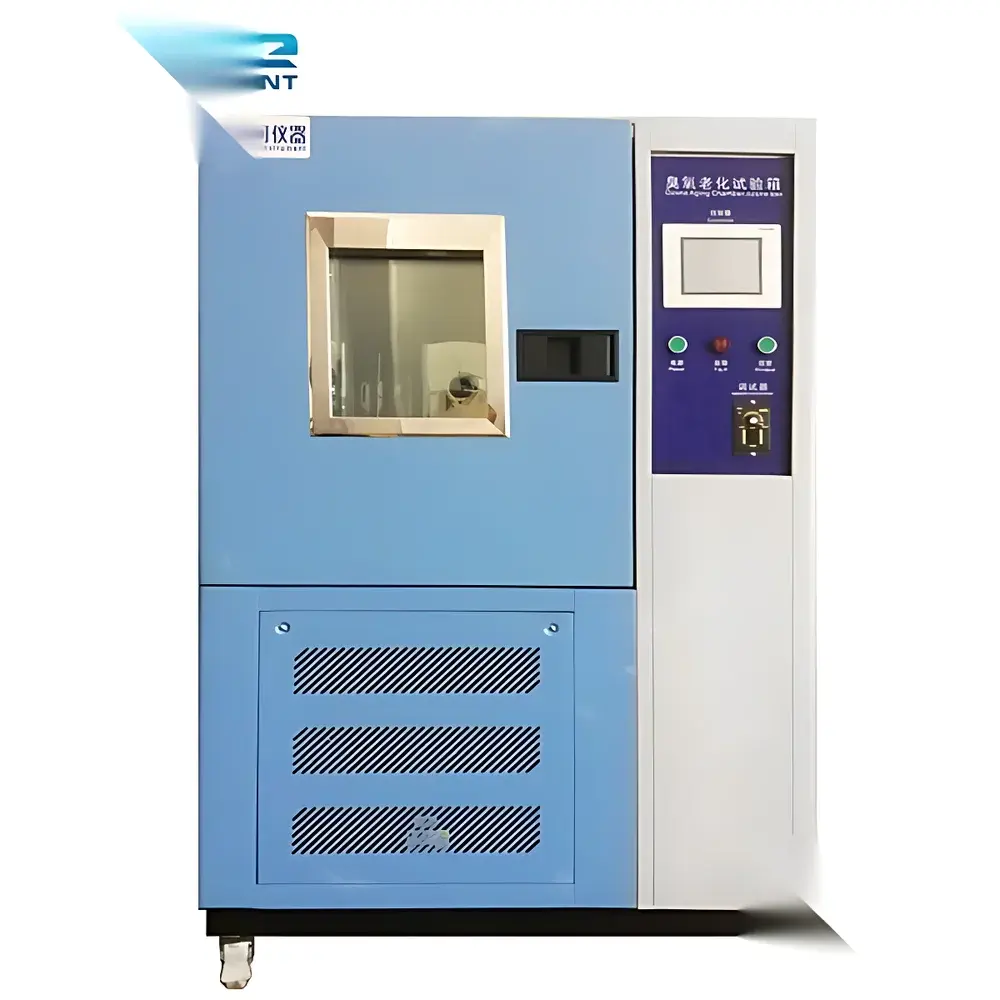
Ozone Aging Test Chamber – QY Series for Rubber Material Durability Evaluation
| Key Features | Stainless steel test chamber |
|---|---|
| Ozone concentration range | 50–1500 ppm (pphm) |
| Temperature range | 25–40 °C, ±0.5 °C stability |
| Humidity range | 30–65 % RH |
| Sample rack rotation | 360°, 1 rpm |
| Gas flow velocity | 8–16 mm/s |
| Compliance with GB/T 7762–2003, GB/T 2951.21–2008, GB/T 11206–2009, ISO 1431-1 | 2004 |
Overview
The QY Series Ozone Aging Test Chamber is an engineered environmental test system designed specifically for accelerated evaluation of rubber and elastomeric materials under controlled ozone exposure. It operates on the principle of simulating atmospheric ozone degradation mechanisms—where ozone (O₃) induces surface cracking in unsaturated polymer chains through ozonolysis—enabling quantitative assessment of material resistance to oxidative aging. Unlike ambient exposure testing, which may require months or years to observe measurable deterioration, this chamber delivers reproducible, standardized stress conditions that accelerate failure modes while preserving mechanistic fidelity. The system maintains a fully sealed, recirculating gas loop to ensure operator safety and experimental integrity, with ozone generated in situ via silent discharge technology and continuously monitored using non-dispersive ultraviolet (UV) absorption spectroscopy—a method recognized for its selectivity, linearity, and long-term stability per ISO 1431-1:2004 Annex B.
Key Features
- Hermetically sealed stainless steel test chamber with inert internal surfaces to prevent catalytic ozone decomposition and contamination.
- Silent discharge ozone generator with adjustable output, enabling precise setpoint control across 50–1500 ppm (parts per hundred million, ppHM), traceable to NIST-traceable reference standards.
- Dual-mode specimen mounting: static tension fixtures compliant with ISO 1431-1 Method A, and dynamic rotary sample racks (1 rpm, 360° continuous rotation) meeting Method B requirements for strain-induced crack propagation studies.
- Integrated UV photometric ozone analyzer with real-time digital display, automatic zero/span compensation, and ≥5-year lamp service life—calibration-verifiable via built-in metrology port.
- Climate control subsystem featuring Siemens S7-1200 PLC and Weinview 7-inch color touchscreen HMI, supporting independent PID tuning for temperature (25–40 °C, ±0.5 °C uniformity) and relative humidity (30–65 % RH).
- Comprehensive safety architecture including earth leakage protection, overtemperature cutoff, motor thermal overload sensing, and ozone leak detection interlocks—fully compliant with IEC 61000-6-2/6-4 EMC and EN 61010-1 safety directives.
Sample Compatibility & Compliance
The QY chamber accommodates standard dumbbell-shaped, ring, or strip specimens per ASTM D1149 and ISO 1431-1 geometries, with customizable fixture kits available for proprietary component forms. All models support both static and dynamic test protocols, allowing correlation between laboratory screening data and field-service performance. The system meets full technical and procedural alignment with GB/T 7762–2003 (Chinese national standard for rubber ozone resistance), GB/T 2951.21–2008 (cable insulation testing), GB/T 11206–2009 (vulcanized rubber surface cracking), and ISO 1431-1:2004 (determination of ozone resistance—part 1: static strain method). Optional validation packages include IQ/OQ documentation templates aligned with GLP and ISO/IEC 17025 laboratory accreditation requirements.
Software & Data Management
Data acquisition and instrument control are managed through embedded firmware with dual-output capability: analog 4–20 mA signals for integration into centralized SCADA or LIMS environments, and digital RS232 serial interface for direct PC connection. Real-time logging includes ozone concentration (pphm), chamber temperature (°C), relative humidity (% RH), elapsed test time (h:mm:ss), and rack rotational status. Export formats include CSV and timestamped binary logs, compatible with MATLAB, Python Pandas, and JMP for statistical analysis of crack initiation time, crack density, and threshold concentration modeling. Audit trail functionality supports FDA 21 CFR Part 11 compliance when paired with user-access-controlled networked operation mode.
Applications
- Formulation development of antiozonant additives (e.g., p-phenylenediamine derivatives) in natural rubber (NR), styrene-butadiene rubber (SBR), and nitrile butadiene rubber (NBR).
- Quality assurance of automotive seals, tire sidewalls, conveyor belts, and medical tubing where ozone-induced microcracking compromises barrier function or mechanical integrity.
- Comparative lifetime prediction modeling using Arrhenius-type acceleration factors derived from multi-level ozone concentration trials.
- Regulatory submission support for REACH, RoHS, and UL certification programs requiring documented resistance to atmospheric aging agents.
- Research into synergistic degradation mechanisms involving ozone combined with UV irradiation or thermal cycling (when integrated with auxiliary modules).
FAQ
What ozone concentration units does the system use, and how are they traceably calibrated?
The chamber reports ozone concentration in parts per hundred million (pphm), equivalent to 10⁻⁸ volume/volume. Calibration is performed using a certified UV absorption analyzer with NIST-traceable ozone standard gas; optional third-party calibration certificates are available upon request.
Can the system operate continuously for extended test durations (e.g., 168+ hours)?
Yes—the silent discharge generator, thermal management system, and sealed gas loop are rated for uninterrupted operation up to 30 days, with automated fault logging and email alerting via optional Ethernet module.
Is dynamic testing (rotating sample rack) compatible with all chamber volumes?
Dynamic mode is standard on all QY-225, QY-500, and QY-1000 models; QY-80 supports static-only configuration due to dimensional constraints.
Does the system meet international electrical safety and electromagnetic compatibility requirements?
All units are CE-marked per EN 61010-1 (safety) and EN 61000-6-2/6-4 (EMC), with factory-installed residual current devices (RCDs) and reinforced insulation on high-voltage ozone generator circuits.
How is humidity controlled without introducing water vapor that could interfere with ozone chemistry?
Humidity is regulated via chilled-mirror dew point control and desiccant-assisted dry-air mixing—ensuring stable RH without condensation or aqueous-phase side reactions that would compromise test validity.



