
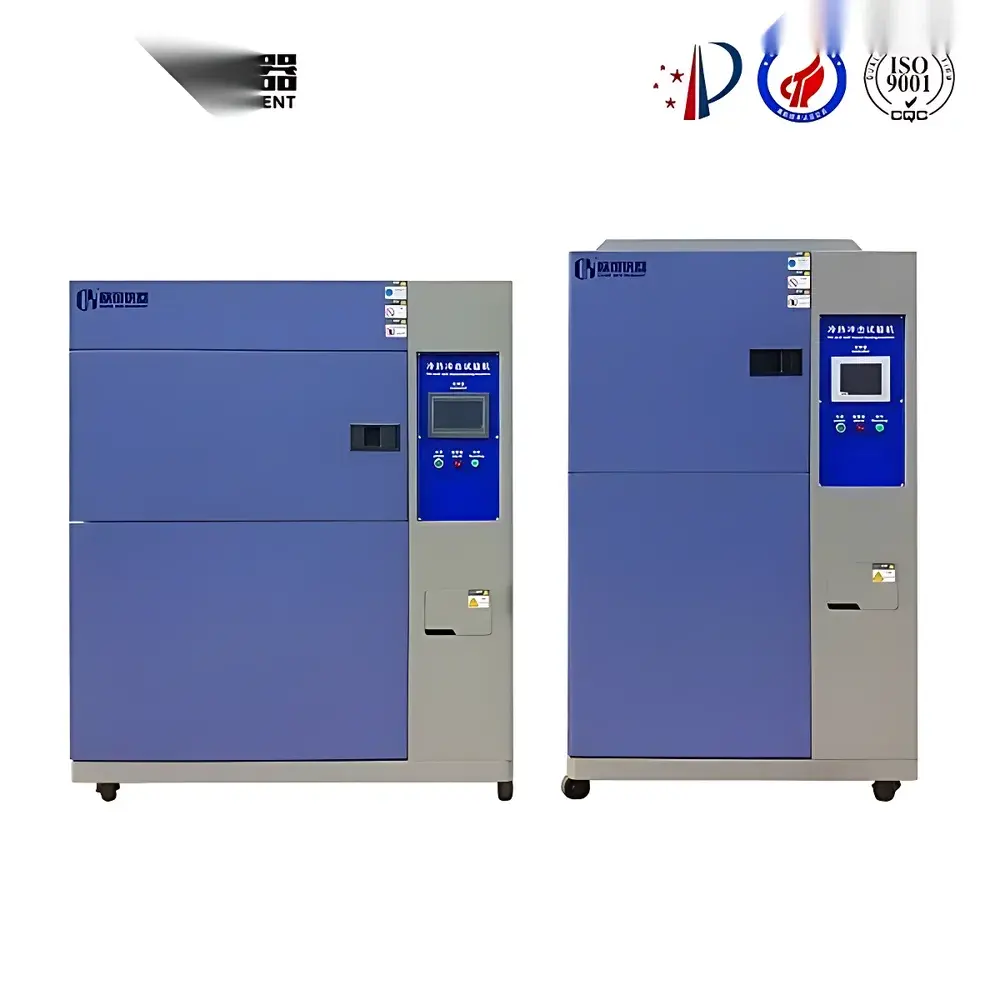
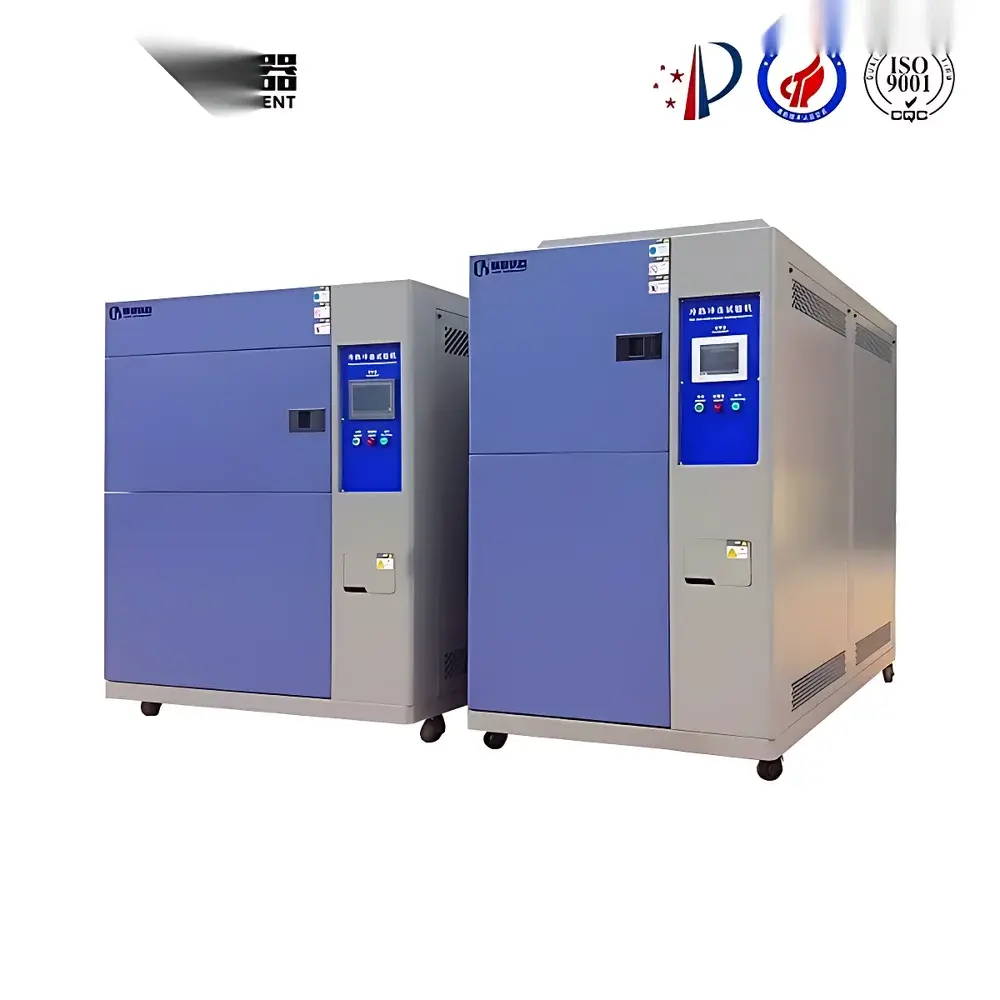
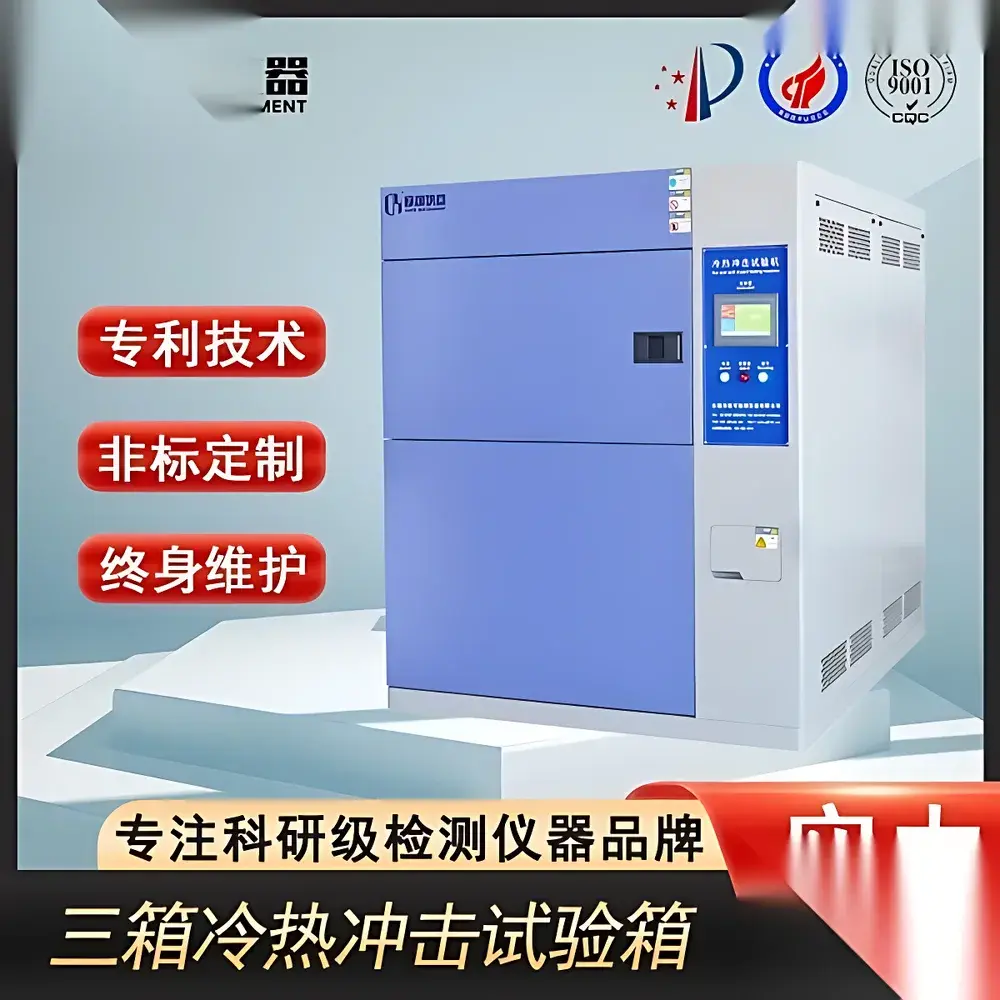
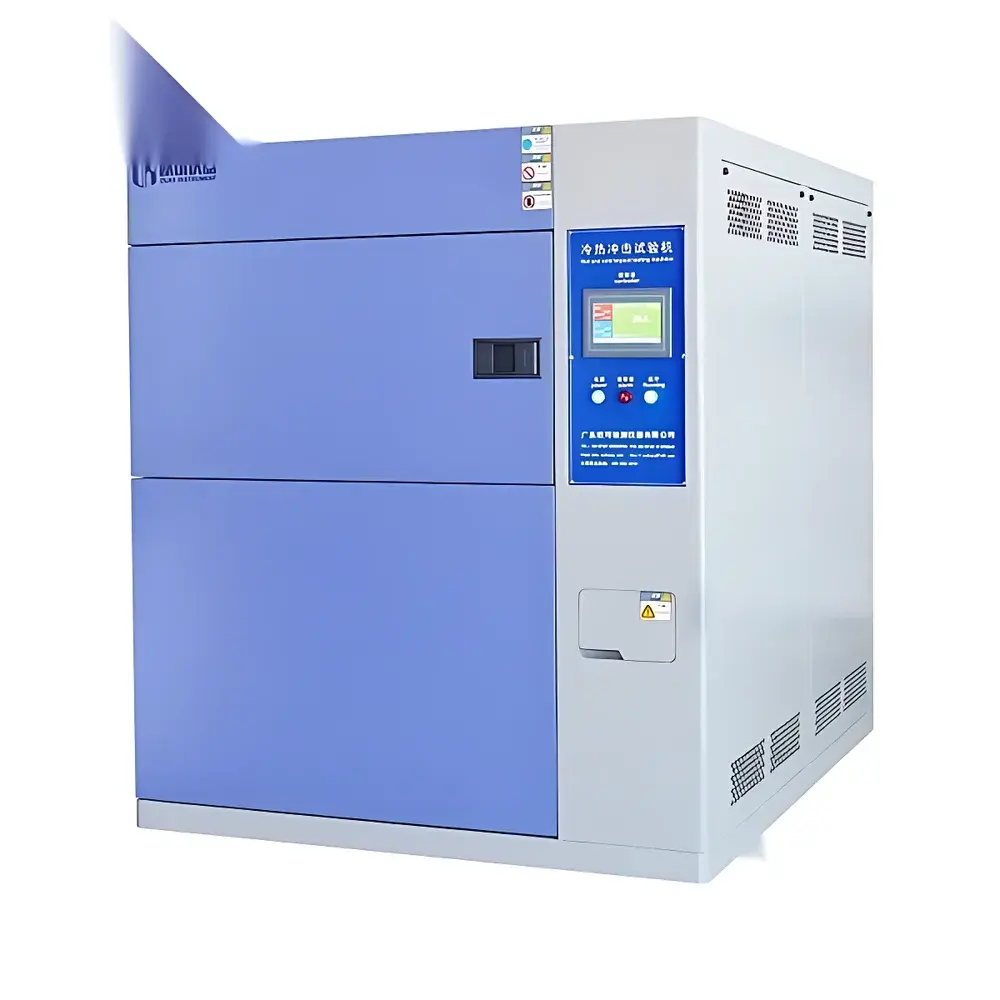
Thermal Shock Test Chamber – Dual-Compartment or Three-Zone Configuration, Industrial-Grade Environmental Test System
| Key Specifications | Temperature Range: -65°C to +180°C (typical) |
|---|---|
| Transfer Time | ≤15 s (dual-compartment), ≤30 s (three-zone) |
| Recovery Time | ≤5 min (standard load) |
| Internal Volume | 100–1000 L (configurable) |
| Cooling Method | Dual-stage cascade refrigeration with water-cooled condensers |
| Compliance | GB/T 2423.1–2, GB/T 2423.22, GJB 150.5, IEC 60068-2-14, MIL-STD-810H Method 503.5, ASTM D648, ISO 11359-2 |
| Power Supply | 380 VAC ±10%, 3-phase, 50/60 Hz |
| Water Cooling Requirement | External cooling tower (10 m³/h flow rate, 32°C max inlet temperature) |
| Control System | PID-based programmable controller with Ethernet interface |
| Data Logging | Built-in memory + optional USB/RS485 export |
| Safety Features | Over-temperature, over-pressure, compressor high/low pressure, phase failure, door interlock |
Overview
The Thermal Shock Test Chamber is an industrial-grade environmental test system engineered for rapid, repeatable thermal cycling between extreme temperature extremes. It operates on the principle of abrupt thermal transition—either via mechanical transfer (dual-compartment configuration) or spatial isolation (three-zone configuration)—to subject specimens to defined high-to-low or low-to-high temperature shifts within seconds. This methodology accelerates the manifestation of thermally induced degradation mechanisms including interfacial delamination, solder joint fatigue, polymer chain scission, and coefficient-of-thermal-expansion (CTE) mismatch stress in multilayer assemblies. Designed for compliance-driven validation workflows, the chamber supports qualification testing across aerospace, automotive electronics, semiconductor packaging, and medical device manufacturing sectors where reliability under transient thermal loads is mission-critical.
Key Features
- Dual-stage cascade refrigeration system utilizing R404A/R23 mixed-refrigerant cycles, enabling stable operation down to –65°C while maintaining precise control at +180°C
- Water-cooled condenser architecture requiring external cooling tower integration (10 m³/h capacity, 32°C max inlet temperature) for consistent heat rejection under continuous duty
- Two distinct structural configurations: (a) dual-compartment design with motorized specimen carrier (“basket”) for rapid transfer between hot and cold zones; (b) three-zone layout with independent hot soak, cold soak, and test chambers for zero-cross contamination and ultra-stable setpoint hold
- High-accuracy PID temperature controller with ±0.3°C uniformity (±0.5°C fluctuation) across working volume, compliant with IEC 60068-3-5 for thermal performance verification
- Robust stainless-steel interior with reinforced insulation (≥150 mm polyurethane foam, 0.022 W/m·K thermal conductivity) minimizing thermal bridging and energy loss
- Integrated safety architecture including compressor high/low pressure cutouts, phase failure detection, over-temperature protection, and electromechanical door interlock with forced-air purge prior to opening
Sample Compatibility & Compliance
The chamber accommodates a broad spectrum of physical forms—from PCB subassemblies and molded plastic housings to metallic fasteners and elastomeric seals—within standardized test fixtures or custom mounting trays. Its thermal profiles are validated against internationally recognized standards including IEC 60068-2-14 (Test N: Change of Temperature), MIL-STD-810H Method 503.5 (Temperature Shock), GJB 150.5A (Chinese military standard for temperature shock), and GB/T 2423.22-2012 (China national standard for temperature change testing). For regulated industries, the system supports GLP/GMP-aligned data integrity when paired with optional audit-trail-enabled software modules compliant with FDA 21 CFR Part 11 requirements for electronic records and signatures.
Software & Data Management
Equipped with a built-in programmable logic controller (PLC) featuring Ethernet TCP/IP connectivity, the chamber enables remote monitoring, parameter upload/download, and real-time trend visualization via standard web browsers. Optional PC-based software provides full test sequence scripting—including ramp-soak-dwell-transfer cycles, multi-step profiles, and conditional branching—alongside automated report generation in PDF/CSV formats. All temperature readings are timestamped with millisecond resolution and stored with checksum-verified integrity. Data export supports traceability frameworks required by ISO/IEC 17025-accredited laboratories and automotive APQP documentation packages.
Applications
- Qualification of automotive ECUs and powertrain sensors per QC/T 17-92 and ISO 16750-4 thermal shock protocols
- Reliability screening of BGA, QFN, and wafer-level chip-scale packages in semiconductor packaging development
- Validation of adhesive bond strength and coating adhesion under cyclic thermal stress (ASTM D3359, ISO 2409)
- Accelerated life testing of lithium-ion battery modules exposed to extreme ambient transitions
- Material compatibility assessment for medical device sterilization cycles involving steam-to-freeze transitions
- Design verification of optical enclosures subjected to diurnal temperature extremes in outdoor deployment scenarios
FAQ
What is the difference between dual-compartment and three-zone thermal shock configurations?
The dual-compartment system uses a single test space with movable specimen basket transferred mechanically between hot and cold zones—optimized for speed and cost efficiency. The three-zone configuration isolates hot soak, cold soak, and test chambers physically, eliminating cross-contamination and enabling superior temperature stability during dwell phases—preferred for high-precision qualification testing.
Does this chamber support automated test sequencing and data export for regulatory audits?
Yes—when configured with optional software, it delivers full 21 CFR Part 11-compliant audit trails, electronic signatures, and tamper-evident data archives suitable for FDA, ISO 13485, and IATF 16949 submissions.
What external infrastructure is required for operation?
A dedicated water-cooled condenser loop is mandatory: users must supply a circulating cooling tower delivering ≥10 m³/h at ≤32°C inlet temperature. Electrical supply must be stable 380 VAC ±10%, 3-phase, 50/60 Hz with appropriate circuit protection.
How is temperature uniformity verified and maintained across the working volume?
Uniformity is certified per IEC 60068-3-5 using nine calibrated PT100 sensors placed in a 3×3 grid. Active airflow management via adjustable vane diffusers and dual centrifugal circulation fans ensures ≤±0.3°C deviation across the rated volume under static load conditions.



