
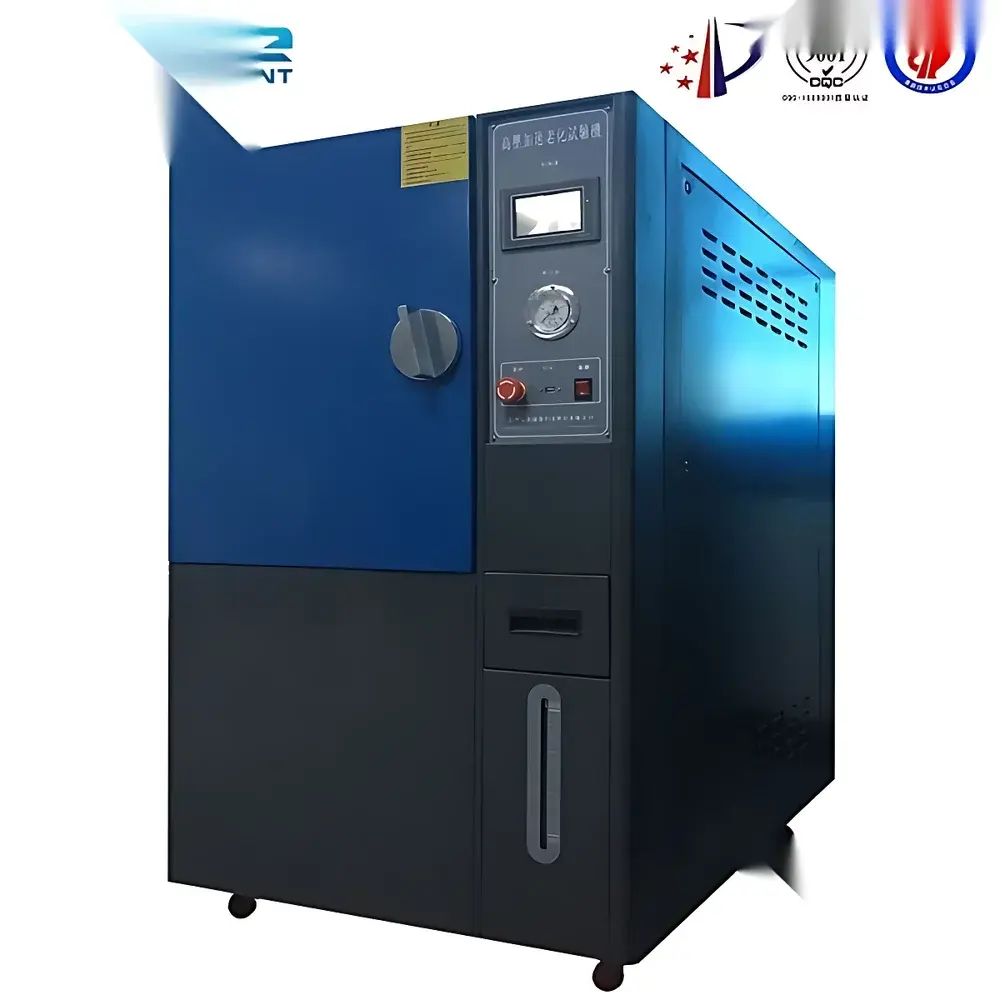
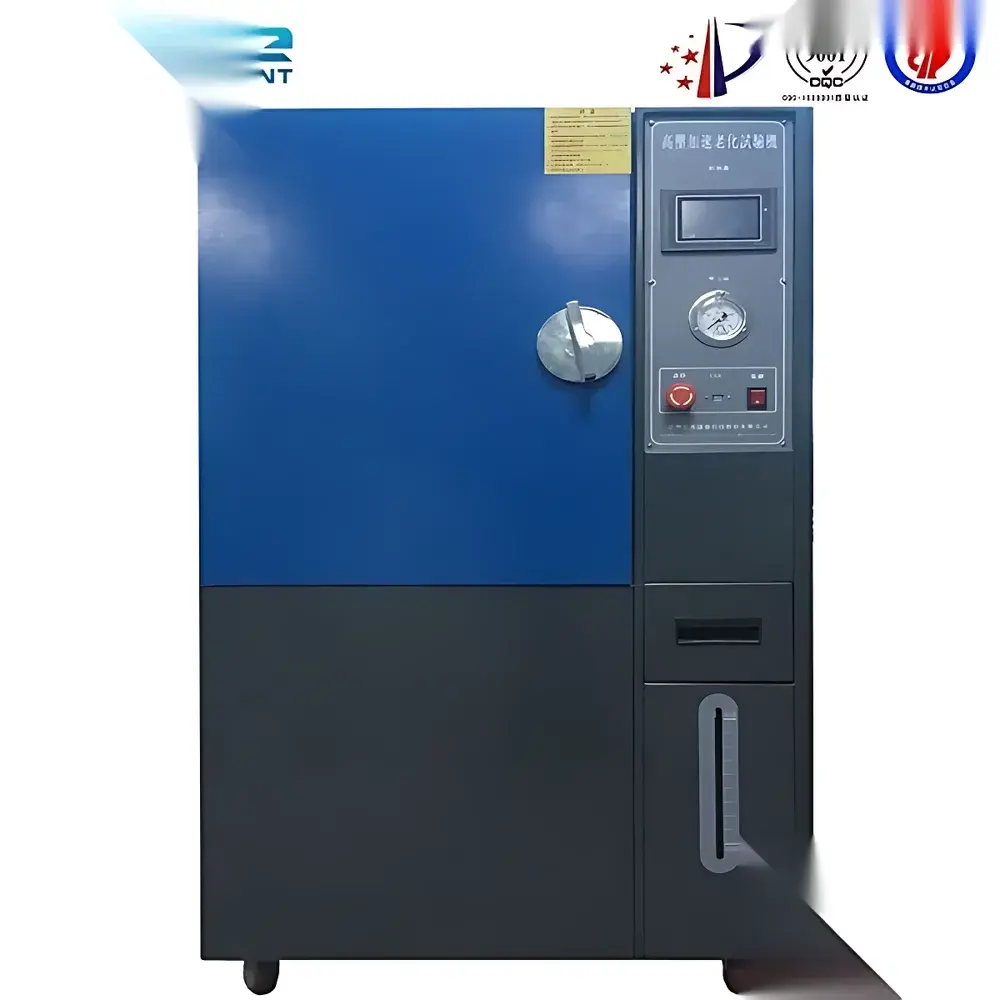
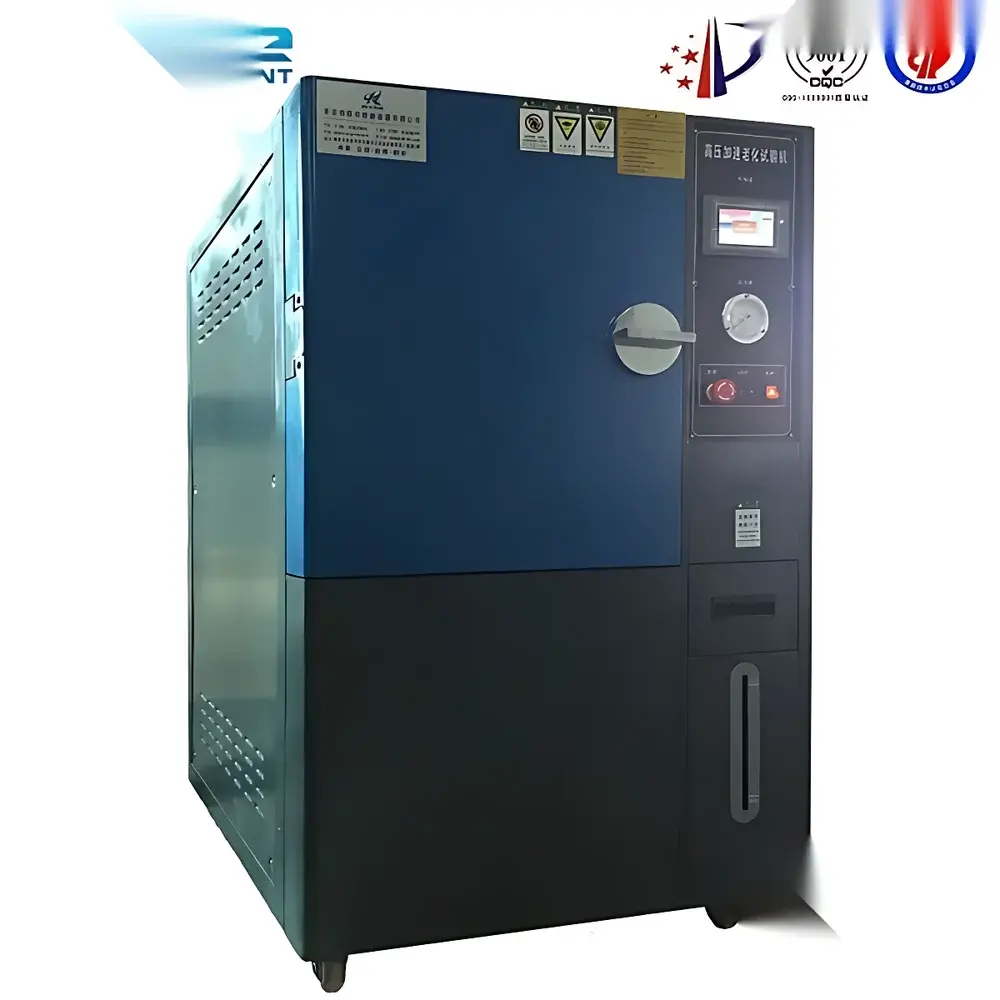
HAST High-Accelerated Stress Test Chamber – Industrial-Grade Saturation Steam Aging System for Semiconductor Reliability Testing
| Brand | OEM / Custom Manufacturer |
|---|---|
| Origin | Imported |
| Supplier Type | Authorized Distributor |
| Price | USD 14,200 (FOB) |
| Internal Chamber Dimensions | Ø300 × 450 mm (D × H) |
| External Dimensions | 660 × 950 × 600 mm (W × H × D) |
| Internal Material | SUS316 Stainless Steel or Epoxy-Coated Steel |
| Temperature Resolution | 0.1 °C |
| Pressure Control Range | 0–4 kg/cm² (0–392 kPa) |
| Operating Pressure Range | 1.0–2.5 kg/cm² (98–245 kPa) |
| Saturation Steam Temperature Range | Up to 143 °C at 2.5 kg/cm² |
| Pressure Accuracy | ±0.2–1.5 kg/cm² |
| Heating Method | Insulated High-Voltage Nichrome Heater with PID + SSR Control |
| Air Circulation | Natural Convection of Saturated Steam |
| Compliance | ASTM B117, IEC 60068-2-66, JIS C 60068-2-66, MIL-STD-202G, ISO 9001, UL 61010-1, NACE TM0177 |
Overview
The HAST High-Accelerated Stress Test Chamber is an industrial-grade saturated steam aging system engineered for accelerated reliability evaluation of semiconductor devices, IC packages, PCB assemblies, and hermetically sealed electronic components. Unlike conventional temperature-humidity testing, HAST leverages elevated pressure (up to 2.5 kg/cm²) to increase the partial pressure of water vapor, thereby driving moisture diffusion into encapsulants, die attach interfaces, and wire bond regions at significantly accelerated rates. This enables detection of latent defects—including delamination, interfacial corrosion, metallization degradation, and popcorn cracking—within hours rather than weeks or months. The chamber operates under strict thermodynamic saturation conditions, where temperature and pressure are intrinsically coupled per the steam saturation curve; at 2.5 kg/cm² (245 kPa), the equilibrium saturated steam temperature reaches 143 °C. This precise physical relationship ensures reproducible test conditions compliant with international qualification standards for automotive AEC-Q100, JEDEC JESD22-A110, and IEC 60749-29.
Key Features
- Robust SUS316 stainless steel inner chamber construction—resistant to chloride-induced stress corrosion cracking and long-term exposure to high-humidity saturated steam environments.
- Microprocessor-based PID + SSR control architecture with dual-loop regulation of saturated steam temperature and chamber pressure, delivering stable thermal-hygric profiles across extended test durations (up to 96 h continuous operation).
- High-fidelity platinum resistance temperature sensor (Pt100, Class A) and calibrated mechanical pressure gauge with analog pointer display for real-time verification and redundancy.
- Natural convection steam circulation system driven by thermally optimized magnetic-coupled fan assembly—eliminates forced-air turbulence that may disturb condensation dynamics or induce non-uniform moisture ingress.
- Insulated high-voltage heating elements with ceramic sheathing ensure uniform thermal distribution and prevent localized dry-out or superheating zones within the saturated environment.
- Integrated safety interlocks including over-pressure relief valve, temperature cut-off switch, and door-locking mechanism compliant with EN 61010-1 and UL 61010-1 requirements.
Sample Compatibility & Compliance
The chamber accommodates standard JEDEC trays (JEDEC STD-20), 8-inch/12-inch wafer carriers, and discrete component racks without modification. Its cylindrical internal geometry (Ø300 × 450 mm) supports optimal steam saturation homogeneity and minimizes cold spots. All operational parameters adhere to test method definitions in IEC 60068-2-66 (HAST Method), JESD22-A110 (HAST for plastic-encapsulated microcircuits), and MIL-STD-202G Method 108 (Moisture Resistance). Calibration traceability follows ISO/IEC 17025-accredited procedures, with documented uncertainty budgets for temperature (±0.3 °C) and pressure (±1.2 kPa) measurements. The system meets GLP audit requirements for data integrity, including time-stamped event logging and non-editable test record generation.
Software & Data Management
While the base configuration features standalone LED controller with manual setpoint entry, optional Ethernet-enabled data acquisition modules support remote monitoring via Modbus TCP or OPC UA protocols. Logged parameters—including real-time chamber pressure, saturated temperature, elapsed test time, and alarm status—are exportable in CSV format for integration into LIMS or MES platforms. Audit trail functionality complies with FDA 21 CFR Part 11 requirements when paired with validated user access controls and electronic signature modules. All firmware updates undergo regression testing against IEC 62443-3-3 cybersecurity benchmarks.
Applications
- Qualification of mold compound adhesion strength and moisture barrier performance in QFN, BGA, and WLP packages.
- Evaluation of wire bond lift-off susceptibility under high-humidity thermal stress.
- Failure analysis root cause identification for field returns exhibiting corrosion-related opens or shorts.
- Process validation of conformal coating effectiveness on flex-rigid PCBs.
- Accelerated life testing of MEMS sensors, power modules, and automotive ECUs per AEC-Q200 guidelines.
FAQ
What distinguishes HAST from standard THB (Temperature-Humidity-Bias) testing?
HAST eliminates reliance on ambient air humidity control by operating under pressurized saturated steam—yielding up to 10× acceleration factor versus 85 °C/85% RH testing while avoiding condensation variability caused by airflow or dew point drift.
Can the chamber be used for unsaturated steam or dry heat testing?
No. This system is purpose-built for saturated steam environments only. Operation outside defined pressure–temperature saturation curves invalidates test compliance and risks thermal runaway or pressure vessel failure.
Is third-party calibration certification included with delivery?
Yes—each unit ships with a factory-issued calibration certificate traceable to NIST standards, covering temperature and pressure transducers at three critical points (1.0, 1.8, and 2.5 kg/cm²).
How is maintenance performed to ensure long-term pressure seal integrity?
Quarterly inspection of silicone gasket compression force, annual hydrostatic verification of pressure vessel weld seams, and biannual recalibration of safety relief valves per ASME BPVC Section VIII Division 1 requirements.



