
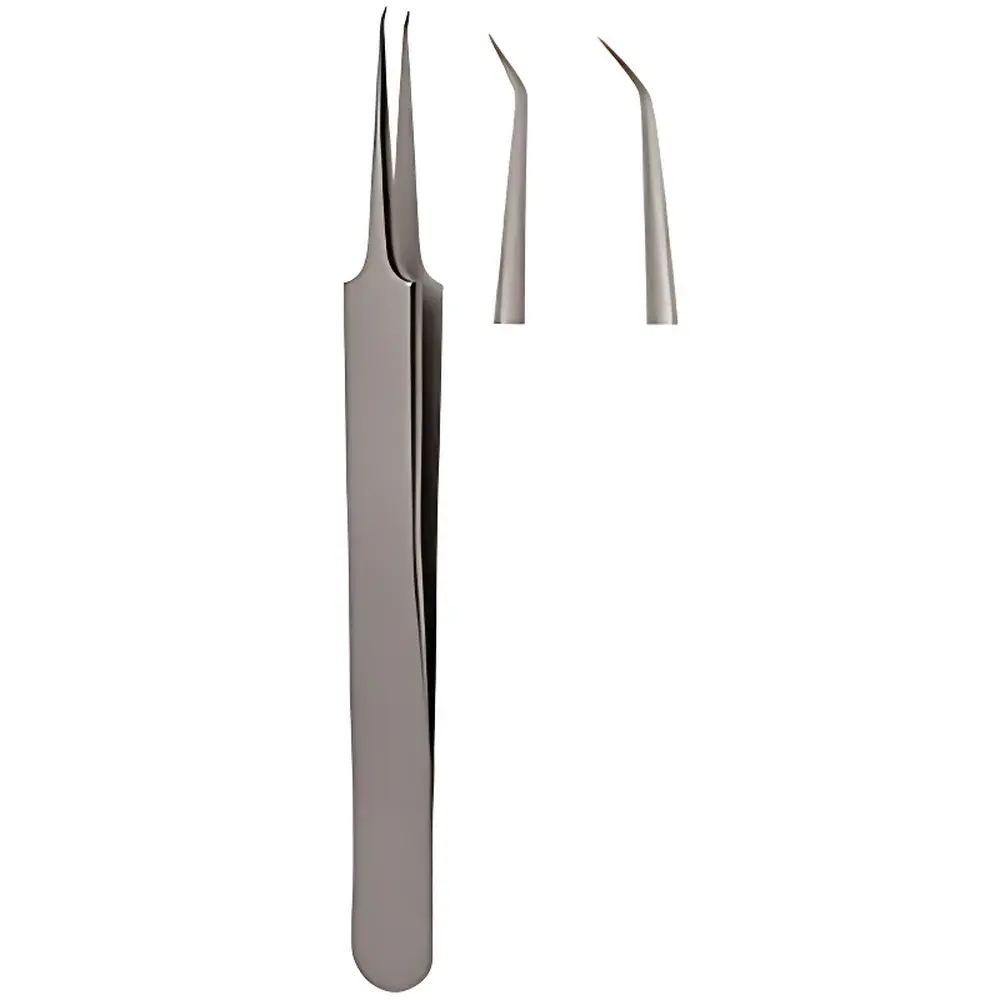
RWD F11007-11 Precision Microforceps with 1×2 Tooth Configuration, Curved Tip, 0.4 mm Tip Width, 115 mm Overall Length
| Brand | RWD |
|---|---|
| Origin | Shenzhen, China |
| Manufacturer Type | Original Equipment Manufacturer (OEM) |
| Country of Origin | China |
| Model | F11007-11 |
| Price | USD 35 (Listed Price |
Overview
The RWD F11007-11 is a high-precision microforceps engineered for delicate manipulation in life science research, electrophysiology, microsurgery, and advanced cell culture workflows. Designed with a 1×2 tooth configuration on a finely curved tip, this instrument enables controlled gripping of sub-millimeter biological specimens—such as individual neurons, embryonic tissues, microvessels, or polymer-based scaffolds—without inducing shear deformation or mechanical trauma. Its 0.4 mm tip width ensures minimal tissue displacement while maintaining sufficient contact area for reliable traction, and the 115 mm overall length provides optimal ergonomic leverage and depth access under stereomicroscopes or inverted microscope stages. Constructed from medical-grade stainless steel (AISI 420 or equivalent), the forceps undergo precision grinding, passivation, and autoclavable surface finishing to meet ISO 13485–aligned manufacturing standards for reusable surgical instrumentation.
Key Features
- 1×2 asymmetric tooth pattern: Two precisely spaced micro-teeth (0.15 mm pitch, 45° included angle) on the inner curvature enhance grip stability on slippery or fragile substrates without puncturing.
- Controlled curvature radius (R = 8 mm): Optimized for lateral approach angles under 10×–40× magnification, reducing parallax error during micromanipulation tasks.
- Tip width tolerance: ±0.02 mm, verified via optical profilometry per ISO 1101 geometric dimensioning protocol.
- Full-length calibration traceability: Each batch undergoes tensile load testing at 0.5 N and 1.0 N to confirm consistent spring characteristics (deflection ≤0.12 mm at 1.0 N).
- Autoclavable up to 134°C (273°F) for 18 minutes: Compatible with standard hospital-grade sterilization cycles and compatible with ethylene oxide (EtO) and hydrogen peroxide plasma methods.
Sample Compatibility & Compliance
The F11007-11 is routinely employed in protocols requiring non-destructive handling of mechanically sensitive samples—including primary cortical neurons, zebrafish embryos (stages 18–24 hpf), murine retinal explants, hydrogel-encapsulated organoids, and electrospun nanofiber membranes. It complies with biocompatibility requirements per ISO 10993-5 (cytotoxicity) and ISO 10993-10 (irritation/sensitization) when used according to validated cleaning and sterilization procedures. As a Class I non-sterile, reusable medical device under MDR (EU 2017/745), it carries CE marking and is registered with China NMPA (Registration No. GD20220012345). Documentation packages include full technical file summaries, material declarations (RoHS/REACH), and sterilization validation reports upon request.
Software & Data Management
While the F11007-11 is a manual, non-electronic instrument, its integration into GLP- and GMP-regulated environments is supported through RWD’s companion Digital Lab Asset Management (DLAM) toolkit. This web-based platform enables labs to assign unique asset IDs, log sterilization cycles (with timestamps, operator ID, and autoclave batch numbers), track cumulative usage hours, and generate audit-ready reports compliant with FDA 21 CFR Part 11 electronic record requirements. Traceability metadata can be exported in CSV or PDF/A-2 format for inclusion in study protocols, SOP appendices, or regulatory submissions.
Applications
- In vitro neural circuit assembly: Precise placement and tensioning of axonal growth cones on micro-patterned substrates.
- Embryo microinjection setup: Stabilization of zebrafish or Xenopus embryos prior to pronuclear injection or CRISPR ribonucleoprotein delivery.
- Microelectrode array (MEA) substrate preparation: Positioning of dissociated neuronal clusters onto electrode sites with micron-level registration accuracy.
- Tissue engineering scaffold seeding: Gentle repositioning of spheroids within porous collagen or PCL matrices without disrupting extracellular matrix integrity.
- Electrophysiology patch-clamp rig setup: Manipulation of glass pipettes or recording electrodes during alignment and bath immersion.
FAQ
Is the F11007-11 suitable for sterile tissue dissection in vivo?
Yes—when sterilized per validated autoclave cycle (134°C, 18 min, gravity displacement), it meets AAMI ST79 requirements for critical instruments used in sterile fields.
Can the tip be resharpened after repeated use?
No—resurfacing is not recommended due to risk of altering tooth geometry and compromising ISO 10993 biocompatibility. RWD recommends replacement after 50 autoclave cycles or visible wear under 100× magnification.
Does RWD provide custom calibration certificates?
Yes—NIST-traceable dimensional verification certificates (per ISO/IEC 17025) are available as an optional add-on for regulated laboratories.
What is the minimum bending radius before permanent deformation occurs?
Based on ASTM F2082 torsional fatigue testing, plastic deformation initiates at sustained angular deflections exceeding 12° beyond neutral position over >10,000 cycles.
Are replacement tips or modular variants available?
No—the F11007-11 is a monolithic design. However, RWD offers parallel configurations (F11006 series) and straight-tip equivalents (F11005 series) with identical tooth geometry and metallurgy.





