
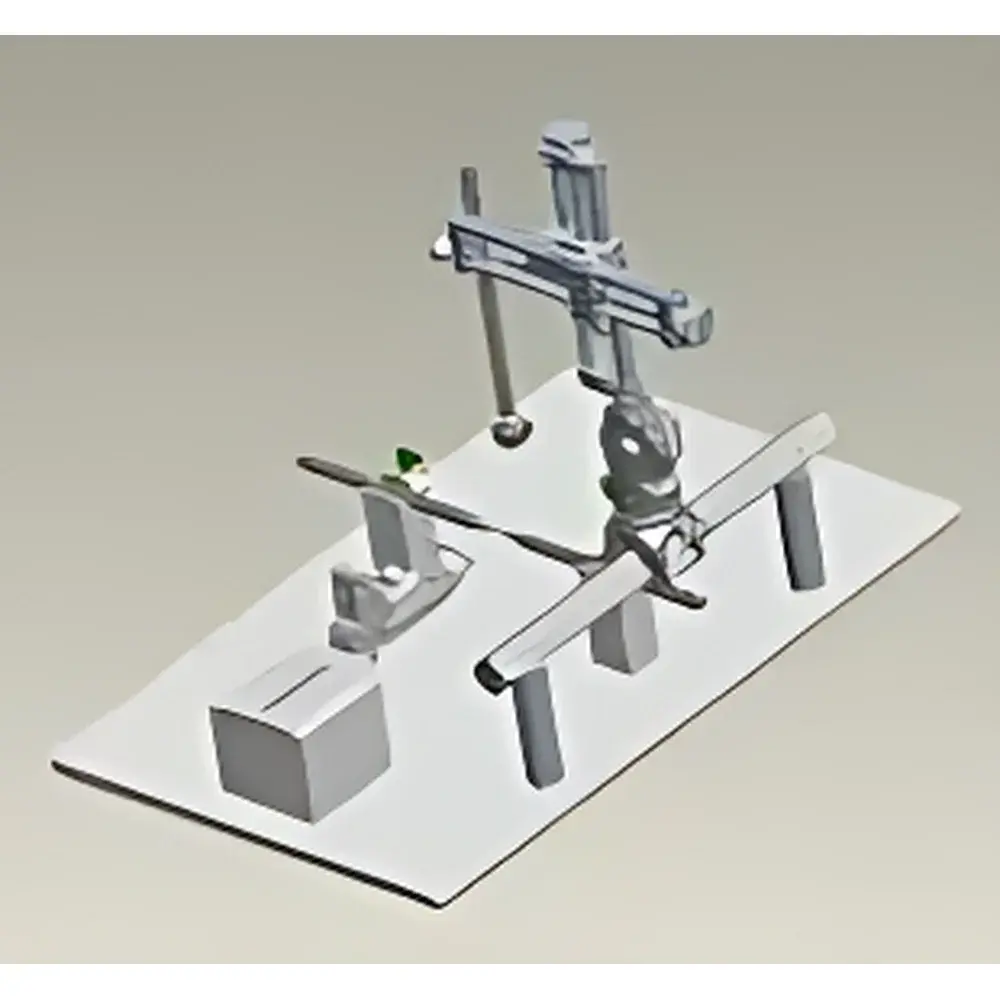
Neurostar 68506轨道式大鼠脑立体定位仪
| Origin | Guangdong, China |
|---|---|
| Manufacturer Type | Authorized Distributor |
| Origin Category | Domestic (PRC) |
| Model | 68506 |
| Pricing | Upon Request |
| Base Plate Dimensions | 400 mm × 255 mm |
| Ear Bar Angle | 18° |
| Ear Bar Scale Resolution | 0.1 mm |
| Ear Bar Height from Base | 55.5 mm |
| Track Length | 255 mm |
| Track Zero Alignment | Coincident with Ear Bar Center |
| Track Graduation Range | ±100 mm from Zero |
| Adapter Anterior–Posterior Travel | 43.5 mm |
| Adapter Vertical Adjustment Range | +10 mm to –20 mm (30 mm total) |
| Vertical Adjustment Resolution | 0.1 mm |
Overview
The Neurostar 68506 Orbital-Track Rat Stereotaxic Instrument is a precision-engineered platform designed for reproducible intracranial targeting in rodent neurosurgical procedures. Unlike conventional U-frame stereotaxic systems, the 68506 employs a linear orbital track architecture that significantly expands lateral working space and improves ergonomic access to the surgical field—particularly during multi-electrode implantation, bilateral cannula placement, or simultaneous dual-arm manipulations. Its measurement principle relies on orthogonal Cartesian coordinate referencing (anterior–posterior, medial–lateral, dorsal–ventral), anchored to anatomical landmarks (bregma and lambda) via calibrated ear bars and a zero-referenced sliding track. The system is optimized for adult Sprague-Dawley and Wistar rats (250–500 g), supporting stereotactic accuracy within ±0.1 mm across all three axes under standard laboratory conditions.
Key Features
- Orbital-track design replaces rigid U-frame geometry, enabling unobstructed lateral access and facilitating concurrent use of multiple manipulators or microinjection arms.
- Extended base plate (400 mm × 255 mm) provides enhanced stability and accommodates auxiliary equipment such as heating pads, electrophysiology rigs, or imaging adapters without compromising rigidity.
- 18° angled ear bars with 35-mm engraved scale ensure consistent skull alignment and reduce temporalis muscle compression during prolonged fixation.
- Ear bar height (55.5 mm above base plane) is calibrated to match standard rat skull curvature, minimizing angular deviation during bregma/lambda leveling.
- 0.1-mm resolution vernier scale integrated into the ear bar slot enables precise midline verification prior to coordinate initialization.
- 255-mm linear track, zero-aligned with the ear bar centerline, features symmetrical ±100-mm graduation for rapid AP-axis referencing relative to bregma.
- Adapter stage offers 43.5 mm anterior–posterior travel and 30 mm vertical range (–20 mm to +10 mm), with micrometer-driven 0.1-mm incremental control for fine DV positioning.
Sample Compatibility & Compliance
The Neurostar 68506 is validated for use with adult rats (including transgenic and immunocompromised models) requiring chronic electrode implantation, viral vector delivery, optogenetic fiber placement, or microdialysis probe insertion. It supports standard stereotaxic atlases (Paxinos & Watson, 7th ed.) and integrates seamlessly with digital calipers, microdrives (e.g., Kopf 1770 series), and motorized manipulators via standardized 1/4″-20 threaded mounting interfaces. The instrument complies with ISO 13485–aligned manufacturing documentation practices and meets mechanical safety requirements per IEC 61000-6-2 (EMC immunity) and IEC 61000-6-3 (EMC emissions). All metal components are passivated stainless steel (AISI 304), ensuring compatibility with ethanol, hydrogen peroxide, and autoclave sterilization cycles (up to 121°C, 20 min).
Software & Data Management
While the Neurostar 68506 is a manually operated mechanical platform, it is fully compatible with third-party digital workflow systems including StereoInvestigator (MBF Bioscience), Brainstorm (NIH), and custom Python/MATLAB-based coordinate calculators. Its dimensional repeatability (≤0.05 mm inter-session SD, n=20) supports GLP-compliant recordkeeping when paired with electronic lab notebooks (ELNs) such as LabArchives or Benchling. All positional settings—including ear bar depth, track offset, and adapter height—are documented in accordance with ALARA principles and NIH Animal Welfare Guidelines. Audit trails for experimental coordinates may be generated using timestamped imaging metadata (e.g., pre-op CT/MRI registration overlays) and exported in CSV or JSON format for regulatory submission.
Applications
- Chronic intracranial electrode array implantation for in vivo electrophysiology (LFP, single-unit recording).
- Bilateral microinjection of AAV vectors, siRNA, or pharmacological agents into discrete nuclei (e.g., hippocampus, striatum, amygdala).
- Fiber photometry and optogenetic stimulation with dual-site illumination control.
- Microdialysis probe placement for real-time neurotransmitter monitoring (dopamine, serotonin, glutamate).
- Lesion studies using electrolytic, thermocoagulative, or excitotoxic methods with submillimeter targeting fidelity.
- Training platform for stereotaxic surgery certification in academic and CRO environments (per FELASA Category C requirements).
FAQ
Is the Neurostar 68506 compatible with mouse stereotaxic procedures?
The 68506 is specifically engineered for rats (250–500 g); for mice (<40 g), we recommend the Neurostar 68504 Mini-Orbital variant with scaled ear bar geometry and reduced track inertia.
Can the orbital track accommodate motorized linear stages?
Yes—the track features dual M4 tapped holes at 50-mm intervals and a standardized 12-mm-wide T-slot profile, compatible with Thorlabs LTS series and Newport IMS linear actuators.
Does the system include calibration certificates or traceable metrology documentation?
Each unit ships with a factory-verified mechanical calibration report (traceable to NIM China), including runout, orthogonality, and zero-alignment verification data.
What maintenance is required to sustain long-term positional accuracy?
Annual recalibration of the vernier scale and track linear bearing preload is recommended; lubrication-free PTFE-coated slides eliminate need for oiling and reduce particulate generation in SPF facilities.




