
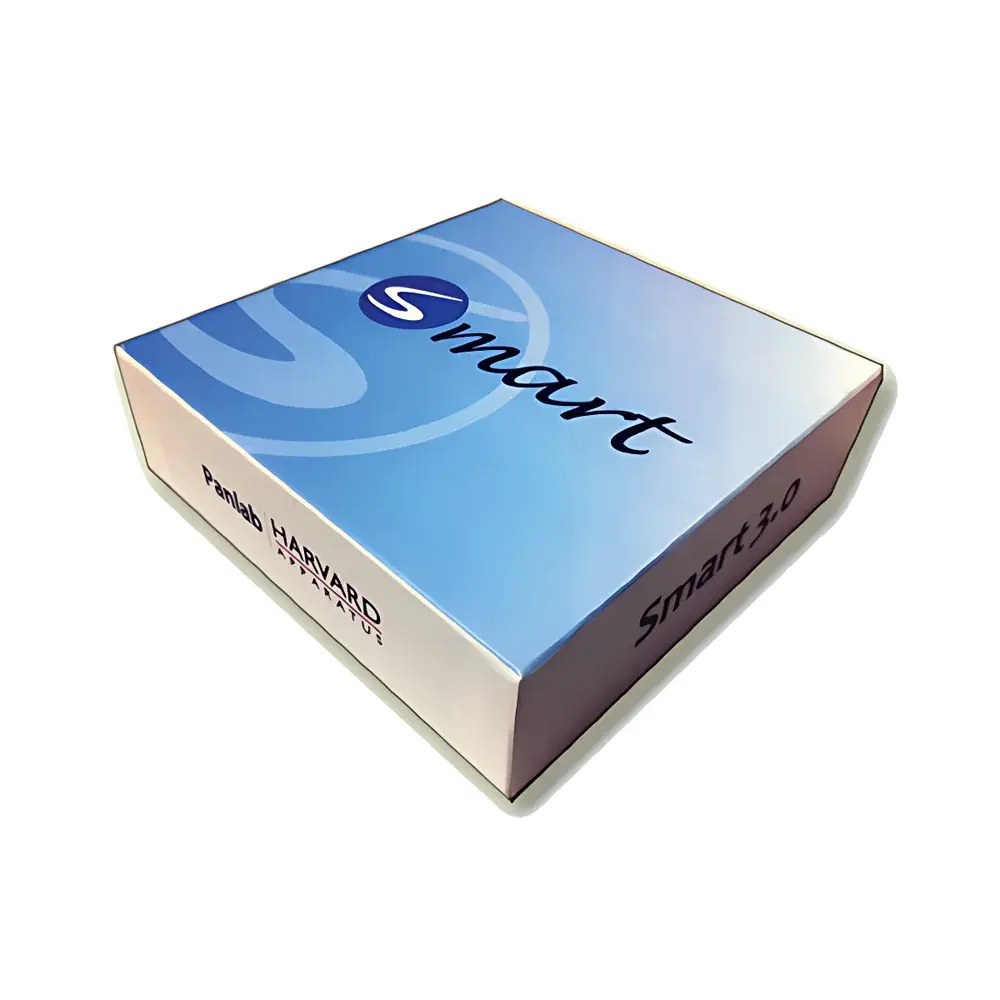
SMART 3.0 Animal Behavior Tracking and Analysis System
| Origin | Shenzhen, China |
|---|---|
| Manufacturer Type | Distributor |
| Origin Category | Domestic |
| Model | SMART 3.0 |
| Price | USD 14,000 (approx.) |
Overview
The SMART 3.0 Animal Behavior Tracking and Analysis System is a high-precision, video-based behavioral phenotyping platform engineered for reproducible quantification of rodent locomotor activity, exploratory behavior, anxiety-related responses, learning & memory performance, and social interaction dynamics. Built upon robust computer vision algorithms and real-time motion segmentation, the system employs frame-difference and contour-based tracking to deliver sub-pixel spatial resolution in 2D coordinate reconstruction (x, y) at up to 60 fps. Its architecture supports both single-animal and multi-scene parallel acquisition, enabling standardized compliance with NIH-defined behavioral assay protocols—including open field (OF), Morris water maze (WM), elevated plus maze (EPM), Y-maze/T-maze, conditioned place preference (CPP), forced swim test (FST), tail suspension test (TST), and contextual/cued fear conditioning paradigms. Designed for academic neuroscience laboratories, preclinical CROs, and pharmacological research units, SMART 3.0 operates under Windows 10/11 64-bit environments and integrates seamlessly with third-party physiological recording systems via TTL or serial event triggers.
Key Features
- Modular software architecture: Core platform (SMART-CS) supports full customization of tracking parameters, region definitions, and analysis logic for non-standard experimental setups.
- Preset behavioral modules: SMART-WM (water maze), SMART-PM (plus maze), SMART-OF (open field), SMART-CPP (conditioned place preference), SMART-TY (T/Y-maze), SMART-FST/TST (forced swim/tail suspension) — each includes validated parameter defaults, automated latency/distance/time calculations, and ISO/ASTM-aligned reporting templates.
- Multi-scene acquisition (SMART-MA): Concurrent real-time tracking across up to 8 independent arenas using synchronized USB 3.0 or GigE cameras; maintains individual animal ID integrity through adaptive appearance modeling.
- TriWise™ three-point tracking engine: Simultaneously localizes head centroid, body center, and tail base to compute posture-dependent metrics—rearing frequency, stretching index, rotation angle, and self-grooming bout detection—without requiring marker attachment.
- Event annotation framework: Manual behavioral coding via on-screen panel or keyboard shortcuts (e.g., ‘R’ = rearing, ‘G’ = grooming); all events are time-stamped, region-anchored, and exportable with video clip references.
- Advanced region editor: Supports up to 255 user-defined zones per arena using polygon, rectangle, circle, grid, or quadrant tools; enables conditional triggering (e.g., “exit zone A → start timer”) and hierarchical zone grouping (e.g., “center + periphery = total arena”).
Sample Compatibility & Compliance
SMART 3.0 is validated for use with mice (C57BL/6, BALB/c, CD-1, FVB/N) and rats (Sprague-Dawley, Wistar) aged 6–24 weeks, under standard laboratory lighting (100–300 lux) and controlled ambient temperature (22 ± 2°C). The system complies with GLP-relevant data integrity requirements: all raw videos, configuration files (.cfg), region definitions (.roi), and analysis databases (.db3) are stored within timestamped experiment folders, ensuring full audit trail traceability. Exported Excel® reports include metadata headers (operator ID, date/time, camera calibration ID, arena dimensions), satisfying documentation needs for internal SOPs and external regulatory submissions (e.g., FDA preclinical study reports under ICH S7A/S7B guidelines).
Software & Data Management
The SMART 3.0 application features a ribbon-style GUI with icon-driven workflow navigation—eliminating nested menus and reducing operator training time to under 90 minutes. All configurations persist as XML-based project files; batch analysis mode processes ≥100 sessions overnight with automatic outlier flagging based on velocity variance thresholds. Raw trajectory data (X/Y coordinates, speed, acceleration, heading angle) is stored in SQLite format with ACID-compliant transactions. Export options include CSV (for R/Python integration), Excel® (.xlsx) with pivot-ready tables, BMP/PNG snapshots of heatmaps and path plots, and MP4 video overlays with annotated trajectories and event markers. Audit logs record every user action (login, region edit, analysis run, export), supporting 21 CFR Part 11 readiness when paired with institutional identity management systems.
Applications
- Neuropharmacology: Dose-response evaluation of anxiolytics (diazepam), antidepressants (imipramine, fluoxetine), NMDA antagonists (ketamine), and dopaminergic agents in validated behavioral domains.
- Transgenic model characterization: Quantitative phenotyping of APP/PS1, 5xFAD, Tau P301L, and Shank3 KO lines across developmental timepoints.
- Circadian & sleep-wake studies: Long-term (>72 h) spontaneous activity monitoring with custom light-cycle scheduling and rest-activity bout detection.
- Social behavior assays: Dyadic interaction scoring (sniffing duration, following latency, proximity time) with configurable inter-animal distance thresholds and contact point definition.
- Motor function assessment: Gait pattern analysis (stride length, base width, swing phase) in MPTP or 6-OHDA lesion models when combined with high-speed camera hardware (≥120 fps).
FAQ
What camera specifications are recommended for optimal tracking accuracy?
We recommend USB 3.0 monochrome CMOS cameras (e.g., FLIR Blackfly S BFS-U3-16S2C-C) with global shutter, ≥1280 × 960 resolution, and adjustable exposure (1–100 ms). Lighting must be uniform (±15% intensity variation) and shadow-free; infrared illumination (850 nm) is supported for nocturnal testing.
Can SMART 3.0 integrate with electrophysiology or optogenetics rigs?
Yes—via TTL input/output ports for synchronized event tagging (e.g., laser pulse onset, electrode stimulation), and UDP packet streaming for real-time behavioral state feedback to external controllers.
Is cloud-based data backup or remote analysis supported?
Local deployment only; no cloud storage or remote execution. However, encrypted network shares (SMB/CIFS) enable centralized archive servers compliant with HIPAA/FERPA institutional policies.
How does SMART 3.0 handle occlusion or overlapping animals?
In single-animal mode, occlusion recovery uses Kalman filtering with motion prediction. In social interaction mode, appearance-based re-identification (using HOG + color histogram features) maintains ID continuity during brief (<1.5 s) overlaps.
Are validation documents (IQ/OQ/PQ) available?
Comprehensive Installation Qualification (IQ) and Operational Qualification (OQ) protocols—including camera calibration verification, pixel-to-mm conversion checks, and inter-rater reliability benchmarks—are provided upon request for GxP-regulated environments.



