
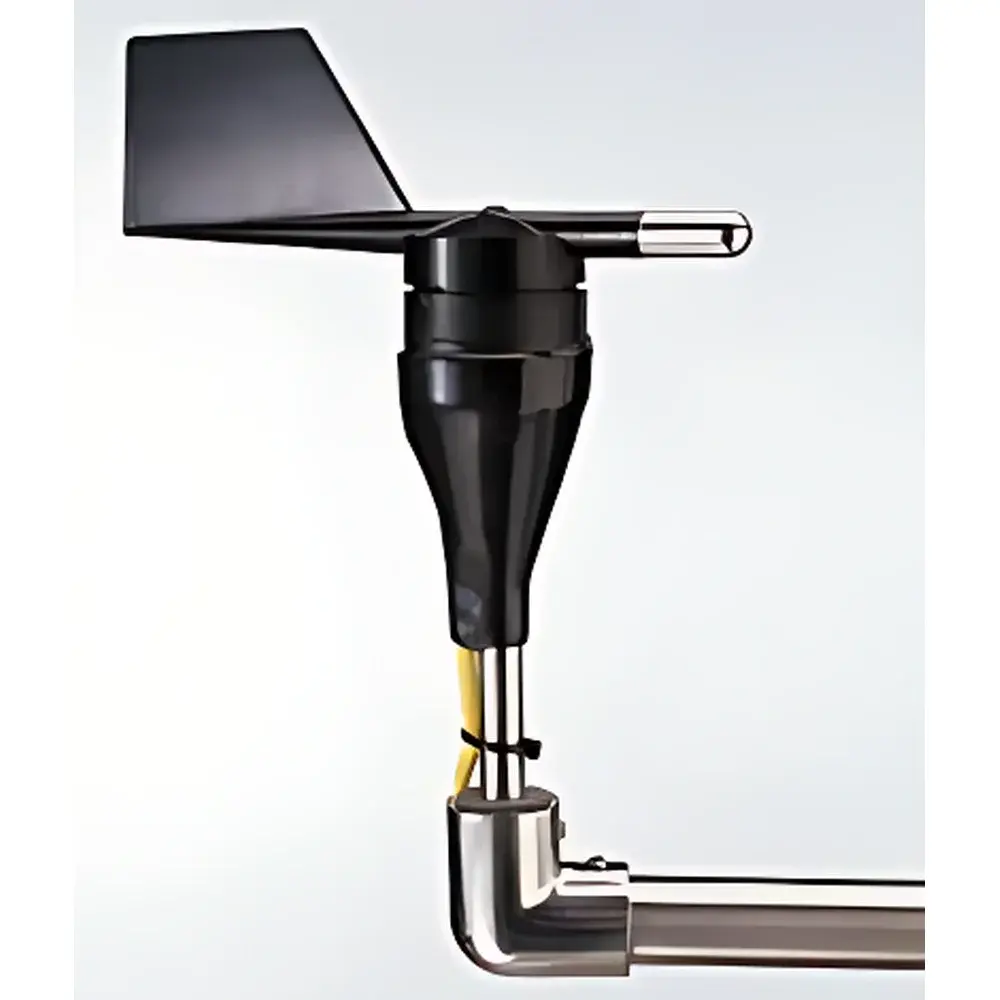
GW WE570 Wind Vane Sensor
| Brand | GW |
|---|---|
| Origin | USA |
| Model | WE570 |
| Output | 4–20 mA |
| Wind Direction Range | 0–360° |
| Sensitivity | ≥1 m/s |
| Accuracy | ±1° |
| Operating Voltage | 10–36 VDC |
| Warm-up Time | ≥3 s |
| Operating Temperature | −40 to +55 °C |
| Diameter × Height | 21.5 cm × 26.7 cm |
| Weight | 0.5 kg |
| Enclosure | Fully Sealed Electronics |
| Mounting | 1" NPT Threaded Fitting |
| Cable | Marine-Grade Shielded Cable |
| Standard Package | WE570 Sensor Unit + User Manual |
Overview
The GW WE570 Wind Vane Sensor is a precision electromechanical transducer engineered for continuous, high-reliability wind direction measurement in demanding environmental and industrial monitoring applications. Utilizing a robust potentiometric wind vane mechanism, the sensor converts angular position of the wind vane—driven by aerodynamic forces—into a proportional 4–20 mA analog current signal. This industry-standard output ensures seamless integration with programmable logic controllers (PLCs), data loggers, SCADA systems, and distributed control systems (DCS) without requiring external signal conditioning. Designed for long-term stability in outdoor deployments, the WE570 operates across an extended temperature range (−40 to +55 °C) and features a fully sealed electronic housing rated to IP65 or higher, protecting internal components from moisture, dust, salt fog, and UV exposure. Its mechanical design adheres to standard meteorological orientation conventions, delivering true geographic heading referenced to magnetic north (calibration optional per site requirements). The sensor complies with IEC 61000-6-2 (immunity) and IEC 61000-6-4 (emissions) for electromagnetic compatibility in industrial environments.
Key Features
- Potentiometric sensing architecture ensuring stable zero-point retention and minimal hysteresis over time
- True 0–360° azimuthal resolution with ±1° accuracy under steady-state wind conditions
- Marine-grade shielded cable assembly with tinned copper conductors and PVC/PUR jacketing for corrosion resistance and mechanical durability
- Integrated 1-inch NPT male threaded mounting interface compatible with standard weather mast adapters and structural brackets
- Low-power operation (typical draw <25 mA at 24 VDC) suitable for solar-powered remote stations
- Rapid thermal stabilization with ≤3 seconds warm-up time following power-on
- Robust aluminum alloy housing with anodized finish and stainless steel fasteners for extended service life in coastal or industrial atmospheres
Sample Compatibility & Compliance
The WE570 is optimized for open-air atmospheric sampling and does not require sample media or consumables. It is intended for permanent or semi-permanent installation on meteorological towers, offshore platforms, airport wind observation systems, and environmental compliance monitoring networks. The sensor meets applicable provisions of WMO No. 8 (Guide to Meteorological Instruments and Methods of Observation) for directional wind sensors used in synoptic and climatological observations. Electrical safety conforms to UL 61010-1 and CSA C22.2 No. 61010-1. While not intrinsically safe, it may be deployed in Class I, Division 2 hazardous locations when installed per NEC Article 501 guidelines and paired with appropriate barrier systems. RoHS 2 and REACH compliance are certified by the original equipment manufacturer.
Software & Data Management
As a passive 4–20 mA analog device, the WE570 requires no embedded firmware, driver software, or configuration utilities. Signal interpretation is performed externally by the connected acquisition system. When integrated into data acquisition platforms supporting Modbus RTU or analog input modules (e.g., Campbell Scientific CR series, Siemens Desigo CC, or Honeywell Experion PKS), the sensor supports audit-trail-capable data logging compliant with 21 CFR Part 11 when paired with validated software and procedural controls. Calibration certificates traceable to NIST standards are available upon request and include as-found/as-left data, linearity verification, and temperature compensation validation across the full operating range.
Applications
- Air quality monitoring networks requiring co-located wind vector data for plume dispersion modeling (e.g., EPA AERMOD input)
- Renewable energy site assessment and operational wind farm performance analysis
- Aviation weather stations (AWOS/ASOS) fulfilling FAA AC 150/5220-16C requirements for surface wind reporting
- Industrial stack emission monitoring per EPA Method 9 and ISO 9096
- Research-grade microclimate studies in agricultural, ecological, and urban boundary layer investigations
- Emergency response systems for chemical release tracking and hazard zone prediction
FAQ
Does the WE570 provide digital output options such as RS-485 or SDI-12?
No—the WE570 is strictly an analog 4–20 mA device. For digital communication, users must integrate an external analog-to-digital converter or select a companion model with embedded microcontroller and protocol support.
Is field recalibration possible without returning the unit to the manufacturer?
Yes—zero and span adjustments can be performed using a calibrated multimeter and reference voltage source per instructions in Section 4.2 of the supplied manual; however, full metrological recalibration requires controlled wind tunnel testing.
What is the expected service life under continuous outdoor exposure?
Based on accelerated life testing and field deployment history, median operational lifespan exceeds 10 years with routine visual inspection and periodic electrical continuity verification every 24 months.
Can the WE570 be mounted vertically or only horizontally?
It must be installed in a horizontal plane with the vane axis perpendicular to ground level; vertical mounting invalidates angular response and voids calibration validity.
Is lightning protection included or recommended?
The sensor itself contains no built-in surge suppression; installation requires external Type II SPDs (e.g., DEHNventil or Phoenix Contact VAL-M) on both power and signal lines, grounded per IEEE 1100 and NFPA 780.







