
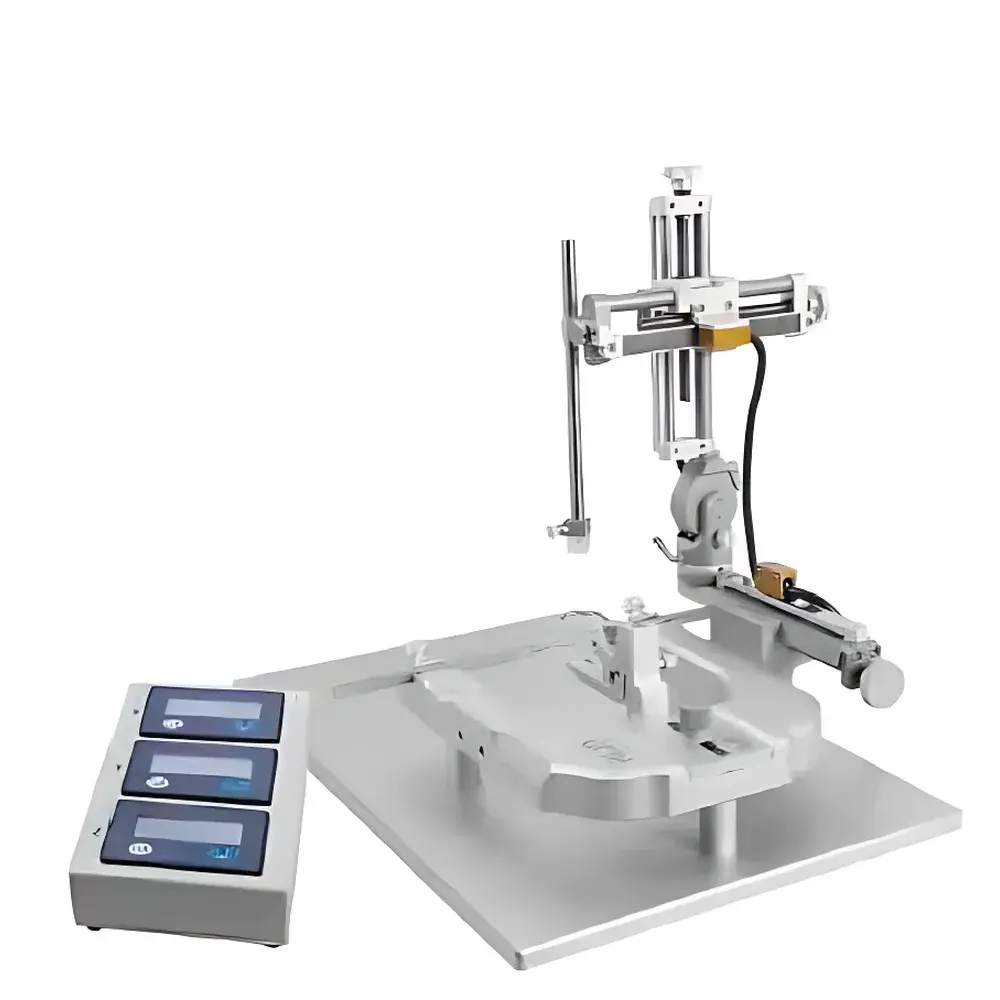
RWD 68016 Desktop Digital Stereotaxic Instrument for Rodent Neurosurgery
| Brand | RWD |
|---|---|
| Origin | Guangdong, China |
| Manufacturer Type | Direct Manufacturer |
| Regional Classification | Domestic (China) |
| Model | 68016 |
| Price Range | USD 1,400 – 7,000 |
Overview
The RWD 68016 Desktop Digital Stereotaxic Instrument is an engineered solution for precise intracranial targeting in rodent neurosurgical and electrophysiological applications. Based on the classical stereotaxic principle—where anatomical coordinates are referenced to standardized bregma-lambda landmarks—the instrument enables reproducible, three-dimensional positioning of microelectrodes, cannulae, or injection needles relative to the brain atlas. Unlike analog counterparts, the 68016 integrates high-resolution linear displacement sensors (10 µm resolution) into all three orthogonal axes (X, Y, Z), coupled with a low-noise, battery-powered LCD display module. This architecture eliminates reliance on external power sources and mitigates electromagnetic interference—critical for concurrent extracellular recording, optogenetic stimulation, or patch-clamp experiments where signal fidelity is paramount.
Key Features
- Real-time digital readout of X-, Y-, and Z-axis displacements directly on an integrated LCD screen—no manual scale reading or secondary calculation required.
- Zero-point reset functionality for any axis at any position, enabling rapid coordinate referencing against published stereotaxic atlases (e.g., Paxinos & Watson).
- Imported European displacement sensors and display electronics ensure long-term stability, thermal drift resistance, and consistent metrological performance across laboratory environments.
- Battery-powered (AA cell) display unit eliminates AC line noise, preserving signal integrity during sensitive electrophysiology protocols.
- Modular design supports both single-arm (68025) and dual-arm (68026) configurations; the 68016 model serves as the core digital upgrade path for legacy RWD 68000-series base systems.
- Compatible with standard 18° rat ear bars (models 68025/68026) and interchangeable accessories including universal clamps, micromanipulator adapters, and stereotaxic head holders.
Sample Compatibility & Compliance
The RWD 68016 is validated for use with adult Sprague-Dawley and Wistar rats (typical weight range: 200–500 g). Its mechanical geometry conforms to widely adopted rodent stereotaxic standards defined in ISO 10993-1 (biocompatibility of surgical accessories) and supports GLP-compliant experimental documentation when paired with traceable calibration logs. While not FDA-cleared as a medical device, its construction materials (anodized aluminum alloy frame, stainless steel actuators) meet USP Class VI requirements for non-reactive hardware in preclinical research settings. All mechanical tolerances and sensor specifications align with internal RWD quality control protocols per ISO 9001:2015.
Software & Data Management
The 68016 operates as a standalone hardware platform without embedded firmware or proprietary software dependencies. Coordinate data are displayed exclusively on the integrated LCD and are not digitized for export. For laboratories requiring audit trails or electronic lab notebook (ELN) integration, users may manually log positions alongside timestamped procedural notes. When deployed in regulated environments (e.g., contract research organizations supporting IND-enabling studies), the instrument supports 21 CFR Part 11 compliance through documented operator training records, periodic mechanical verification using certified gauge blocks, and maintenance logs tracking sensor calibration history.
Applications
- Implantation of chronic microelectrode arrays for in vivo neural recording
- Stereotactic delivery of viral vectors, tracers, or pharmacological agents into discrete nuclei (e.g., hippocampus, ventral tegmental area, amygdala)
- Targeted intracerebral injection for behavioral pharmacology and disease modeling (e.g., 6-OHDA lesions, AAV-mediated gene expression)
- Combined optogenetics-electrophysiology setups requiring minimal EM interference
- Training platforms for graduate neuroscience curricula emphasizing spatial accuracy and atlas-based targeting
FAQ
Is the 68016 compatible with mice?
The 68016 base system is optimized for rat-scale anatomy. Mouse applications require optional miniature ear bars and reduced-range adapters (e.g., RWD 68881 series), which must be ordered separately.
Can the digital module be retrofitted to older RWD stereotaxic frames?
Yes—the 68023 (3D) and 68024 (2D) digital modules are designed specifically for upgrading RWD 68000-series analog instruments; compatibility requires matching mounting interfaces and actuator shaft dimensions.
What is the recommended recalibration interval for the displacement sensors?
RWD recommends annual verification using NIST-traceable linear gauges; no field recalibration is user-serviceable due to sealed sensor housing and factory-set gain coefficients.
Does the LCD display retain position memory after battery replacement?
No—the display is volatile and resets upon power cycle; zero-point re-establishment is required prior to each experimental session.
Are CE or RoHS certifications available for this instrument?
Yes—RWD provides RoHS 2011/65/EU compliance documentation upon request; CE marking applies to the electrical safety of the display module only, not the full mechanical assembly.




