
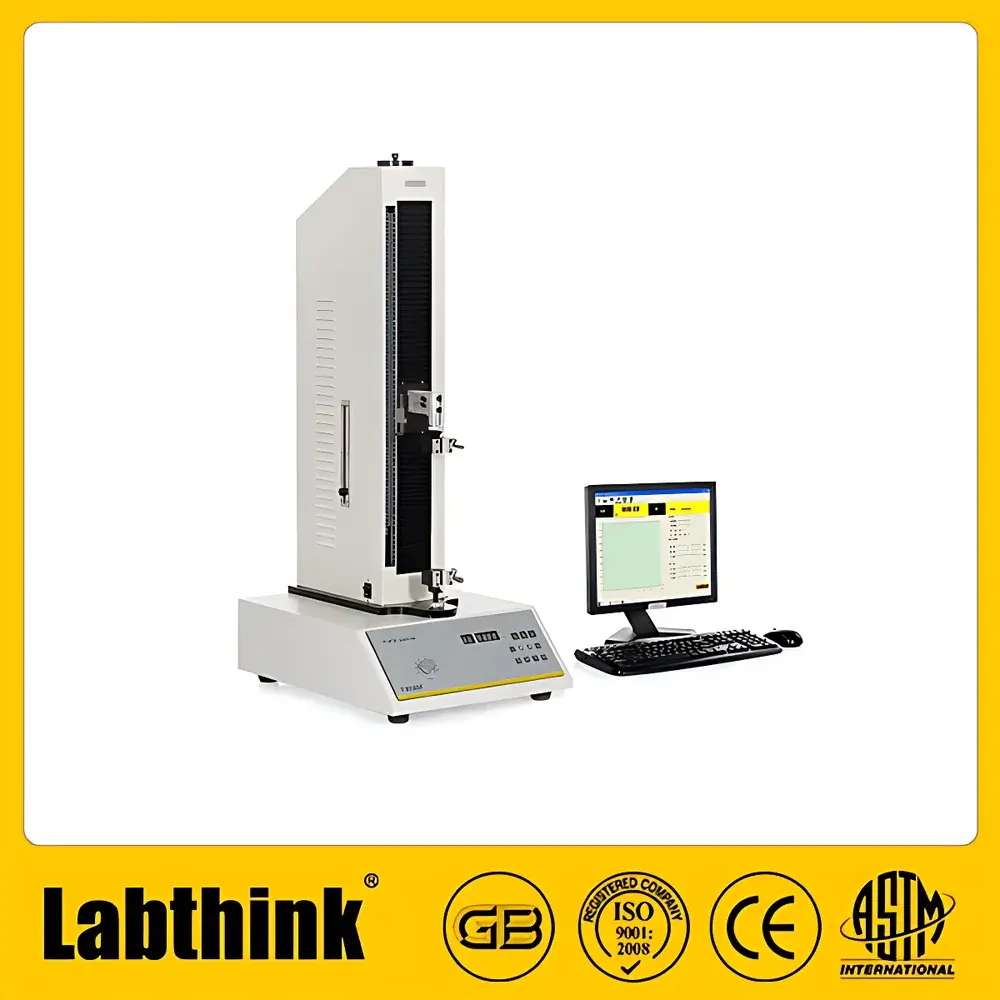
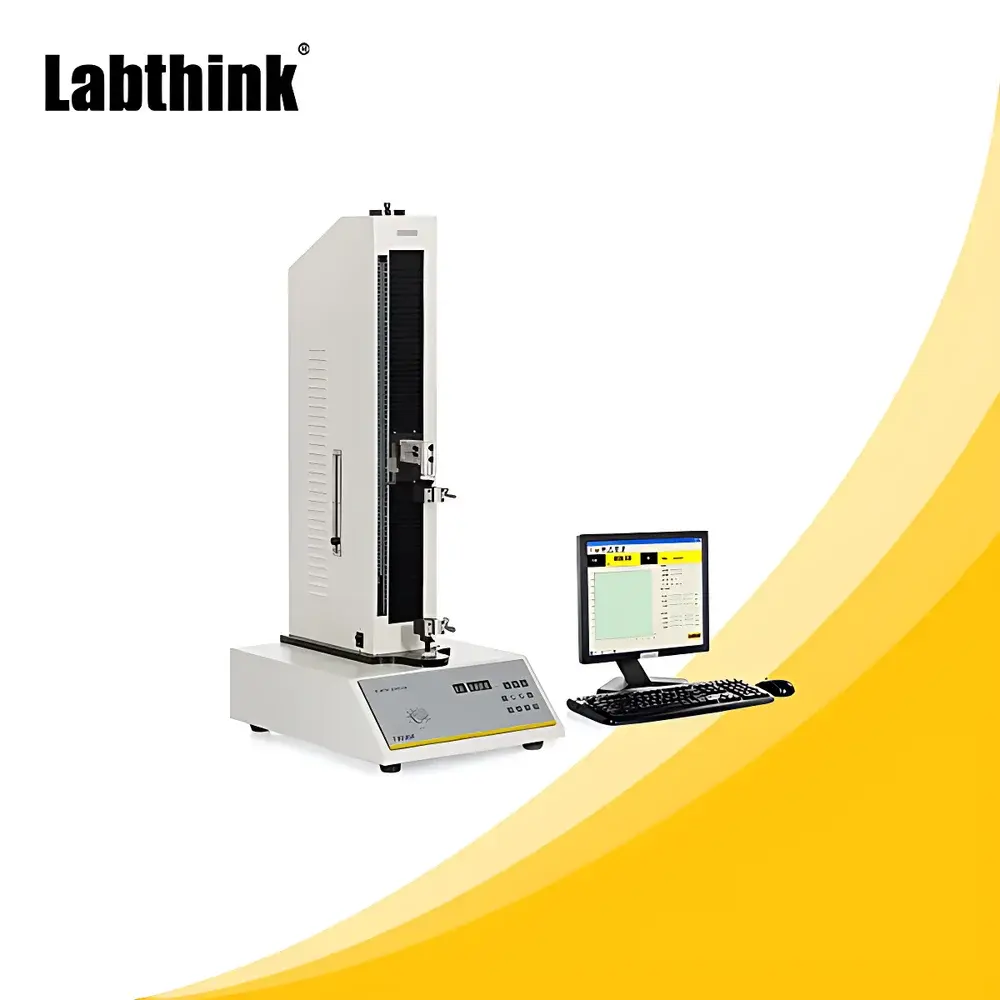
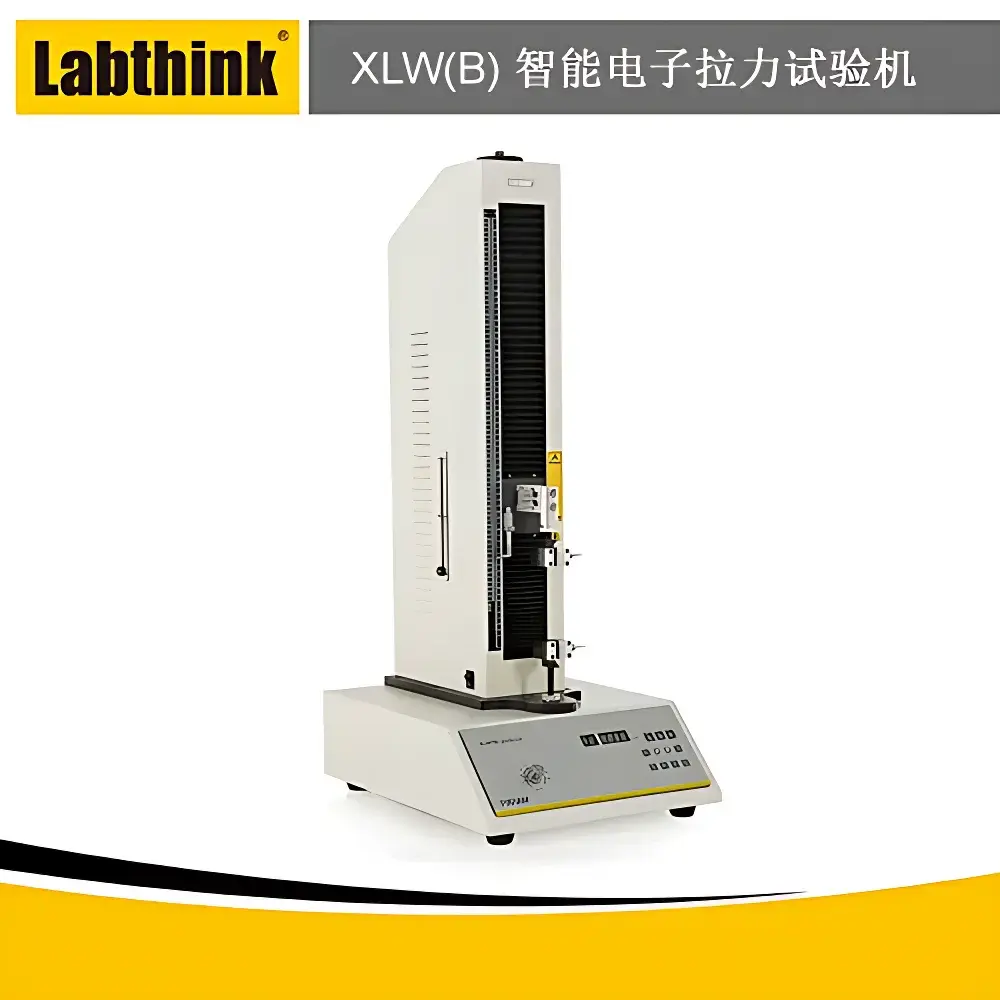
Labthink XLW(B) Electronic Tensile Tester for Magnetic Stripe Card Core Peel Strength and Battery Electrode Foil Delamination Testing
| Brand | Labthink |
|---|---|
| Origin | Shandong, China |
| Manufacturer Type | Direct Manufacturer |
| Regional Category | Domestic (China) |
| Model | XLW(B) Labthink |
| Price Range | USD 2,800 – 7,000 |
| Instrument Type | Electronic Tensile Testing Machine |
| Maximum Test Load | 0.5 kN |
| Force Accuracy Class | Class 1 |
| Test Stroke | 600 mm |
| Displacement Resolution | 1 mm |
| Standard Load Cell | 200 N |
| Optional Load Cells | 30 N, 50 N, 100 N, 500 N, 750 N (customizable) |
| Test Speeds | 50, 100, 150, 200, 250, 300, 500 mm/min |
| Specimen Width (Standard Clamp) | 30 mm |
| Optional Clamp Width | 50 mm |
| Clamping Method | Manual |
| Dimensions (L×W×H) | 450 × 580 × 1100 mm |
| Weight | 61 kg |
| Power Supply | 220 VAC 50 Hz / 120 VAC 60 Hz |
Overview
The Labthink XLW(B) Electronic Tensile Tester is a precision-engineered universal testing system designed specifically for quantitative mechanical evaluation of interfacial adhesion and tensile integrity in thin-film and laminated structures. It operates on the fundamental principle of uniaxial force application under controlled displacement: two independently actuated grips apply opposing motion to a specimen clamped between them, while high-fidelity force transducers (Class 1 accuracy per ISO 7500-1 and ASTM E4) and linear displacement sensors continuously record load vs. extension data in real time. This architecture enables rigorous determination of peel strength (e.g., magnetic stripe card core delamination, battery electrode foil–current collector interface), tensile strength (e.g., polymer films, nonwovens), tear resistance, and elongation at break—critical parameters for quality assurance in packaging, medical device manufacturing, energy storage R&D, and flexible electronics production.
Key Features
- Class 1 force measurement accuracy compliant with ISO 7500-1 and ASTM E4, ensuring traceable and reproducible results across laboratories.
- Dual-mode test protocols: dedicated peel and tensile test routines with pre-configured parameter sets aligned with international standards.
- Seven selectable crosshead speeds (50–500 mm/min), supporting both quasi-static and dynamic adhesion assessments without hardware modification.
- Integrated digital display with PVC membrane keypad and LED readout for immediate access to peak load, minimum load, mean value, and coefficient of variation for grouped specimens.
- Manual clamping system with standardized 30 mm width jaws (50 mm optional) optimized for thin, flexible substrates including PET-based magnetic stripe cores, aluminum/copper foil electrodes, pressure-sensitive adhesives, and biomedical tapes.
- Comprehensive safety architecture: mechanical stroke limit switches, electronic overload cutoff, automatic zero-reset, and fault diagnostics displayed via status indicators.
- RS232 serial interface and parallel printer port enable direct data export to external PCs or thermal printers; compatible with Lystem™ Laboratory Data Management System for centralized audit-trail generation and 21 CFR Part 11–compliant report archiving.
Sample Compatibility & Compliance
The XLW(B) accommodates a broad spectrum of planar, flexible materials up to 600 mm travel length and 61 kg structural capacity. Validated applications include magnetic stripe card core lamination integrity (per GB/T 4850-2000), lithium-ion battery anode/cathode foil delamination from current collectors (aligned with GB/T 2790 and internal cell manufacturer specifications), protective film adhesion (GB/T 2792), peel strength of medical transdermal patches (ISO 10993-10), and tensile properties of plastic films (GB/T 1040.3-2006). All test methods are implemented in accordance with ISO 1798, ASTM D903, ASTM D3330, and QB/T 2358. The instrument’s mechanical design and software logic support GLP/GMP-aligned workflows, including user-level access control, electronic signature capability, and full audit trail logging when integrated with Lystem™.
Software & Data Management
The embedded microcontroller firmware provides deterministic real-time acquisition at ≥100 Hz sampling rate, with synchronized force and displacement timestamps. Raw data files (.txt) contain calibrated load (N), displacement (mm), and time (s) columns, enabling post-processing in MATLAB, Excel, or third-party statistical packages. Optional Lystem™ integration adds role-based permissions, automated report generation (PDF/CSV), calibration certificate tracking, instrument usage logs, and deviation alerting. All data exports include metadata: operator ID, test date/time, environmental conditions (if linked to optional hygrothermograph), sample ID, and method version—meeting FDA 21 CFR Part 11 requirements for electronic records and signatures.
Applications
- Quantification of interfacial bond strength between cathode active material layers and aluminum foil substrates in LiCoO₂/NMC pouch cells.
- Evaluation of magnetic stripe encoding layer adhesion durability during card embossing, thermal lamination, and cyclic flex testing.
- Quality control of pressure-sensitive adhesive performance on silicone release liners used in wound care dressings.
- Comparative analysis of tensile modulus and yield point in biaxially oriented polypropylene (BOPP) films subjected to accelerated aging.
- Validation of delamination resistance in multilayer barrier films (e.g., AlOx/PET/PE) under humidity-controlled peel conditions.
FAQ
What standards does the XLW(B) comply with for peel testing?
It supports GB/T 4850-2000 (peel strength of magnetic stripe cards), GB/T 2790 (adhesive peel strength), GB/T 2792 (pressure-sensitive tape peel), and ASTM D903 (standard test method for peel resistance).
Can the instrument be used for battery electrode foil testing under controlled environmental conditions?
Yes—the base unit integrates seamlessly with optional temperature/humidity chambers (e.g., Labthink TH-1000) via analog I/O triggers, enabling peel tests at 23°C/50% RH or elevated temperatures per OEM cell qualification protocols.
Is calibration traceable to national metrology institutes?
All factory calibrations are performed using NIST-traceable deadweight standards and documented in ISO/IEC 17025-accredited calibration certificates available upon request.
How is data integrity ensured during long-duration peel tests?
The system employs non-volatile memory buffering and dual-clock synchronization to prevent data loss during power interruption; all measurements are timestamped and checksum-verified before storage.
Does the software support multi-user environments with audit trails?
When deployed with Lystem™, it delivers full 21 CFR Part 11 compliance—including electronic signatures, change history, and immutable record retention—for regulated pharmaceutical and medical device QA/QC labs.



