
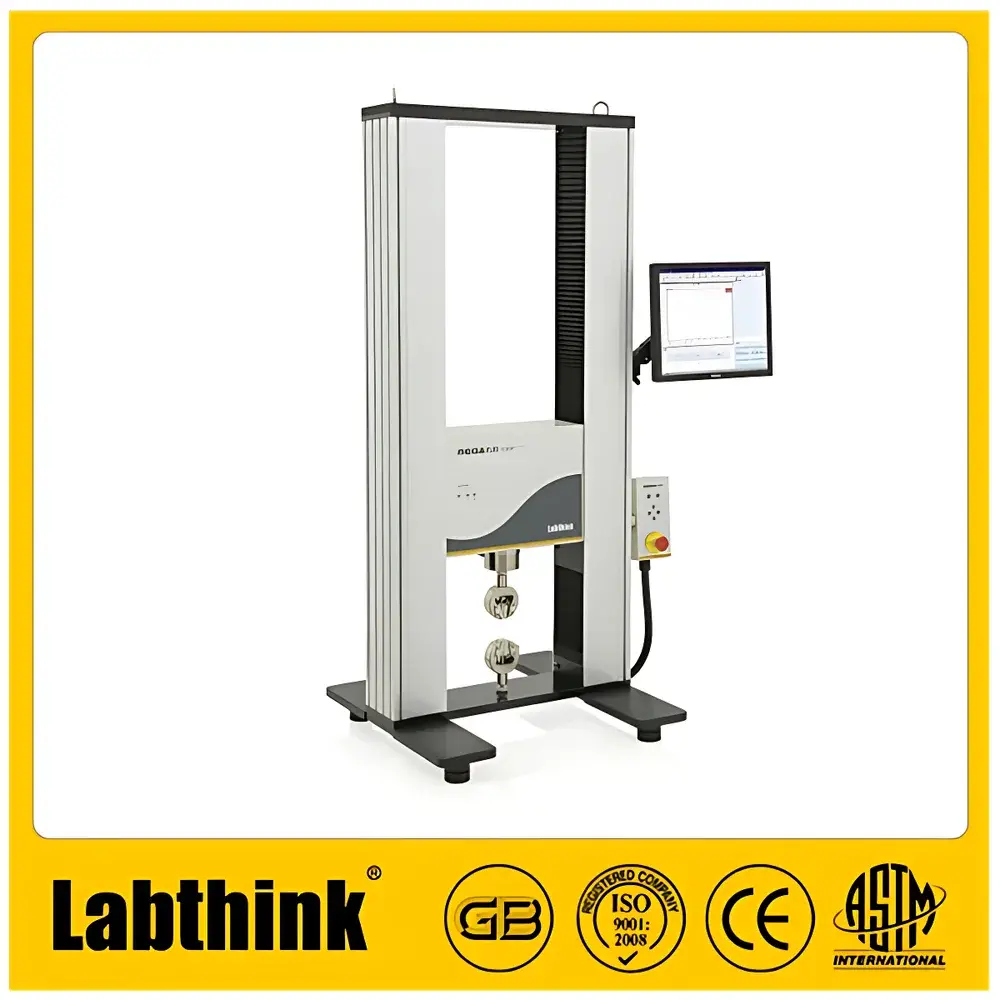
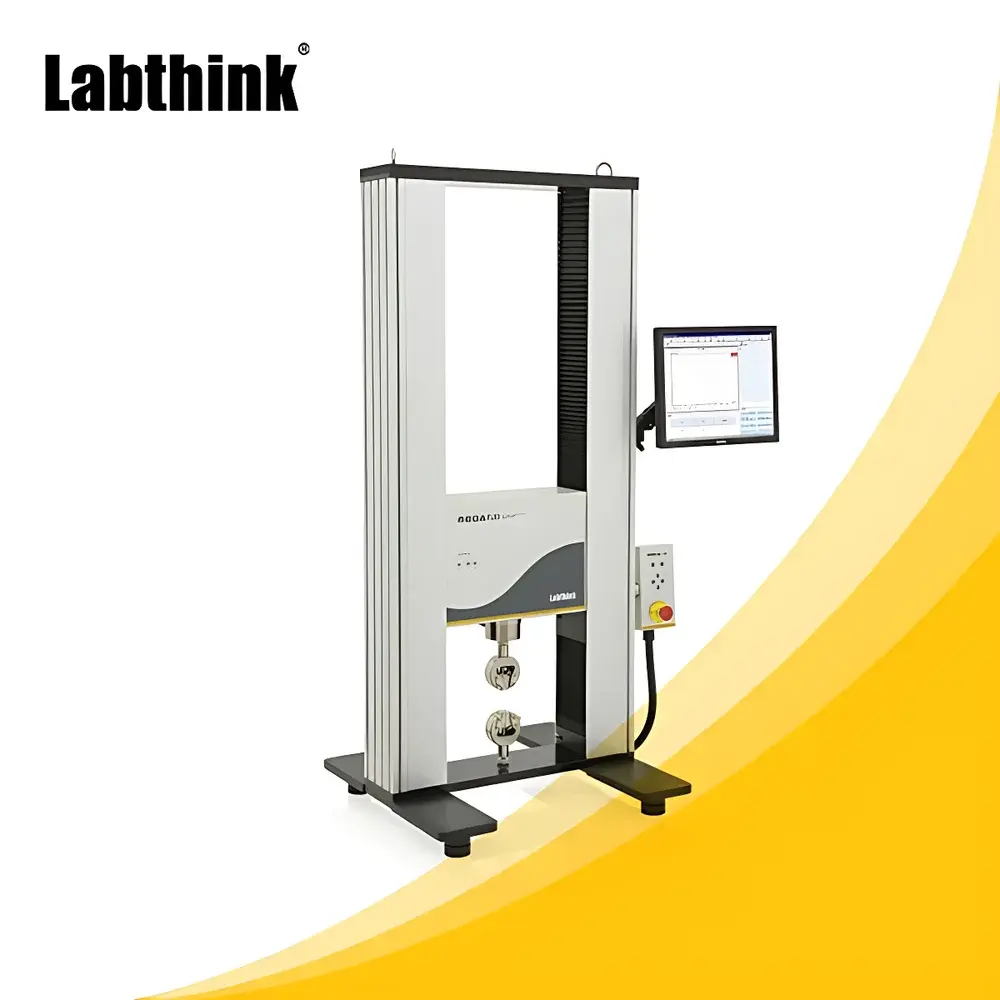
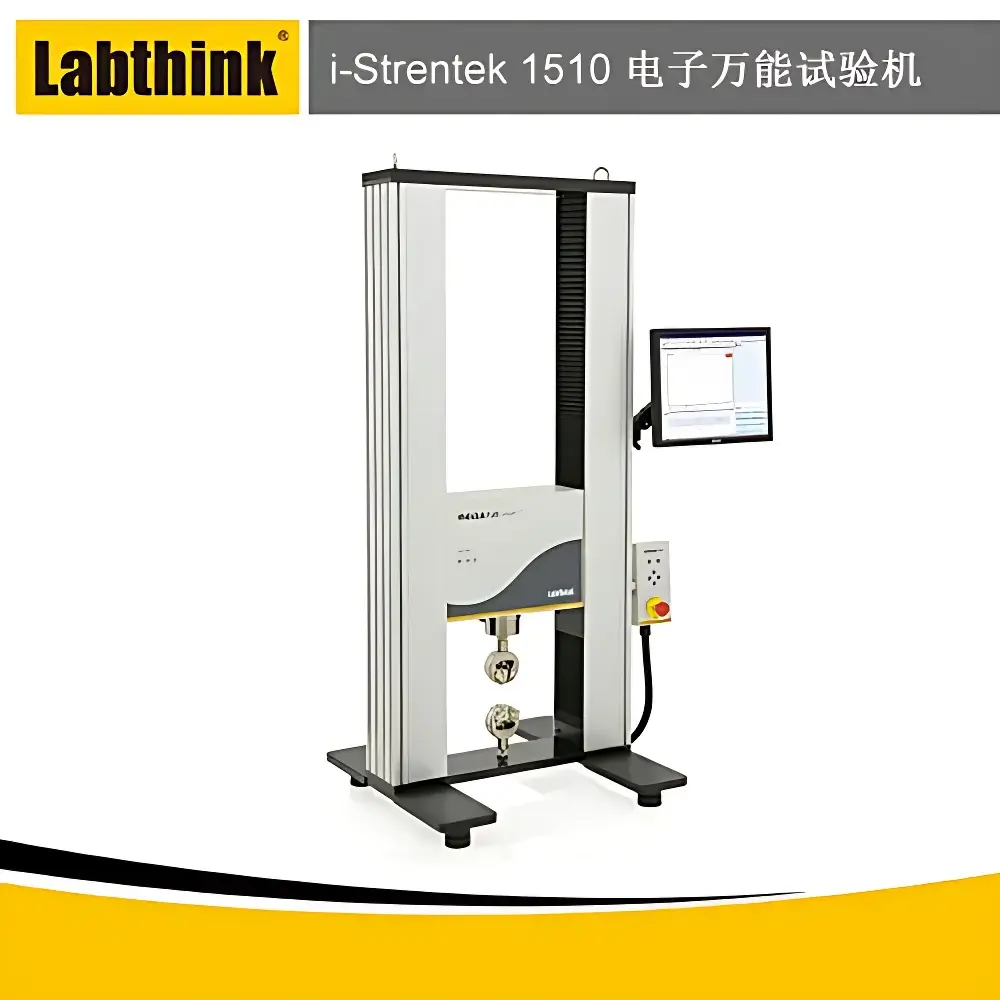
Labthink i-Strentek 1510 Universal Testing Machine for Plastic Films and Flexible Packaging
| Brand | Labthink |
|---|---|
| Origin | Shandong, China |
| Manufacturer Type | Direct Manufacturer |
| Model | i-Strentek 1510 |
| Instrument Type | Electromechanical Universal Testing Machine |
| Standard Load Capacity | 500 N |
| Optional Load Cells | 50 N, 100 N, 250 N, 500 N, 1000 N, 2000 N, 5000 N, 10000 N |
| Accuracy Class | Class 1 (per ISO 7500-1 & ASTM E4) |
| Test Speed Range | 1–500 mm/min (infinitely variable) |
| Maximum Travel | 800 mm |
| Test Station | Single station |
| Gripping Method | Pneumatic or manual clamping |
| Air Supply Requirement | 0.5–0.7 MPa (user-provided, Ø6 mm polyurethane tubing) |
| Dimensions (L×W×H) | 850 × 700 × 1630 mm |
| Power Supply | 220 VAC 50 Hz / 120 VAC 60 Hz |
| Net Weight | 150 kg |
Overview
The Labthink i-Strentek 1510 Universal Testing Machine is an electromechanical force-testing platform engineered for high-reproducibility mechanical characterization of polymeric films, flexible packaging, elastomers, paper-based substrates, and rigid-to-semirigid containers. It operates on the principle of controlled displacement-driven tensile, compressive, peel, tear, and flexural loading, conforming to fundamental mechanics-of-materials methodologies defined in ISO 7500-1, ASTM E4, and GB/T 16578.1. Designed specifically for quality control laboratories in packaging R&D, pharmaceutical secondary packaging validation, food contact material certification, and medical device component testing, the system delivers traceable, standards-aligned data for regulatory submissions and internal specification compliance.
Key Features
- Modular load cell architecture supporting eight selectable capacities (50 N to 10,000 N), enabling seamless transition between micro-force seal integrity tests and macro-scale container crush evaluation
- Class 1 accuracy certified per ISO 7500-1 and ASTM E4 — validated across full load range with NIST-traceable calibration certificates available
- Infinitely variable crosshead speed (1–500 mm/min) with real-time closed-loop velocity control, ensuring precise strain-rate application per ASTM D882 and ISO 37 protocols
- Pneumatic gripping system (0.5–0.7 MPa) with rapid actuation and consistent clamping pressure, minimizing slippage during high-speed peel or tear tests
- 800 mm vertical travel accommodates tall specimens including IBC totes, corrugated shipping cases, and stacked blister packs without repositioning
- Rigid C-frame construction with reinforced aluminum alloy housing and precision-ground lead screws ensures long-term dimensional stability and minimal deflection under load
- Integrated safety interlocks, emergency stop circuitry, and overload protection compliant with EN ISO 13857 and GB/T 5226.1
Sample Compatibility & Compliance
The i-Strentek 1510 supports standardized mechanical testing of a broad spectrum of soft and semi-rigid materials, including but not limited to: biaxially oriented polypropylene (BOPP), PET/PE laminates, aluminum foil composites, hot-melt adhesive tapes, medical-grade silicone tubing, pharmaceutical blister lidding foils, child-resistant closures, and sterilization pouches. Its test methodology aligns with over 30 internationally recognized standards—including ASTM D1938 (trouser tear), ASTM F88 (heat seal strength), ASTM F904 (peel adhesion), ISO 37 (rubber tensile properties), GB/T 1040 series (plastic tensile behavior), and YBB pharmaceutical packaging monographs. The system is routinely deployed in GLP-compliant environments and supports audit-ready documentation for FDA 21 CFR Part 11 compliance when paired with Labthink’s optional secure software module.
Software & Data Management
Controlled via Labthink’s proprietary TESTSuite™ software (v4.2+), the i-Strentek 1510 provides intuitive workflow-driven test setup, real-time force-displacement curve visualization, automatic peak detection, and customizable report generation. Software features include multi-curve overlay, statistical batch analysis (mean, SD, CV%), pass/fail thresholding against user-defined limits, and export to CSV, PDF, and XML formats. Audit trails record operator ID, timestamp, parameter changes, and calibration events—meeting requirements for ISO/IEC 17025 accreditation and GMP documentation integrity. Raw data files are stored with embedded metadata (test standard, specimen ID, environmental conditions), facilitating traceability throughout product lifecycle validation.
Applications
- Tensile analysis: Young’s modulus, yield strength, ultimate tensile strength, elongation at break per ASTM D882 and GB/T 1040.3
- Peel testing: 90° and 180° peel adhesion of pressure-sensitive tapes, labels, and laminated structures per ASTM D903 and GB/T 2792
- Tear propagation resistance: Elmendorf-type and trouser tear per ASTM D1938 and GB/T 16578.1
- Heat seal evaluation: Seal strength and failure mode analysis per ASTM F88 and ISO 11607-2
- Compression testing: Edge crush test (ECT) simulation for corrugated boxes, top-load resistance of PET bottles, and buckling behavior of collapsible tubes
- Specialized functional assessments: Cap removal torque simulation, syringe plunger glide force, IV bag port detachment, blister pack push-through force, and pouch zipper durability cycling
FAQ
What standards does the i-Strentek 1510 support out-of-the-box?
The instrument is pre-configured with test methods aligned to ASTM D882, ASTM F88, ISO 37, GB/T 1040, and YY/T 0681 series — all accessible via one-click method templates in TESTSuite™.
Can the system be integrated into an existing LIMS or MES environment?
Yes. TESTSuite™ supports OPC UA and RESTful API interfaces for bidirectional data exchange with laboratory information management systems and enterprise manufacturing execution platforms.
Is pneumatic grip air supply included with the system?
No. A clean, oil-free compressed air source (0.5–0.7 MPa, minimum 10 L/min flow) must be provided by the user; the system includes a regulated inlet fitting for Ø6 mm polyurethane tubing.
How is calibration maintained across multiple load cells?
Each load cell is individually calibrated with NIST-traceable reference standards. Calibration coefficients are stored in non-volatile memory and automatically invoked based on selected capacity.
Does the machine meet electromagnetic compatibility (EMC) requirements for global deployment?
Yes. Certified to IEC 61326-1 (industrial environment) and FCC Part 15 Subpart B, with CE, RoHS, and CCC markings applied per unit.



