
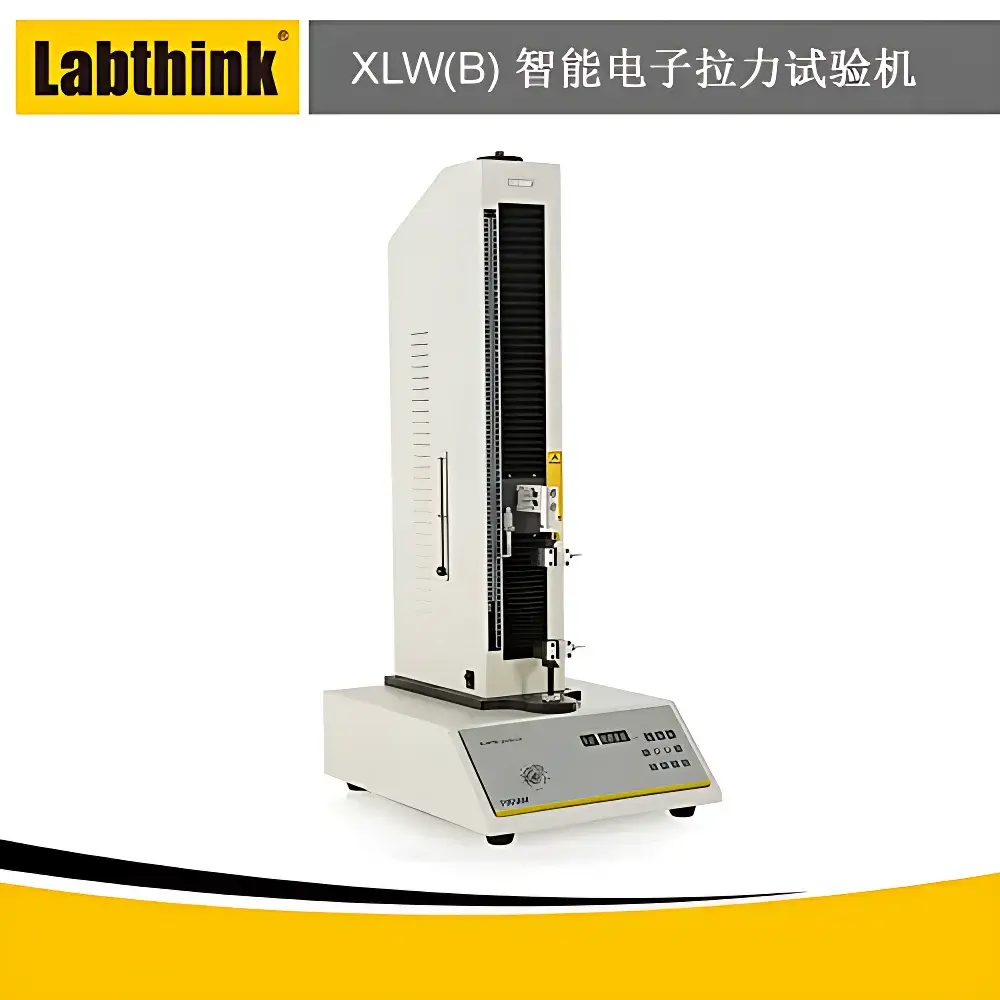
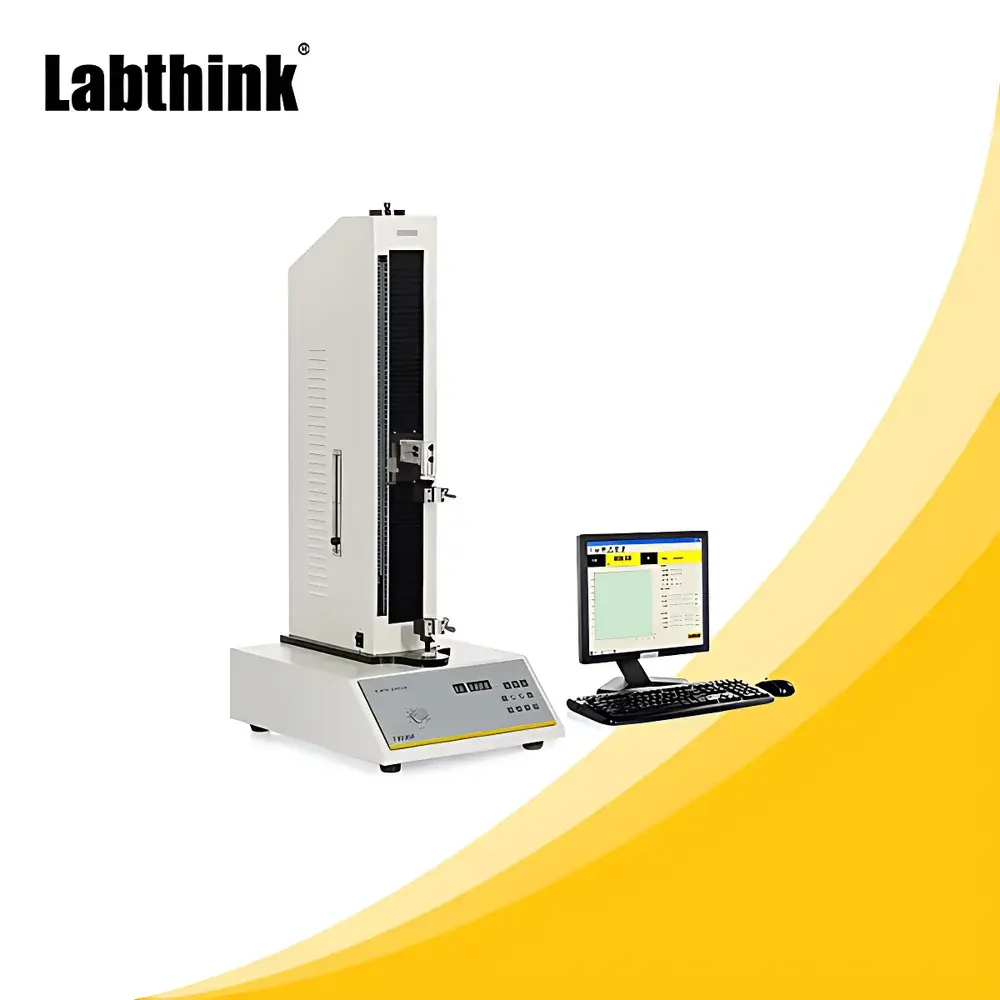
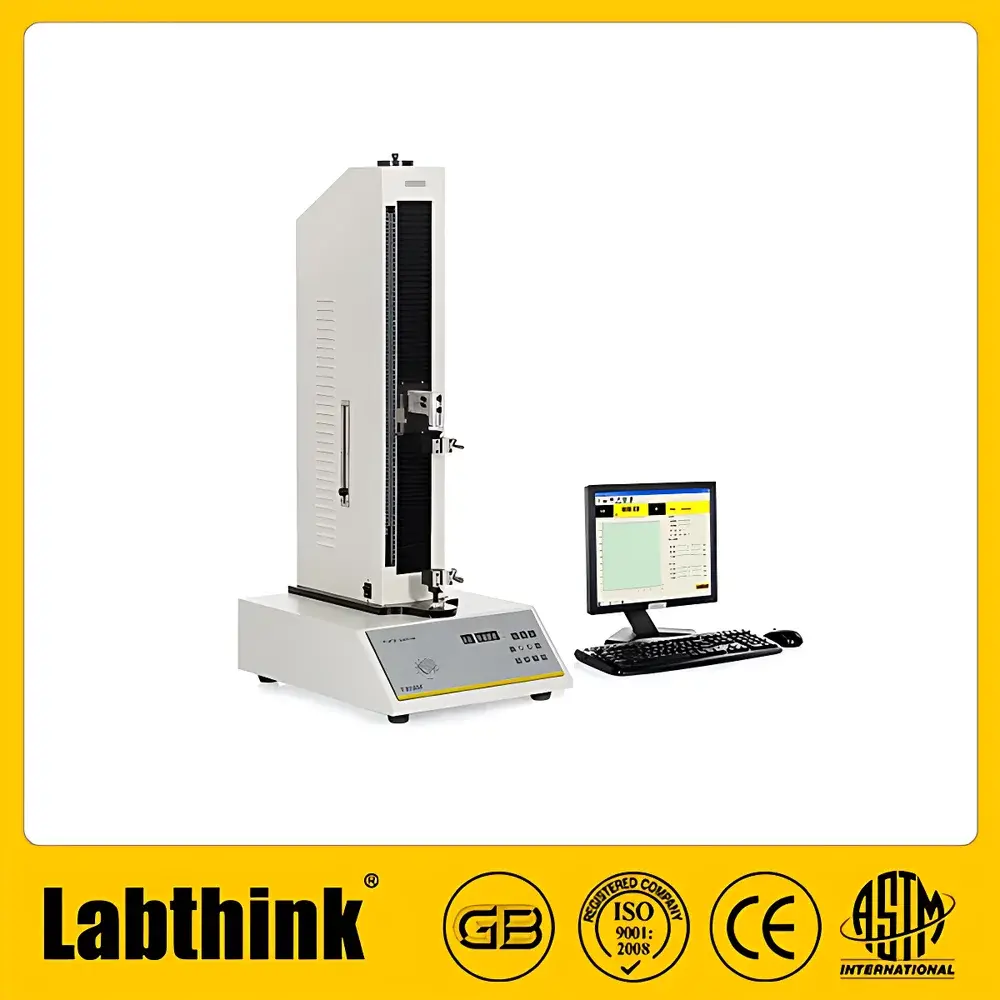
Labthink XLW(B) Intelligent Electronic Tensile Testing Machine
| Brand | Labthink |
|---|---|
| Model | XLW(B) |
| Type | Electronic Tensile Tester |
| Origin | Shandong, China |
| Manufacturer | Labthink Co., Ltd. |
| Standard Load Capacity | 200 N |
| Optional Load Cells | 30 N, 50 N, 100 N, 500 N, 750 N (customizable) |
| Accuracy Class | Class 1 |
| Test Speeds | 50, 100, 150, 200, 250, 300, 500 mm/min (7 selectable ranges) |
| Maximum Travel | 600 mm |
| Standard Specimen Width | 30 mm (50 mm optional) |
| Power Supply | 220 VAC 50 Hz / 120 VAC 60 Hz |
| Dimensions (L×W×H) | 450 × 580 × 1100 mm |
| Net Weight | 61 kg |
| Compliance Standards | GB/T 4850–2000, GB 8808, GB/T 1040.3–2006, GB/T 17200, GB/T 2790, GB/T 2791, GB/T 2792, QB/T 2358 |
Overview
The Labthink XLW(B) Intelligent Electronic Tensile Testing Machine is a precision-engineered mechanical testing system designed for quantitative evaluation of tensile, peel, and elongation properties in flexible packaging materials and thin-film substrates. Based on the fundamental principle of uniaxial force application under controlled displacement, the instrument applies calibrated tension between two pneumatically or manually actuated grips while synchronously measuring load (via high-stability strain-gauge load cells) and axial displacement (via integrated linear encoder). Real-time force–displacement data are processed to derive critical mechanical parameters including tensile strength (MPa), elongation at break (%), Young’s modulus (MPa), peel adhesion (N/25 mm), and puncture resistance—enabling rigorous physical property characterization aligned with international standard test methods.
Key Features
- Class 1 accuracy per ISO 7500-1 and ASTM E4, ensuring traceable, reproducible mechanical measurements across laboratories.
- Dual-mode operation: independent tensile and peel test programs with pre-configured parameter sets compliant with GB/T 1040.3, GB/T 2792, and ASTM D882.
- Seven programmable crosshead speeds (50–500 mm/min), supporting both quasi-static and high-rate deformation protocols for viscoelastic material assessment.
- Integrated digital readout system with LED display and PVC membrane keypad for intuitive local control; no PC dependency required for basic operation.
- Comprehensive safety architecture: mechanical end-stop limit switches, electronic overload cutoff (110% full-scale), automatic zero-reset, and real-time fault diagnostics.
- Modular sensor design: interchangeable load cells (30 N to 750 N) allow optimization for low-force films (e.g., PET/Alu laminates) or high-strength composites (e.g., woven PP sacks).
- Standard 30 mm grip width with optional 50 mm configuration to accommodate diverse specimen geometries per ISO 527-3 and ASTM D3759.
Sample Compatibility & Compliance
The XLW(B) accommodates a broad spectrum of thin, flexible specimens used in food packaging, medical device packaging, and industrial barrier applications—including polyethylene (PE), polypropylene (PP), polyester (PET), aluminum foil laminates, paperboard composites, pressure-sensitive adhesives, protective films, release liners, rubber sheets, and nonwoven textiles. All test configurations adhere strictly to national and international regulatory frameworks: GB/T 4850 (peel strength of adhesive tapes), GB/T 2790 (adhesion of flexible materials), QB/T 2358 (heat-seal strength), and ISO 1184 (tensile properties of plastic films). The system supports GLP-compliant documentation workflows when paired with Lystem™ Laboratory Data Sharing System, enabling audit-ready electronic records meeting FDA 21 CFR Part 11 requirements for signature, retention, and change control.
Software & Data Management
The included professional software provides full test method definition, automated result calculation, statistical reporting (mean, min, max, coefficient of variation), and graphical visualization of stress–strain curves. Raw data export is supported in CSV and XML formats for integration into LIMS or enterprise QA systems. RS232 serial interface enables bidirectional communication with external PCs or PLC-controlled production lines. Optional micro-printer output delivers immediate hard-copy reports for shop-floor verification. Lystem™ integration enables centralized management of test methods, calibration logs, user permissions, and electronic signatures—facilitating multi-site laboratory harmonization and regulatory audits.
Applications
- Quantitative validation of seal integrity in thermoformed trays and pouches under simulated distribution stresses.
- Comparative analysis of tensile modulus degradation in UV-exposed agricultural mulch films.
- Quality control of cold-seal adhesive performance on confectionery wrappers per GB/T 2791.
- Evaluation of delamination resistance in retort-stable multilayer pouches after thermal cycling.
- Characterization of tear propagation behavior in oriented polypropylene (OPP) shrink films using standardized notched specimens.
- Verification of mechanical stability in sterile barrier systems for Class II medical devices per ISO 11607-2.
FAQ
What standards does the XLW(B) support for tensile testing of food packaging films?
It complies with GB/T 1040.3–2006 (plastic films), GB/T 2790 (adhesive bond strength), GB/T 2792 (peel resistance), and ASTM D882 for thin plastic sheeting.
Can the instrument perform both tensile and peel tests without hardware modification?
Yes—the dual-test mode is software-configurable; only fixture substitution (e.g., 180° peel jig vs. tensile grips) is required.
Is calibration traceable to national metrology institutes?
All load cells are factory-calibrated against NIM (National Institute of Metrology, China) reference standards, with optional UKAS-accredited calibration certificates available.
What is the maximum specimen thickness the standard grips can accommodate?
Standard manual grips accept specimens up to 2.5 mm thick; custom high-capacity grips support up to 5 mm for rigid laminates.
Does the system support automated batch testing for routine QC environments?
Yes—through Lystem™ integration, users can define multi-step test sequences, auto-save results by lot ID, and trigger pass/fail alerts based on configurable specification limits.
Related Products



